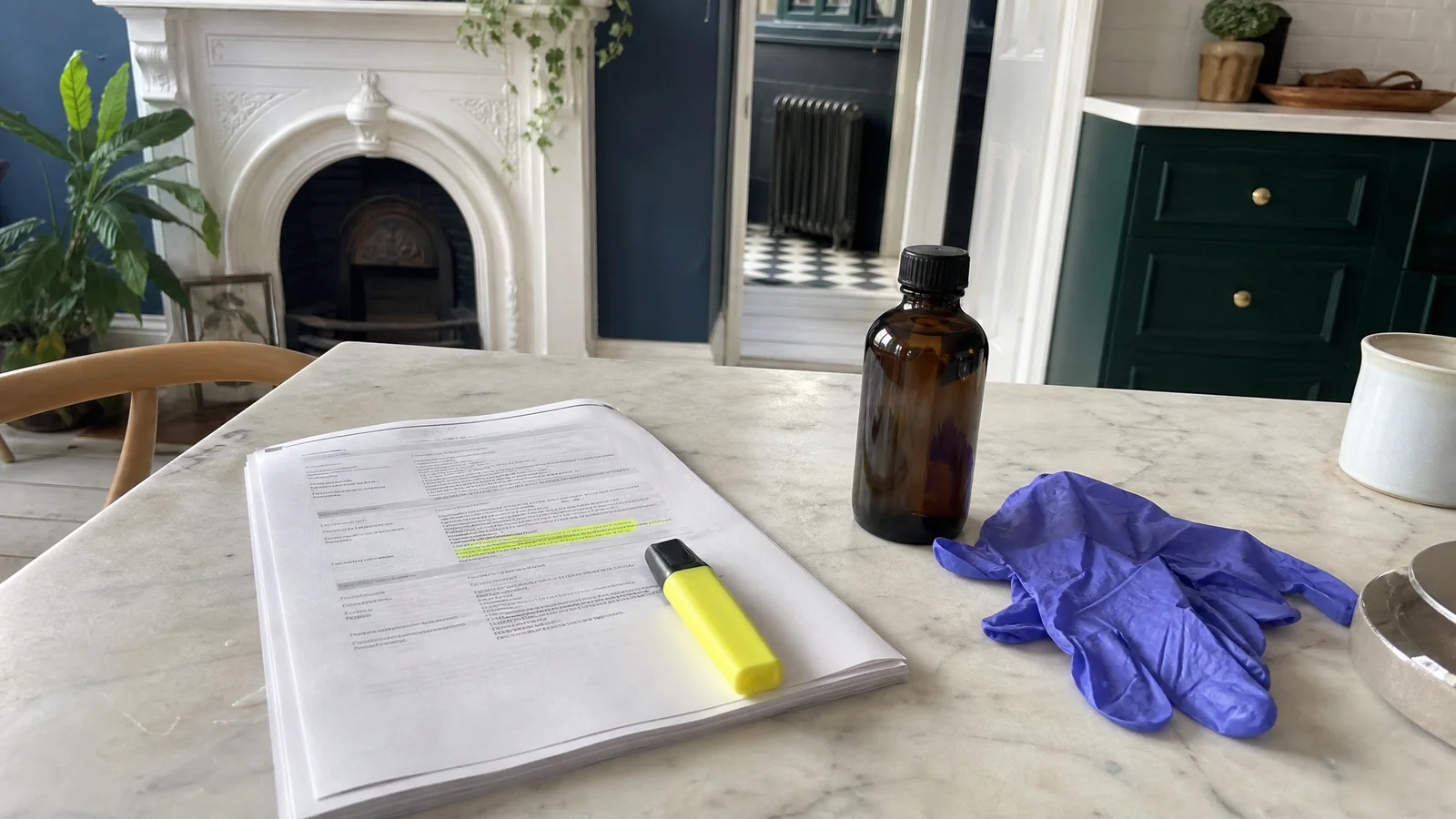
How to Read a Birch Oil SDS and Hazard Label
We do not publish a safety data sheet for our birch oil, so this guide cannot annotate one. What it can do is explain how to read any seller's SDS using the OSHA Hazard Communication standard and the public hazard data on methyl salicylate, show where those sources disagree with each other, and give you a list of questions to put to every supplier, us included. For anything beyond our published COA, contact us before ordering and we will tell you what we can provide.
Four checks before you read a single hazard statement
Most SDS mistakes happen before Section 2. Run these four checks first.
- Supplier and product match. Section 1 must name the product and give the supplier's name, address and phone. An SDS from a chemical distributor for "methyl salicylate" is not an SDS for a distilled birch oil, even though the two are chemically close.
- Pure chemical or named oil. Section 3 shows what the sheet actually describes. Authentic sweet birch oil is 93.24-99.84% methyl salicylate with more than 60 compounds identified (Dosoky et al., 2022); a sheet that lists a single substance with a CAS number is describing the chemical, and a sheet for a plant oil should say so.
- A date. Section 16 carries the date of preparation or last revision (29 CFR 1910.1200(g)(2)). An undated sheet cannot be compared with current classifications.
- Whose classification. Section 2 should say which system produced the hazard statements. The next sections show why that matters.
Who an SDS is written for
HazCom is a workplace standard. It does not apply to a consumer product or hazardous substance "when subject to a consumer product safety standard or labeling requirement" of the Consumer Product Safety Act or Federal Hazardous Substances Act (29 CFR 1910.1200(b)(5)(v)). A retail bottle is therefore labeled under the FHSA, which asks for a signal word of DANGER, WARNING or CAUTION and a statement of principal hazard such as "HARMFUL OR FATAL IF SWALLOWED" (16 CFR 1500.121). A business that uses the oil in its own workplace, such as a soap or candle studio with employees, is the reader an SDS is built for.
No source we could locate states that a shop must publish an SDS for consumers. That is why the absence on our site is a gap we report rather than a violation we can cite, and why you should ask for the document in writing if you are a business buyer.
The 16 sections, and what to look for in each
HazCom fixes the order: sections 1 through 16 appear in the same sequence on every compliant sheet. OSHA states it "will not be enforcing information requirements in sections 12 through 15," although those sections may be included (29 CFR 1910.1200, Appendix D).
| Section | What it contains | What to check for birch oil |
|---|---|---|
| 1 Identification | Product identifier, supplier details | Supplier named is the one you are buying from |
| 2 Hazard identification | Classification, signal word, pictograms, hazard and precautionary statements | Compare against the classifications in the next table |
| 3 Composition | Ingredients | Pure methyl salicylate or a named oil |
| 4 First-aid measures | Exposure instructions | Does it say not to induce vomiting for swallowing, as poison-center guidance does (Poison Control) |
| 5 Fire-fighting measures | Extinguishing media, hazards | Flash point in Section 9 should match |
| 6 Accidental release | Spill steps | Any mention of ventilation and skin protection |
| 7 Handling and storage | Storage conditions | HSDB lists methyl salicylate as sensitive to light and heat (HSDB); look for cool, dark and tightly closed |
| 8 Exposure controls | Exposure limits, protective equipment | Where an occupational limit would appear; check its source rather than assuming a blank means safe |
| 9 Physical and chemical properties | Flash point, density, boiling point | See the worked example below |
| 10 Stability and reactivity | Incompatibilities | NOAA CAMEO lists oxidizers and strong bases as incompatible (CAMEO Chemicals) |
| 11 Toxicological information | LD50 and exposure effects | HSDB lists rat oral LD50 of 0.887 g/kg for the pure chemical (PubChem) |
| 12-15 Ecological, disposal, transport, regulatory | Optional under OSHA | Useful, but treat as supplier-supplied |
| 16 Other information | Revision date | Dated and current |
Section 8 deserves a caution. We have not verified an occupational exposure limit for methyl salicylate from OSHA's own tables. The international chemical safety card reproduced in PubChem says that "no indication can be given" about how quickly a harmful airborne concentration is reached on evaporation at 20 C (PubChem). Read that as a statement that the number is unknown, not that the vapor is harmless.
Signal words, pictograms and hazard statements
An OSHA-compliant label must carry a product identifier, signal word, hazard statement(s), pictogram(s), precautionary statement(s), and the responsible party's name, address and phone. "Danger" is the signal word for the more severe hazards and "Warning" for the less severe ones, and eight pictograms are designated (29 CFR 1910.1200(c) and (f)). The code letters mean: H302 harmful if swallowed, H317 may cause an allergic skin reaction, H361d suspected of damaging the unborn child, H412 harmful to aquatic life with long lasting effects.
The conflict: four classifications for one chemical
The public records on methyl salicylate do not agree, and this is the part of an SDS that surprises buyers.
| Source | Signal word | Pictograms | Hazard statements |
|---|---|---|---|
| EU CLP entry (Regulation 1272/2008) | Warning | GHS07 exclamation mark, GHS08 health hazard | H302, H317, H361d, H412 |
| ECHA company notifications for methyl salicylate (2,210 reports from 32 notifications) | Warning | GHS07 | H302 in 96.9% of reports; 0.3% said criteria were not met |
| ECHA company notifications for Gaultheria procumbens extract, wintergreen oil (1,530 reports from 10 notifications) | Warning | GHS07 | H302 in 97.5%, H319 (serious eye irritation) in 91.1%; 2.4% said criteria were not met |
| Japan NITE-CMC (FY2020) | Danger | GHS05 corrosive | H314 (severe skin burns and eye damage), H318 |
All four come from the same PubChem record (PubChem, ECHA and NITE-CMC data). PubChem notes that notified information "may vary between notifications depending on impurities, additives, and other factors." Those entries describe the pure chemical or, for the wintergreen row, a plant extract; none of the rows is an entry for a Betula lenta oil, and the research behind this page did not retrieve one.
Reasoning from the table, a seller's SDS can cite any of these and be internally consistent. The practical response is to ask which source the sheet used, and to treat the strictest classification as the planning assumption for handling. The H361d statement is the one that bears on pregnancy; our pregnancy and children page covers it.
Reading Section 9 against a certificate of analysis
Section 9 will list physical constants, and so does our published COA: relative density 1.183 at 20 C and refractive index 1.537, with the oil optically inactive. The same constants on an SDS and a COA do not prove authenticity. The USP monograph gives a specific gravity range of 1.180-1.185 for synthetic methyl salicylate and 1.176-1.182 for the natural variety, and states that synthetic methyl salicylate and that from Betula are both optically inactive (USP 32, 2009 edition). A density of 1.183 sits in the synthetic range, so the physical constants are consistent with genuine oil but cannot settle the question.
Flash point is another place sources split. PubChem lists 205 F (96 C) closed cup from HSDB and 101 C from ICSC for pure methyl salicylate (PubChem), while ScenTree gives 75 C (ScenTree). If an SDS gives a number, ask which test it came from. Our guide to reading lab reports shows what GC-MS and isotope work add beyond a constants certificate.
What to ask any seller, including us
- Do you have an SDS for the product as sold, with a revision date and the supplier's name, address and phone? For us the answer today is no: we have no SDS on file or published, and no IFRA certificate on file.
- Which classification system and source does Section 2 use?
- Does Section 3 describe the pure chemical or the named oil?
- Is there a per-batch analysis with the methyl salicylate percentage? The owner states that methyl salicylate is measured for every batch and that the figure is available on request for any lot, so ask via the contact page. Our published COA does not contain a percentage, a GC-MS profile or an isotope result.
- What does the lot reference on the bottle tie to? Our amber glass bottles carry the still date, fill date and a lot reference connecting both to an analysis.
- Does the packaging meet the child-resistant rule for liquids above 5% methyl salicylate by weight (16 CFR 1700.14(a)(3))? CPSC has applied that rule to birch oil by name in a December 2022 warning (CPSC warning 23-079).
- What shelf life is stated and how is it dated? Our product page says typically 2 to 3 years kept tightly capped, cool and dark, and our published COA shows a Best By of 06/02/2031 for its batch.
- Is there an IFRA certificate? IFRA calls a Certificate of Conformity a supplier document and takes no responsibility for it (IFRA Guidance, 2023), and the 51st Amendment of the IFRA Standards contains no entry for methyl salicylate (IFRA Standards), so any methyl salicylate limit on such a certificate is the supplier's own. For soap sellers who need paperwork, see selling soap and IFRA documentation.
For larger quantities, the bulk buying guide covers sizes from 5 lb up, and the safety guide is the starting point for handling.
Treat an SDS as a record of what a supplier claims, then check it against sources like those above. This is a sourced explainer by the shop, not legal or regulatory advice, and no regulatory consultant has reviewed it; a consultant or attorney can confirm what your workplace must do.
Birch Essential Oil
Birch Essential Oil from our own shop, in sizes from 1 oz to bulk.
From $15.99
Shop Now →Sources & Further Reading
- Dosoky NS, Poudel A, Satyal P, 2022. Authentication and Market Survey of Sweet Birch (Betula lenta L.) Essential Oil. Plants 11(16):2132. pmc.ncbi.nlm.nih.gov
- OSHA, 29 CFR 1910.1200. Hazard Communication (including Appendix D). law.cornell.edu
- U.S. CPSC, 16 CFR 1500.121. Labeling requirements for hazardous substances. law.cornell.edu
- Poison Control (National Capital Poison Center), 2026 page. First aid: Act fast! poison.org
- HSDB via PubChem, stability and shelf life entry for methyl salicylate. pubchem.ncbi.nlm.nih.gov
- NOAA CAMEO Chemicals, accessed 2026. Methyl salicylate datasheet. cameochemicals.noaa.gov
- National Library of Medicine, accessed October 2026. PubChem compound summary: Methyl salicylate (CID 4133), including HSDB and ECHA data. pubchem.ncbi.nlm.nih.gov
- ECHA classification data for methyl salicylate and Gaultheria procumbens extract, as aggregated in PubChem (CID 4133), accessed October 2026. pubchem.ncbi.nlm.nih.gov
- United States Pharmacopeia 32 / NF 27, 2009. Methyl Salicylate monograph (web mirror). drugfuture.com
- ScenTree. Methyl salicylate. scentree.co
- U.S. CPSC, 16 CFR 1700.14. Substances requiring special packaging. law.cornell.edu
- U.S. CPSC, 2022. CPSC Urges Consumers to Immediately Stop Using and Safely Store Butterfly Express Essential Oils Including Wintergreen, Birch and Other Blends (warning 23-079). cpsc.gov
- IFRA, 2023. Guidance for the use of IFRA Standards (51st Amendment). ifrafragrance.org
- IFRA, 2024. The complete IFRA Standards up to and including the 51st Amendment. d3t14p1xronwr0.cloudfront.net