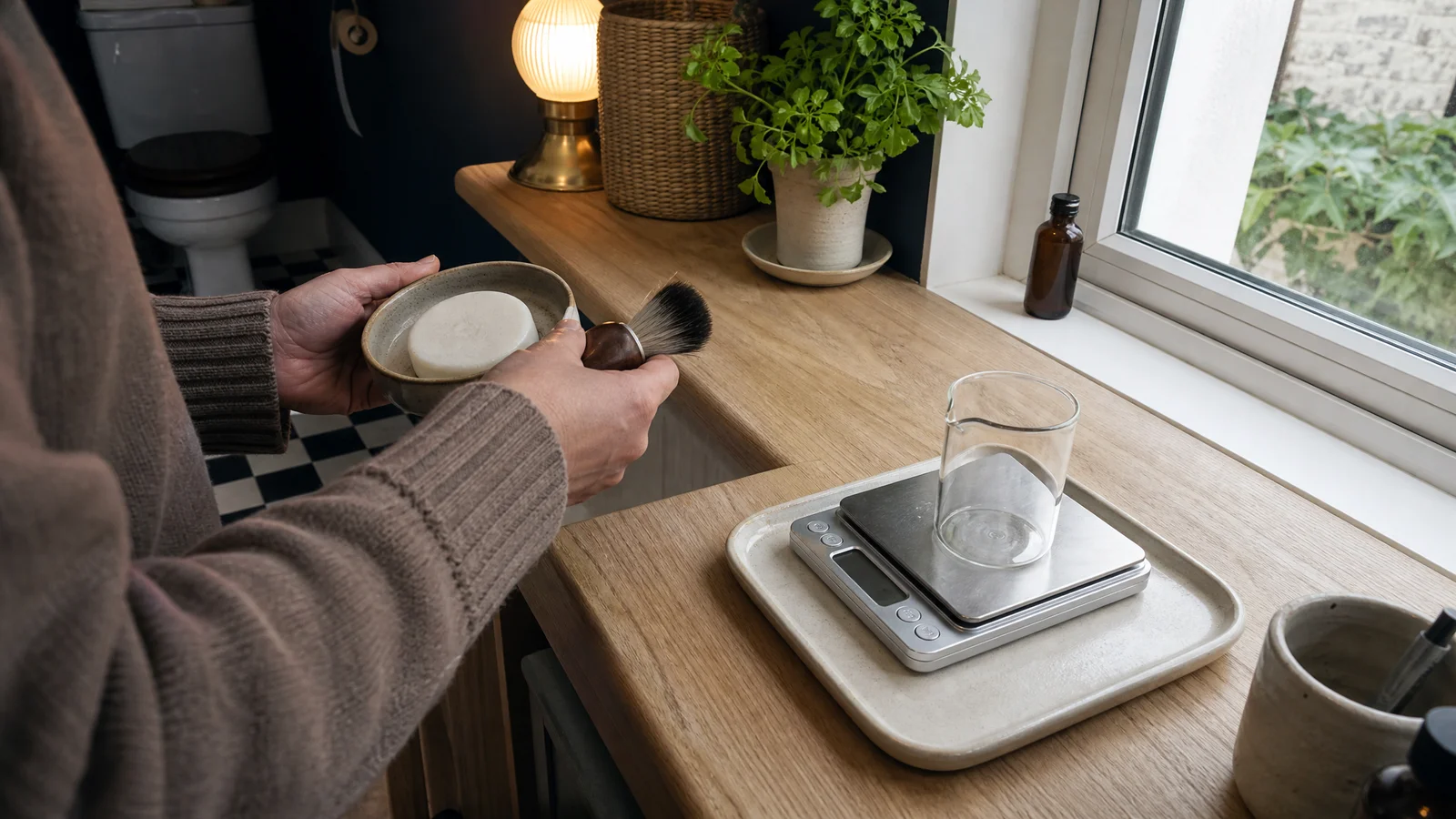
Birch Shaving Soap: How Much Birch a Shaving Bar Can Carry
A shaving bar is the strictest place we know to use sweet birch oil. The oil is 93% to 99.8% methyl salicylate in authentic samples, the lather goes onto skin that a blade just scraped, and the only numeric cosmetic limit that exists for methyl salicylate, 0.06% in the EU and UK, works out to about 0.6 g of oil per kilogram of soap. Below is the arithmetic, a scent plan built around a dose that small, and a test you run yourself, because we have not made or tested a shaving soap.
Why the ceiling is 0.06% for this product
Shaving is a known irritant step before any fragrance arrives. A 2023 paper in Frontiers in Medicine opens by noting that shaving remains the most common hair removal method "despite its propensity to irritate skin" (Costello et al., 2023). The American Academy of Dermatology tells people with very dry or sensitive skin to look for a shaving cream labeled for sensitive skin (AAD). Neither source says anything about fragrance, so we do not attribute a fragrance-free recommendation to them. The point is only that your starting skin is already stressed.
The one binding number for methyl salicylate comes from cosmetic law. Entry 324 of Annex III of the EU Cosmetics Regulation, as amended by Regulation (EU) 2023/1545, allows 0.06% in rinse-off skin products (other than hand wash) and 0.06% in leave-on skin products, and says the substance is not to be used in preparations for children under 6 except toothpaste (Regulation (EU) 2023/1545, text mirror). Great Britain's SI 2025/413 sets the same 0.06% for people over 1 and adults, and 0.02% for ages 0.5 to 1 (UK Government, 2025). A shaving soap is lathered and rinsed, so rinse-off is the natural reading, but whether your bar counts as a rinse-off cosmetic is a classification question for a regulatory consultant. It barely matters here, because the leave-on figure is the same 0.06%.
Other sources give higher numbers, and you should know why we do not use them. The Tisserand Institute gives recommended topical maximums of 2.5% for sweet birch and 2.4% for wintergreen, citing Essential Oil Safety, 2nd edition (Tisserand Institute). Robert Tisserand's 2012 blog post says he would not like to see it used above 5% (Tisserand, 2012). Those are aromatherapy dilution figures, about 40 times the EU cosmetic number. They are a different framework, and for skin that was just shaved we anchor on the lower one.
For shaving soap, use the 0.06% ceiling. In the US there is no numeric cosmetic rule for methyl salicylate that we could find, and IFRA's Standards through the 51st Amendment contain no entry for it (IFRA, 2024), so a supplier's IFRA certificate would not hand you a methyl salicylate number either. The selling guide covers that gap.
The arithmetic: how much oil that is
The limit is a percentage of the finished product, so the working numbers are grams of oil per batch. This is arithmetic, not a tested recipe. It assumes the oil is 100% methyl salicylate, the conservative end of the 93.24% to 99.84% range reported for authentic sweet birch oil (Dosoky, Poudel and Satyal, 2022). The 0.05% column is our suggested target and the reasoning for it follows the table.
| Batter weight | Cap at 0.06% | Target at 0.05% | 10% premix to weigh for the target |
|---|---|---|---|
| 100 g (one puck) | 0.060 g | 0.050 g | 0.50 g |
| 500 g | 0.30 g | 0.25 g | 2.5 g |
| 1,000 g | 0.60 g | 0.50 g | 5.0 g |
| 2,000 g | 1.20 g | 1.00 g | 10.0 g |
Why 0.05% and not 0.06%? Reasoning: a bar loses water as it cures, so the same grams of oil become a higher percentage of the finished bar. If a bar lost 10% of its mass (an illustrative figure, not a measurement), 0.06% of batter weight would become 0.06 / 0.9 = about 0.067% of the bar, over the cap. Starting at 0.05% leaves room for that. No source we read quantifies how much methyl salicylate survives the lye. PubChem lists decomposition by alkalies to methyl alcohol and a salicylate (PubChem, methyl salicylate), but gives no rate, so do not count on any loss to keep you under the cap.
A 10% premix means 1.00 g of oil weighed into 9.00 g of a liquid you already have in the recipe, for example part of the recipe's own liquid oils. This makes the weights large enough to measure. For scale, our COA gives a relative density of 1.183, so 0.50 g of oil is 0.42 mL. Weigh it; do not count drops.
One more number to keep the dose in perspective. A compilation of odor thresholds lists methyl salicylate at 40 parts per billion in water (Leffingwell and Associates). That is water, not air or soap, so it is not a prediction. But 0.05% is 500,000 ppb, about 12,500 times that figure. A dose this small is not inaudible, and there is no need to go higher to be noticed.
A scent plan for a dose that small
At 0.05%, birch is an accent, not the identity of the bar. ScenTree classes methyl salicylate as a heart note used as a modifier, calls it "a very powerful compound," and says it needs only "a very low dilution" (ScenTree). So the bar's character has to come from the rest of the scent, and the barbershop idea fits. The fougère family is described as lavender in the top, geranium or florals in the heart, and oakmoss and coumarin in the base; the name comes from Houbigant's Fougère Royale, dated 1882 in some sources and 1884 in others (Wikipedia, Fougère). Treat birch as the wintergreen flash on top of a lavender-led structure. Our fougère accord guide works through that structure.
Three cautions follow from the sources:
- Do not promise a cooling shave. In a 1989 psychophysics study, methyl salicylate "enhances the perception of warming but does not affect the perception of cooling," and the dominant sensation was burning, though the doses detected were 3% to 12% in solution, far above a soap dose, so this is a reason for caution and not a prediction (Green and Flammer, 1989). A "minty" impression is partly learned from candy and toothpaste, per Arctander as quoted on the Good Scents Company. On a fresh shave, warming is a reason for a low dose.
- Bay rum shortcuts speed up trace. Soap suppliers name clove and cinnamon oils, which carry eugenol and cinnamaldehyde, as fast-moving (Soap Index, 2026). No source we read says birch or methyl salicylate speeds trace or discolors soap. Good Scents lists it as "non-discoloring in most media," a trade-database statement, not a soap test.
- Companion oils have their own limits. We sell only birch. Whatever you add for lavender, citrus or base notes needs its own skin limit checked, and any wintergreen or other methyl salicylate source must be added to the same 0.06% total. The EU's scientific committee flagged exactly this aggregate-exposure problem (SCCS/1633/21, 2021).
Soap makers also report that some top notes fade on their own in soap and suggest anchoring them with base-note oils (Modern Soapmaking). That is a reason to build the bar on base notes you can smell at the end of cure, not on birch.
Lather: what the sources cover and what they do not
This article is about the scent side. For the soap itself, the encyclopedia-level facts are these: sodium hydroxide makes a hard puck and potassium hydroxide a softer, brush-loading soap, tallow is historically common with palm as a substitute, coconut oil is common, and stearic acid "contributes to a more stable, dense lather" (Wikipedia, Shaving soap). Typical cold process recipes use about a 5% superfat (Wholesale Supplies Plus, 2026). No supplier source in our research gave a cure time for shaving soap, so we give none. Take oil percentages from a published shaving-soap recipe, run them through a lye calculator, and add only the scent per the table above. Our soap making guide covers the general method.
Run this test before you pour a full batch
We have not run this protocol. It is built from a method soap suppliers use for fragrance testing: judge acceleration, color and scent at several time points.
- Make four 100 g batches of the same recipe at the same temperature: one unscented control and three scented at 0.02%, 0.035% and 0.05% of batter weight (0.020 g, 0.035 g and 0.050 g of oil, weighed through the 10% premix).
- Record minutes to trace for each, then photograph at 24 hours, 1 week and 4 weeks, as Soap Index recommends. If the scented batches trace no faster than the control, you have your own answer to the folklore.
- After cure, smell each bar dry and then lathered. Have someone else label the bars. Arctander's note is that the most reliable judges of this smell are people who are not used to it as a candy or toothpaste flavor.
- Skin check on the inner forearm first: lather, leave one minute, rinse, wait 24 hours. Only then try a small area of freshly shaved skin. Stop at any sting or redness.
Limits: who skips this and where it stops
Skip it if you are pregnant or breastfeeding, take anticoagulants, are sensitive to aspirin, or are shaving a child; those are our written exclusions, and Tisserand's guidance matches them. Do not use on broken skin or near the eyes, where the EU's scientific committee describes methyl salicylate as "a weak skin sensitiser in humans and eye irritant." Fragrance allergy is not rare in tested groups: in a 2024 review of patch-tested European dermatitis patients, sensitization to fragrance mix I was 6.81% (Botvid et al., 2024). Methyl salicylate is not part of that mix, so this shows the general risk, not a birch figure. FDA also says some fragrance components may cause allergic reactions in some people (FDA, Fragrances in Cosmetics).
We are not giving an aftershave recipe. A leave-on splash on freshly shaved skin sits under the same 0.06% number, and the 0.6% figure is for hydroalcoholic fragrance, not for a splash on raw skin. If you sell the bar in the EU or UK, methyl salicylate must be named in the ingredient list above 0.01% in rinse-off products, which 0.05% exceeds; the selling guide has the label checklist. If the brief calls for a loud, wintergreen-forward shave soap, this oil is not the right tool under these limits. A supplier's fragrance oil with its own compliance paperwork is, as the fragrance oil comparison explains. This is a sourced explainer by the shop, not individual medical advice and has had no clinician review; ask a dermatologist, pharmacist or physician about your own skin and medications, and a cosmetic chemist about a product you will sell.
Our birch oil is undiluted, comes in amber glass from 1 oz, and carries a lot reference tied to batch analysis. At 0.5 g per kilogram of batter, a 1 oz bottle covers about 57 kg of soap if it is 28.35 g by weight, or about 70 kg if it is 29.57 mL of liquid at 1.183 g/mL, so the smallest size is more than enough for testing. The dilution chart sets out the same limits for other uses.
Birch Essential Oil
Birch Essential Oil from our own shop, in sizes from 1 oz to bulk.
From $15.99
Shop Now →Sources & Further Reading
- Costello L et al., 2023. Frontiers in Medicine, in vitro shaving model. pmc.ncbi.nlm.nih.gov
- American Academy of Dermatology. Hair removal: How to shave. aad.org
- European Commission, 2023. Regulation (EU) 2023/1545, Annex III entry 324 (text mirror). lawplayer.com
- UK Government, 2025. The Cosmetic Products (Restriction of Chemical Substances) Regulations 2025, SI 2025/413. legislation.gov.uk
- Tisserand Institute. Methyl Salicylate: Essential Oil Constituents in Food Part 5. tisserandinstitute.org
- Tisserand R, 2012. Wintergreen oil safety. roberttisserand.com
- IFRA, 2024. The complete IFRA Standards, 51st Amendment. ifrafragrance.org (CDN)
- Dosoky NS, Poudel A, Satyal P, 2022. Authentication and Market Survey of Sweet Birch (Betula lenta L.) Essential Oil. Plants 11(16):2132. pmc.ncbi.nlm.nih.gov
- NIH/NLM, PubChem. Methyl salicylate (CID 4133). pubchem.ncbi.nlm.nih.gov
- Leffingwell and Associates. Odor and flavor detection thresholds in water. leffingwell.com
- ScenTree. Methyl salicylate. scentree.co
- Wikipedia. Fougère. en.wikipedia.org
- Green BG, Flammer LJ, 1989. Methyl salicylate as a cutaneous stimulus: a psychophysical analysis. pubmed.ncbi.nlm.nih.gov
- The Good Scents Company. Methyl salicylate (Arctander quotation, stability). thegoodscentscompany.com
- Soap Index, 2026. Fragrance and Essential Oils: Usage Rates. soapindex.com
- European Commission SCCS, 2021. Opinion on methyl salicylate, SCCS/1633/21. health.ec.europa.eu
- Modern Soapmaking. What You Need to Know About Using Essential Oils When You Make Soap. modernsoapmaking.com
- Wikipedia. Shaving soap. en.wikipedia.org
- Wholesale Supplies Plus, 2026. Saponification: How Soap Actually Works. wholesalesuppliesplus.com
- Botvid S et al., 2024. Contact sensitization to fragrance mix I and II. Contact Dermatitis. research.regionh.dk
- US FDA. Fragrances in Cosmetics. fda.gov