Birch Essential Oil for Soap: Real Usage Rates and Limits
Birch essential oil can go in soap, but at a much lower rate than the 1% to 5% most soap pages quote. Sweet birch oil is 93.24% to 99.84% methyl salicylate (Dosoky et al., 2022), and the EU and UK cap that substance at 0.06% in rinse-off products. This guide walks through that decision first, then the process, trace and cure questions, selling, and which bottle size makes sense.
Decide first: what rate, under which rule
Soap-making advice is built around fragrance oils, which arrive with an IFRA certificate and a printed maximum. Wholesale Supplies Plus says the IFRA rate overrides the product rate (Wholesale Supplies Plus). Sweet birch oil breaks that routine. The index of the 51st IFRA Amendment (January 2024) has no entry for methyl salicylate, wintergreen oil or sweet birch oil (IFRA, 2024), and we hold no IFRA certificate for our oil. IFRA does map bar soap to Category 9 (IFRA Guidance, 2023), but a category without a standard sets no number.
The numbers that exist are these:
| Source | Figure | What it applies to |
|---|---|---|
| EU Annex III entry 324, as amended 2023 (Reg. 2023/1545) | 0.06% methyl salicylate | Rinse-off skin products (0.6% for hand wash); not for children under 6 except toothpaste |
| UK SI 2025/413 (legislation.gov.uk) | 0.06% (adults and over 1); 0.02% (ages 0.5 to 1) | Rinse-off skin and hair products excluding hand wash |
| Tisserand Institute, citing Tisserand and Young (Tisserand Institute) | 2.5% topical maximum for sweet birch | Topical use; the page does not say which product types |
| Robert Tisserand's 2012 blog (Tisserand, 2012) | "I would not like to see it used at more than 5%" | Wintergreen oil in general; a casual 2012 opinion |
| Generic soap supplier rates (Wholesale Supplies Plus; Soap Index) | About 3% for melt and pour; 0.7 oz per pound of oils as a cold process starting point for fragrance oils | Fragrance oils with their own IFRA documents; none names birch |
Our recommendation is the EU and UK number, with a margin: 0.05% of the weight of the batter at pour. We pick it because it is the only figure that is both numeric and tied to soap, and because the Tisserand figure is a different framework that does not say what it covers. In the US the picture is looser. FDA treats a product as soap only when its bulk is alkali salts of fatty acids, and it is labeled and sold solely as soap, and such products fall to CPSC, not FDA (FDA). We located no numeric US rule for methyl salicylate in that category. Missing a rule is not a safety finding, so a cosmetic chemist or regulatory consultant is the person to ask if you want to go above 0.05%.
What 0.05% means in grams
Birch oil in grams equals 0.0005 times the pour weight, where pour weight is oils plus lye plus water. For a 500 g oil batch with a 5% superfat the pour weight is about 740 g, so the oil is 0.37 g. The full lye and batch table is on the cold process recipe page, and the general conversion math is in the dilution chart.
Calling that 0.37 g a "fragrance load" overstates it. It is a trace. No source we reviewed says how much methyl salicylate survives in cold process batter, and PubChem records that alkalis decompose it to methyl alcohol and salicylate (PubChem). The shop has not made soap with this oil. Expect a faint scent, and plan the bar so that nothing depends on it.
Choosing the method
Three routes, each with a different reason to pick it.
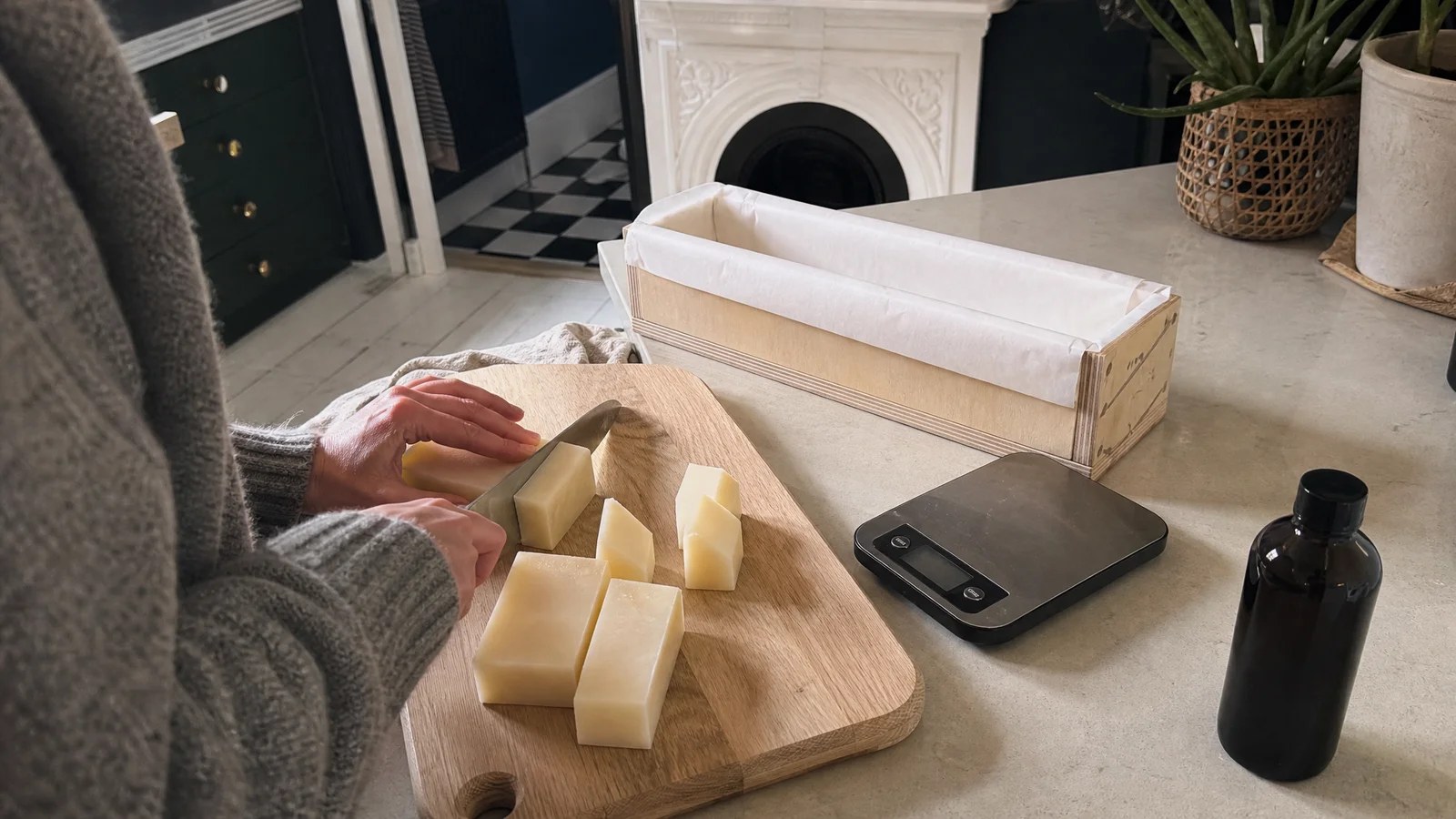
Melt and pour: the beginner route
The base is already saponified, so you handle no lye, and Wholesale Supplies Plus advises adding scent right before you pour, below 140 F (Wholesale Supplies Plus). The birch limit still applies; the melt and pour recipe gives the per-batch table.
Cold process: the full-control route
You pick the oils and compute the lye from saponification values, then cure 4 to 6 weeks (Wholesale Supplies Plus, 2026). The cost is learning lye safety. NIOSH lists sodium hydroxide as corrosive to aluminum, tin and zinc and says to flush skin and eyes with water immediately (NIOSH). Start from the worked recipe.
Shaving soap: harder to document
Wikipedia describes shaving soaps (Wikipedia, Shaving soap) as using sodium hydroxide for hard pucks, potassium hydroxide for soft soap, with stearic acid for a dense lather. No reputable supplier recipe with a cure time turned up, so none is given here. The shaving soap page covers what can be said. Shaving irritates skin by its nature, per a 2023 Frontiers in Medicine paper that opens by noting shaving's propensity to irritate skin; a salicylate oil is a poor addition to a product used on freshly shaved skin, and that is our reasoning, not a finding.
Trace, seizing and color
The common worry is that wintergreen scents speed up trace or brown the bar. No source we reviewed supports it. The named accelerators are clove and cinnamon oils, vanillin fragrance oils and some florals (Soap Index, 2026; The Soapery). The full source review, an arithmetic bound on how much alkali the oil could use, and a split-batch test protocol are in does birch oil accelerate trace. The short version: at 0.05%, the amount of oil is too small to shift the batter chemistry, which is reasoning, not an observation.
Color is similar. Modern Soapmaking says essential oils generally cause fewer color problems than fragrance oils (Modern Soapmaking), and The Good Scents Company lists methyl salicylate as "non-discoloring in most media" (Good Scents). Neither is a soap test. Photograph your own first bar at 24 hours, 1 week and 4 weeks.
What the COA tells a soap maker
Our published certificate lists relative density 1.183 at 20 C, refractive index 1.537 and optical rotation "optically inactive". Those are physical constants. They are consistent with sweet birch oil but cannot separate natural from synthetic methyl salicylate, which have nearly the same values. The certificate has no methyl salicylate percentage, no chromatogram and no isotope result, and it does not name the lab. The owner states that every batch goes to an independent laboratory and that methyl salicylate and isotope and profile work are available per lot on request. For soap this matters in a narrow way: your limit is calculated on methyl salicylate, so ask for the figure for your lot at our contact page and see how to read a birch oil lab report.
Labeling and selling
In the EU, methyl salicylate must appear in the ingredient list above 0.001% in leave-on and 0.01% in rinse-off products (Reg. 2023/1545), so a 0.05% bar needs the declaration. US labeling follows whether the product is soap or a cosmetic, and net weight statements apply under 21 CFR 701.20 (FDA). Claims decide the category too, so do not describe a birch bar as relieving or treating anything. The detail is in selling birch soap: labeling and IFRA. This guide is not legal advice; an attorney or regulatory consultant should review a product before you sell it.
Who should not make or use birch soap
We recommend against birch soap in pregnancy or breastfeeding, for children, for anyone taking anticoagulants or sensitive to aspirin, and never to be swallowed, matching the position on our origin page. The Tisserand Institute lists the same groups and adds Reye's syndrome as a rare salicylate risk (Tisserand Institute). The EU bars the substance in preparations for children under 6. See pregnancy and children and aspirin sensitivity. This is a sourced explainer by the shop, with no clinician's review, and is not individual medical advice. A pharmacist or physician can address your situation. If someone swallows soap with birch oil or the neat oil, call Poison Help at 1-800-222-1222.
From a sample to a larger bottle: the arithmetic
At 0.05%, a 500 g oil batch uses 0.37 g of oil, and a 3,000 g oil batch uses 2.22 g (0.0005 x 4,440.9 g of pour weight). If our "oz" is a weight ounce, a 1 oz bottle is 28.35 g, which covers about 76 batches of the smaller size or about 12 of the larger. If it is a fluid ounce, 29.57 mL x 1.183 g/mL is about 35 g, which is about 94 and 16. We have not confirmed which ounce applies, so ask before you plan around it.
That changes the usual sample-to-bulk story. A home or craft maker should buy the 1 oz size and stop there. A soap house making 3,000 g batches every week would use about 115 g a year at this rate, which a single 16 oz bottle (about 454 g) would cover for about four years, so even they would not need bulk for soap alone. The 5 lb size (about 2,268 g) is for people also making candles and room scents (see the candle making guide) or running very large volumes. Contact us before ordering large sizes and we will say what we can provide.
Soap-maker questions
How much birch oil should go in soap?
For rinse-off soap sold in the EU or UK, methyl salicylate is capped at 0.06% of the product. Treating birch oil as pure methyl salicylate, we suggest 0.05% of pour weight, about 0.37 g in a 500 g oil batch. The US has no numeric rule that we located; ask a cosmetic chemist if you want more.
Does birch oil accelerate trace in soap?
No source we reviewed says it does. Suppliers name clove, cinnamon, vanillin fragrance oils and some florals as accelerators. At 0.05%, the oil amount is tiny relative to the batch. Check other oils in your blend, soaping temperature and your lye calculation first.
Can I use birch oil in melt and pour soap?
Yes, with the same 0.06% methyl salicylate limit in the EU and UK, because lye-free bases do not change that rule. Weigh the oil to 0.01 g and add it right before pouring, below 140 F. Generic 3% supplier rates are about 60 times higher than the birch figure.
The practical advice is to start small, weigh to hundredths of a gram, keep the first bar plain, and let your own cured bar decide whether the scent is worth the recipe.
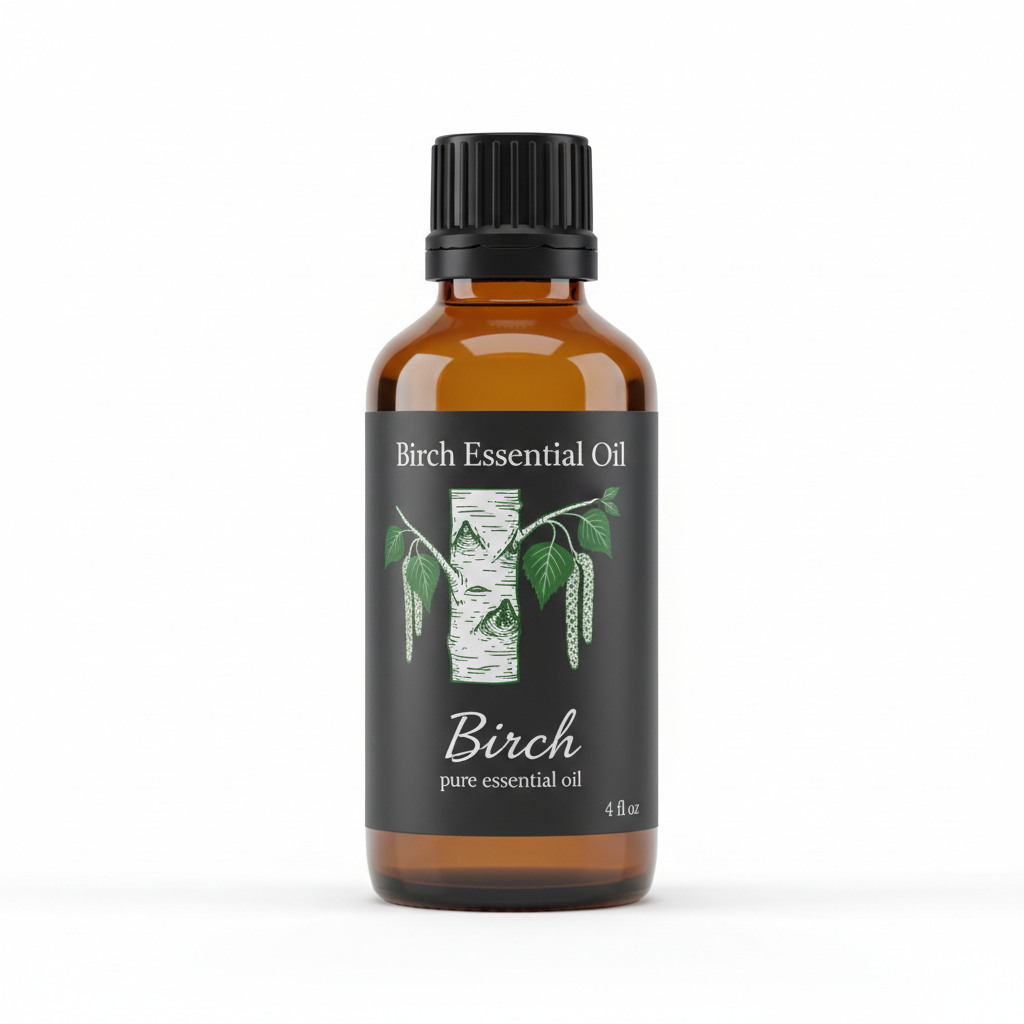
Birch Essential Oil
Birch Essential Oil from our own shop, in sizes from 1 oz to bulk.
From $15.99
Shop Now →Sources & Further Reading
- Wikipedia. Shaving soap. en.wikipedia.org
- Costello L et al., 2023. Frontiers in Medicine (in vitro shaving model). pmc.ncbi.nlm.nih.gov
- Dosoky NS, Poudel A, Satyal P, 2022. Authentication and Market Survey of Sweet Birch (Betula lenta L.) Essential Oil. Plants 11(16):2132. pmc.ncbi.nlm.nih.gov
- IFRA, 2024. The complete IFRA Standards up to and including the 51st Amendment (index). ifrafragrance.org
- IFRA, 2023. Guidance for the use of IFRA Standards, 51st Amendment, Table 12. ifrafragrance.org
- Commission Regulation (EU) 2023/1545, 2023. Annex III entry 324, methyl salicylate. lawplayer.com
- UK Government, 2025. The Cosmetic Products (Restriction of Chemical Substances) Regulations 2025, SI 2025/413. legislation.gov.uk
- Tisserand Institute (Robert Tisserand), n.d. Methyl Salicylate: Essential Oil Constituents in Food Part 5. tisserandinstitute.org
- Robert Tisserand, 2012. Wintergreen oil safety. roberttisserand.com
- Wholesale Supplies Plus. Getting Started: Scenting MP Soap Base. wholesalesuppliesplus.com
- Soap Index, 2026. Fragrance and Essential Oils: Usage Rates. soapindex.com
- US FDA. Is It a Cosmetic, a Drug, or Both? (Or Is It Soap?). fda.gov
- NIH/NLM, 2026. PubChem: Methyl salicylate (CID 4133). pubchem.ncbi.nlm.nih.gov
- Wholesale Supplies Plus, 2026. Saponification: How Soap Actually Works. wholesalesuppliesplus.com
- CDC/NIOSH. NIOSH Pocket Guide to Chemical Hazards: Sodium hydroxide. cdc.gov
- The Soapery. Essential Oils for Soap Making. thesoapery.co.uk
- Modern Soapmaking. What You Need to Know About Using Essential Oils When You Make Soap. modernsoapmaking.com
- The Good Scents Company. Methyl salicylate (119-36-8). thegoodscentscompany.com