Birch Oil, Aspirin Sensitivity and Blood Thinners
Sensitivity to aspirin is not an allergy to birch, and that mismatch is why this topic gets answered badly. Sweet birch oil is 93.24-99.84% methyl salicylate in authentic samples (Dosoky et al., 2022), and methyl salicylate is metabolized to salicylic acid, the same family of compound as aspirin (European Commission SCCS, 2021). This page separates what has been documented (warfarin bleeding reports, skin sensitization) from what is extrapolation (aspirin-sensitive asthma), so you know which questions to take to a pharmacist.
Why "aspirin allergy" is the wrong frame
An allergy is an immune reaction to a specific substance. Aspirin intolerance, anticoagulant interactions and salicylate poisoning are three different mechanisms, and each one has a different amount of evidence behind it for methyl salicylate. Lumping them under "if you are sensitive to aspirin, avoid birch oil" is a reasonable rule of thumb, but it hides which part of the rule rests on case reports and which part rests on reasoning.
The dose arithmetic explains why the oil gets a harder look than a finished product. A case report from Great Ormond Street Hospital states that one teaspoon (5 mL) of oil of wintergreen is equivalent to roughly 7,000 mg of salicylate, or 21.7 adult aspirin tablets of 325 mg (Botma et al., 2001). Reasoning from the density figure of 1.18 g/mL, 5 mL of oil weighs about 5.9 g, so the 7,000 mg figure is an aspirin-equivalent mass, not grams of liquid. Birch and wintergreen oil are both close to pure methyl salicylate, which is why poison-center thresholds written for wintergreen are relevant to birch (a reasoned extension, since those guidelines name wintergreen, not birch).
Blood thinners: the interaction that has case reports
This is the strongest documented interaction, and it involves topical use, not just swallowing. In a 2000 report, a 22-year-old woman on stable warfarin presented with an INR of 12.2 after applying a methyl salicylate gel to her knees daily for eight days. The authors wrote that "a significant interaction can occur with the use of lower topical doses of methyl salicylate as well" (Joss and LeBlond, 2000).
A second report describes a 53-year-old man on warfarin who admitted applying 20 g of a 50% methyl salicylate balm to his calf over three days; after a fall he had a large retroperitoneal hematoma. The author concluded that significant topical use can potentiate warfarin (Chan, 2009). Two caveats apply: both are single case reports, and the second patient had also received enoxaparin and heparin, so causation is the authors' judgment, not a proven rate. By simple arithmetic, 20 g of a 50% product is about 10 g of methyl salicylate (arithmetic, not a figure from the report).
The Tisserand Institute summary of Essential Oil Safety (2nd edition) advises against using wintergreen or sweet birch oil by anyone taking blood-thinning medication such as aspirin or warfarin (Tisserand Institute). Our own written stance on the site is the same: we say do not use the oil if you take anticoagulants, and the sources above are the reason. Our oil is sold undiluted, so that sentence applies to the bottle as it ships. See our statement on the Inside the Still page.
Aspirin-sensitive asthma: where the evidence stops
Aspirin-exacerbated respiratory disease (asthma, nasal polyps and reactions to aspirin or other NSAIDs) is real. A 2019 review puts it at about 0.3-0.9% of the US general population and about 7% of people with asthma (Li et al., 2019). That review is about aspirin and NSAIDs acting on the COX-1 pathway. It does not discuss methyl salicylate.
The sources compiled for this page include no allergy or immunology society statement on topical or inhaled methyl salicylate in aspirin-sensitive asthma. Telling an aspirin-sensitive person to avoid birch oil is therefore an extrapolation from chemistry, not a finding. It is a cautious extrapolation, and we make it ourselves in our written stance, but it is labeled here as reasoning so you can weigh it. A pharmacist or allergist can tell you whether your particular reaction history makes it more or less relevant.
Skin reactions are a separate question
Methyl salicylate carries a skin-sensitizer classification (H317, "may cause an allergic skin reaction") in the EU hazard listing reproduced by PubChem, and the European SCCS calls it "a weak skin sensitiser in humans" (SCCS, 2021). A 1996 review notes that topical methyl salicylate preparations may cause irritant or allergic contact dermatitis and anaphylactic reactions (Chan, 1996).
A patch test only informs the skin question. It says nothing about the systemic one, because a person on warfarin could pass a patch test and still absorb enough through skin to matter. Do not treat a clean patch test as clearance for any medication interaction.
Interaction summary
| Situation | What sources say | Strength of support | Who to ask |
|---|---|---|---|
| Warfarin or other anticoagulants | Two case reports of raised INR or bleeding after topical methyl salicylate; Tisserand advises against use | Case reports, confounders in one | Prescriber or anticoagulation clinic |
| Daily aspirin or other blood thinners | Tisserand advises against use | Secondary expert guidance | Pharmacist |
| Aspirin-sensitive asthma or NSAID reactions | No methyl salicylate study found; condition itself is documented | Extrapolation only | Allergist or physician |
| Skin sensitivity | H317 listing; SCCS "weak skin sensitiser"; contact dermatitis reports | Regulatory and review-level | Pharmacist or dermatologist |
| Children with cold or fever | MedlinePlus says substances with oil of wintergreen contain aspirin-like salicylates and should not be given to a child with a cold or fever | Government health reference | Pediatrician |
The last row is about the Reye syndrome concern. MedlinePlus states that Reye syndrome has occurred in children given aspirin during chickenpox or flu, and warns against giving "substances with oil of wintergreen" to a child who has a cold or fever (MedlinePlus). It does not give a case count for methyl salicylate, so read it as a precaution. Our page on birch oil around pregnancy and children covers the household side.
What to bring to a pharmacist
Pharmacists are the right first stop because they see your whole medication list. Bring:
- Every prescription and over-the-counter product you take, including daily low-dose aspirin.
- How you would use the oil: candle or room scent, diffuser, or skin. Say whether the oil would be undiluted or diluted, and by how much.
- This question, in your own words: "Does methyl salicylate by skin or by inhalation matter with my medications?" The studies above were on topical products, so ask about inhaled and room use separately.
- Any past reaction to aspirin, ibuprofen or naproxen, including wheezing or hives.
If someone swallows the oil, skip the pharmacist and go to the first-aid steps; Poison Control is 1-800-222-1222. For the full risk picture across projects, the safety guide is the hub, and the methyl salicylate explainer covers the chemistry. A separate piece reviews the evidence on sore-muscle products.
This is a sourced explainer by the shop, not individual medical advice, and no clinician has reviewed it. Your pharmacist or prescriber decides what is safe for you.
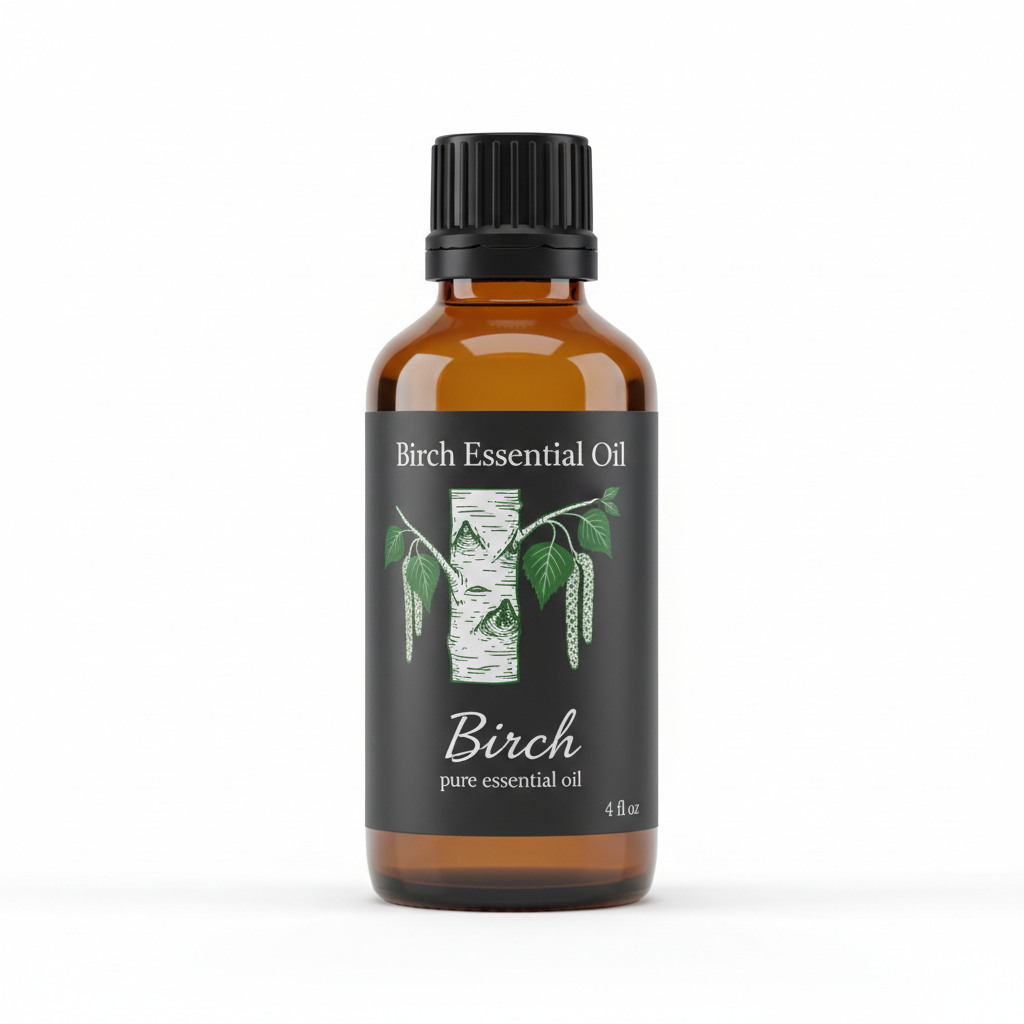
Birch Essential Oil
Birch Essential Oil from our own shop, in sizes from 1 oz to bulk.
From $15.99
Shop Now →Sources & Further Reading
- Dosoky NS, Poudel A, Satyal P, 2022. Authentication and Market Survey of Sweet Birch (Betula lenta L.) Essential Oil. Plants 11(16):2132. pmc.ncbi.nlm.nih.gov
- European Commission SCCS, 2021. Opinion on methyl salicylate (methyl 2-hydroxybenzoate), SCCS/1633/21. health.ec.europa.eu
- Botma M, Colquhoun-Flannery W, Leighton S, 2001. Laryngeal oedema caused by accidental ingestion of Oil of Wintergreen. Int J Pediatr Otorhinolaryngol 58(3):229-232. pubmed.ncbi.nlm.nih.gov
- Joss JD, LeBlond RF, 2000. Potentiation of warfarin anticoagulation associated with topical methyl salicylate. Ann Pharmacother 34(6):729-733. pubmed.ncbi.nlm.nih.gov
- Chan TYK, 2009. Life-threatening retroperitoneal bleeding due to warfarin-drug interactions. Pharmacoepidemiol Drug Saf 18(5):420-422. pubmed.ncbi.nlm.nih.gov
- Tisserand Institute, undated page (accessed 2026). Methyl Salicylate: Essential Oil Constituents in Food Part 5. tisserandinstitute.org
- Li KL, Lee AY, Abuzeid WM, 2019. Aspirin Exacerbated Respiratory Disease: Epidemiology, Pathophysiology, and Management. Med Sci 7(3):45. pmc.ncbi.nlm.nih.gov
- National Library of Medicine, accessed October 2026. PubChem compound summary: Methyl salicylate (CID 4133), including HSDB and ECHA data. pubchem.ncbi.nlm.nih.gov
- Chan TY, 1996. Potential dangers from topical preparations containing methyl salicylate. Hum Exp Toxicol 15(9):747-750. pubmed.ncbi.nlm.nih.gov
- MedlinePlus, National Library of Medicine. Reye syndrome. medlineplus.gov