Methyl Salicylate: The Chemistry Behind Birch Essential Oil's Scent
Pour out a drop of sweet birch essential oil and you already know what you're smelling before you look at the label. That cool, minty-sweet, almost candy-like note is one of the most recognizable in the entire aromatic world, and it comes down almost entirely to a single molecule: methyl salicylate. Understanding this compound, where it comes from, how it behaves, and what current research actually says about it, is the difference between buying birch oil as a novelty and understanding it as a genuine botanical chemical profile. This deep dive walks through the birch oil chemical composition, what is methyl salicylate at a molecular level, and how to read a supplier's documentation like someone who knows what they're looking at.
What Is Methyl Salicylate?
Methyl salicylate is an organic ester, formed when salicylic acid bonds with methanol. In a lab setting it can be synthesized directly. In sweet birch (Betula lenta), it forms naturally through an enzymatic process: the bark and twigs store a related compound called gaultherin, a glycoside that breaks down into methyl salicylate and sugar once the plant tissue is macerated and steeped in water before steam distillation. This is part of what makes sweet birch oil chemistry unusual among essential oils. Most aromatic compounds exist ready-formed in the plant's oil glands or resin ducts. Methyl salicylate in birch is essentially assembled at the moment of processing, which is one reason the traditional maceration-then-distillation method matters so much for yield and character. We cover that mechanical side of production in more detail in our piece on how sweet birch oil moves from bark to bottle.
Wintergreen oil (Gaultheria procumbens) forms methyl salicylate through a nearly identical pathway, which is why the two oils smell so similar and are frequently confused by newcomers. We've written separately about how sweet birch and wintergreen relate to and differ from each other, but from a pure chemistry standpoint, they are close cousins built around the same core molecule.
Birch Oil Chemical Composition
Genuine sweet birch essential oil is remarkably concentrated in a single constituent compared to most botanical oils, which tend to be complex blends of dozens of compounds in modest percentages. Reputable gas chromatography-mass spectrometry (GC/MS) reports on authentic Betula lenta oil typically show methyl salicylate accounting for somewhere in the range of 90 to 99 percent of the total composition. The remaining fraction is made up of minor trace compounds, sometimes including small amounts of other esters or terpene-related molecules, depending on the specific batch, harvest region, and distillation conditions.
| Compound | Typical Range in Sweet Birch Oil | Contribution to Character |
|---|---|---|
| Methyl salicylate | ~90-99% | Defines the entire scent profile: sweet, minty, warm, candy-like |
| Trace esters and terpenoids | <5% combined | Subtle background nuance, varies by harvest and distillation batch |
| Residual moisture/volatiles | Negligible in well-processed oil | Should be minimal; excess suggests incomplete distillation |
This near-single-molecule composition is genuinely unusual in the essential oil world. Lavender oil might contain 100+ identifiable compounds. Sweet birch is, chemically speaking, close to a natural isolate. That simplicity is exactly why GC/MS testing is such a clean, useful verification tool for this particular oil: a batch that comes back anywhere far outside that 90 to 99 percent window is a signal worth paying attention to, whether that means adulteration, a synthetic blend, or simply a mislabeled product.
Research Observations: What Studies Actually Suggest
It's worth being precise about how we talk about research here, because it's easy for enthusiasm to slide into overstatement. Methyl salicylate is one of the more studied aromatic compounds in cosmetic and fragrance science, partly because it's used across skincare formulation, candle and soap making, and topical cosmetic products at large. A few threads worth knowing:
- Sensory and topical research. Formulation studies looking at salicylate esters in topical cosmetic bases have examined how the compound interacts with skin and how it's perceived sensorially, often described in the literature as producing a cooling or warming sensation depending on concentration and carrier. This research is generally framed around cosmetic formulation and sensory science rather than any claim about physiological outcomes.
- Fragrance and atmosphere research. Aromatic compounds like methyl salicylate have been studied in the context of scent perception and environmental atmosphere, the kind of research that informs how diffuser blends and candle formulations are designed. This is squarely aromatic and sensory territory, not a claim about any outcome beyond how a scent is experienced in a room.
- Chemical stability research. A meaningful amount of published work on methyl salicylate focuses on its stability under heat, light, and oxidative exposure, which is directly useful for anyone storing or blending birch oil, since it informs shelf life and how the oil should be kept. We go into the practical side of that in our birch oil storage and shelf life guide.
None of this research supports using birch essential oil as a substitute for guidance from a qualified healthcare provider, and it should not be read as evidence of any outcome beyond cosmetic, aromatic, or sensory experience. Research on isolated methyl salicylate in laboratory or formulation settings also doesn't automatically transfer one-to-one to a home diffuser blend or a diluted topical cosmetic use, since concentration, carrier, and exposure all change the picture. Anecdotal reports from long-time users of sweet birch oil (people who enjoy it in massage-style cosmetic blends, in bath products, or in workshop and wood-care applications) describe it as a favorite for its bracing, minty-sweet character, but that's a preference report, not a research finding.
Safety Profile and Considerations
Because methyl salicylate makes up nearly the entire composition of sweet birch oil, its safety profile is essentially the safety profile of the molecule itself, and it deserves real respect. This isn't a gentle floral oil where a slightly generous pour is a minor issue.
- Concentrated exposure matters. Undiluted methyl salicylate is potent, and concentrated exposure, whether through the skin or otherwise, is genuinely dangerous. A small amount of concentrated oil is chemically equivalent to a much larger dose of aspirin-family compounds, and the margin for a bad outcome is narrow, particularly for children and pets. Keep sweet birch oil, in any form, well out of reach of both. If you have pets in the home, our guide on birch oil and dogs goes into more detail on that specific risk.
- Never ingest. Sweet birch essential oil is intended for cosmetic and aromatic use only. It should never be swallowed or taken internally, and it should be stored in a way that makes accidental ingestion, especially by a curious child, effectively impossible.
- Dilute before any skin contact. This oil should always be diluted in an appropriate carrier oil before it ever touches skin, and even then, a patch test on a small area, waited out for a full 24 to 48 hours, is a sensible step before broader use. Our safety basics and dilution guide walks through recommended ratios in more depth.
- Salicylate sensitivity. People who know they react to aspirin or other salicylate-family compounds should be especially cautious with sweet birch oil, or avoid it, since the chemical relationship is direct.
- Consult a healthcare provider. If you are pregnant, nursing, managing any ongoing health situation, or taking any medication, especially anything related to blood clotting, talk with a qualified healthcare provider before adding sweet birch oil to your routine in any form.
- Broken or compromised skin. Avoid applying birch oil, even diluted, to broken or irritated skin, and keep it away from eyes and mucous membranes entirely.
Sweet birch oil rewards a light hand and careful storage far more than it rewards enthusiasm. Because it's so chemically concentrated, small missteps have outsized consequences compared to gentler oils.
Sourcing and Quality Indicators
Given how much of this oil's identity rests on a single compound, sourcing transparency matters more here than almost anywhere else in the essential oil world. A few things worth checking before you buy:
GC/MS Documentation
Ask whether the supplier provides a batch-specific GC/MS report, and look for that 90 to 99 percent methyl salicylate range discussed above. A supplier who can hand you real chromatography data, tied to the specific bottle you're buying rather than a generic species page, is signaling a level of seriousness worth paying for.
Botanical Source Naming
Confirm the oil is genuinely distilled from Betula lenta bark and twigs rather than being a synthetic methyl salicylate blend or a wintergreen substitute sold under a birch label. We cover this distinction, along with the practical checks you can do at home, in how to spot real sweet birch oil before you buy.
Harvest and Distillation Notes
Because the aromatic compound forms through a maceration step before distillation, batch-to-batch consistency depends heavily on how carefully that process is controlled. Suppliers who talk openly about their harvest region, timing, and distillation approach tend to be more reliable than those offering no detail at all. Sustainable, well-documented sourcing also tends to correlate with better attention to distillation quality, something we explore in our piece on sustainable birch harvesting.
Price as a Signal
Sweet birch oil is not one of the most expensive essential oils on the market, largely because methyl salicylate can also be produced synthetically at low cost, which keeps pressure on pricing. That said, a price that seems dramatically below the norm for a claimed pure, wildcrafted, or sustainably harvested oil is worth a second look. Real sourcing, real land access, and real distillation infrastructure all cost something, and that generally shows up in the price floor.
Packaging and Storage Clues
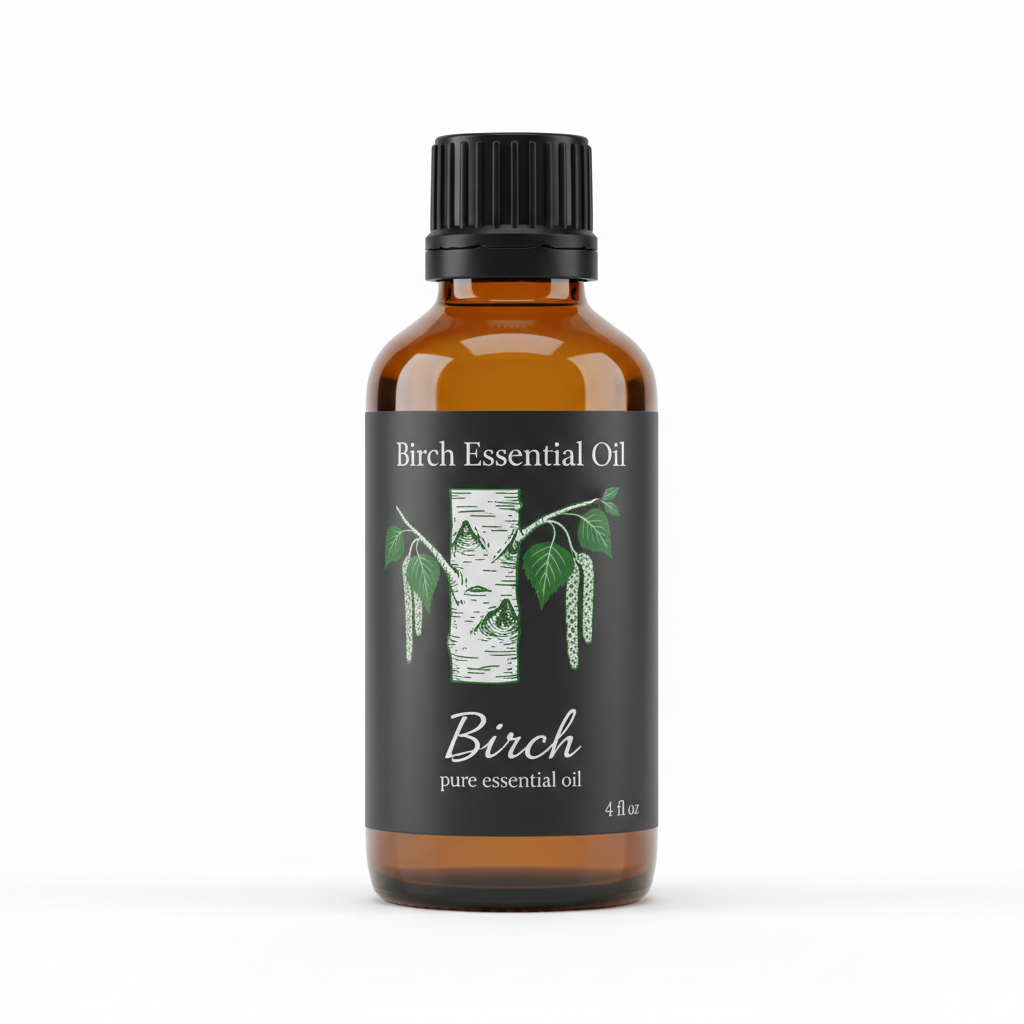
Because methyl salicylate is sensitive to light and heat over time, quality-minded suppliers ship and store it in dark amber or cobalt glass, away from direct sun. If an oil arrives in clear glass or a supplier's storage photos show bottles sitting in direct light, that's a small but real signal about how seriously the chemistry is being respected further up the supply chain.
Reading the Chemistry as a Buyer
None of this is meant to turn buying birch essential oil into a chemistry exam. But it does help to understand why this particular oil behaves the way it does: why it smells so consistently minty-sweet across brands, why a good supplier can hand you a lab report with a single dominant number on it, and why the safety guidance around it is more emphatic than it is for a lot of other botanical oils. Methyl salicylate is a genuinely interesting molecule, biosynthesized inside the bark of a northern hardwood tree through a process that only completes once the wood is macerated and processed. That's a fairly elegant bit of plant chemistry, and it's worth appreciating on its own terms, alongside the practical care the oil deserves once it's in your hands.
If you're building out a broader understanding of this oil before your first purchase, our complete quality and buying guide is a good next stop, and it pairs well with everything covered here on the chemistry side.