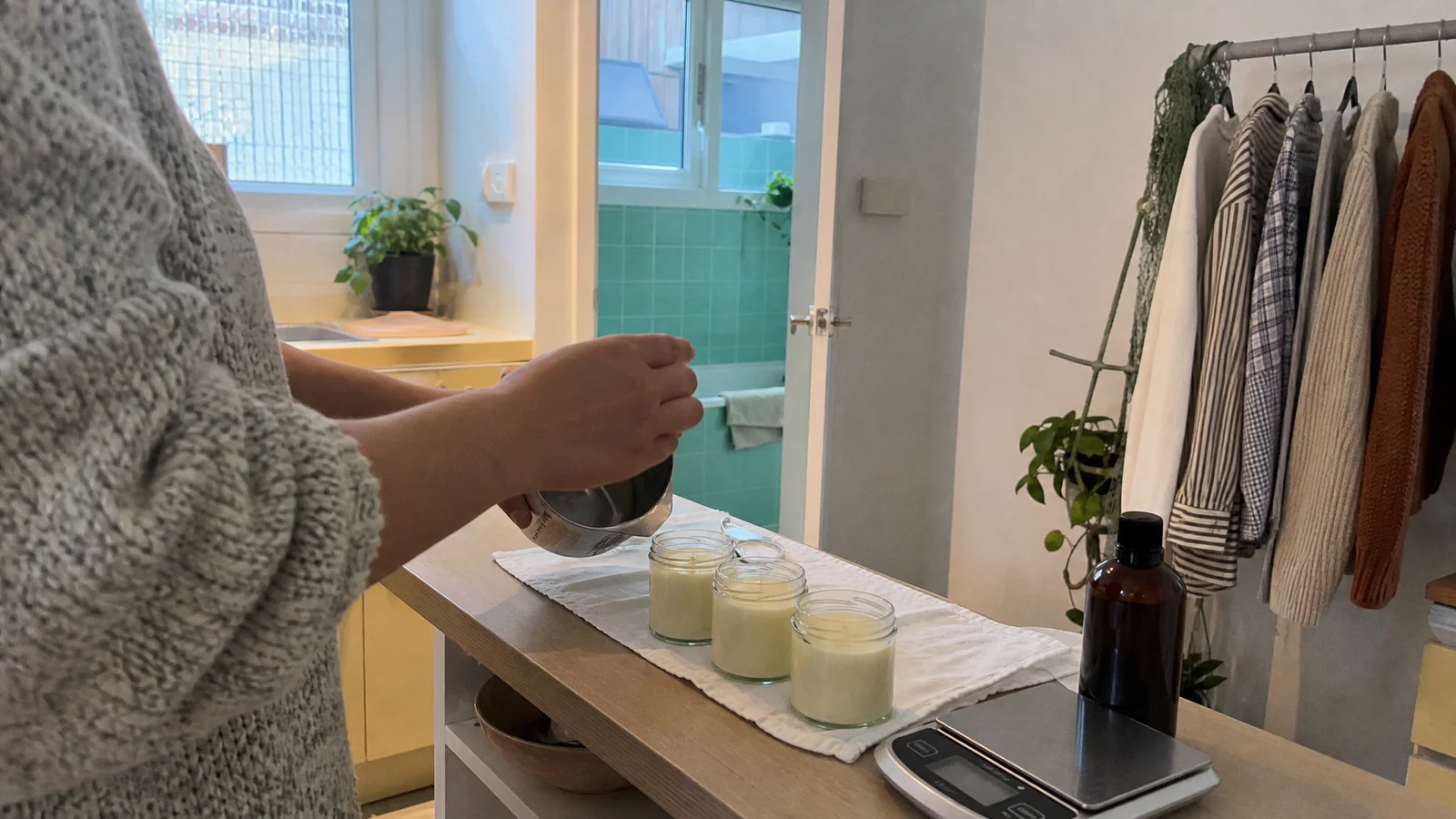
Birch Essential Oil Candle Making Guide: Wax, Load and Wicks
Birch oil is a poor first oil for a candle maker who wants a forgiving project, and a good one for a maker who wants a single distinctive note and will run a proper test. It is more than 93% methyl salicylate in genuine form, it is the most hazardous oil we sell, and no wax maker, trade body or standard we could find publishes a load for it. This guide is the decision path we would walk you through: whether birch belongs in your line, which wax data to read, how to set the load, how to wick it, and how to buy it in the right order.
Decide first: is a one-molecule oil what your candle needs
Sweet birch oil is nearly one compound. In a 2022 authentication study of 21 authentic Betula lenta samples, methyl salicylate ranged from 93.24% to 99.84% of the oil. That is the root-beer, wintergreen note, and it is why birch can sound simple on paper. The same fact removes some of the cushioning a blended fragrance gives you: there is no top-note citrus to lift it and no soft base to round it. The ScenTree perfumery reference classes methyl salicylate as a heart note and calls it a very powerful compound needing very low dilution.
Reasoning from that, you choose birch when you want the wintergreen-meets-woods character to be the point of the candle, and you choose something else when you want a rounded, evolving scent. A birch fragrance oil can be built for candles and arrive with its own data sheet, which an essential oil cannot. If you need a lot-matched, candle-specific fragrance document to sell commercially, our oil is not that product: we publish no safety data sheet and hold no IFRA certificate on file.
Know what regulation says about it, and what it does not
There is no IFRA Standard for methyl salicylate. The IFRA guidance does place candles of all types in Category 12, "products not intended for direct skin contact", and says the concentration of a fragrance ingredient there is not restricted for skin-sensitization reasons. That is a statement about skin, not about breathing the vapor of a burning candle.
Where numeric limits do exist for methyl salicylate they are cosmetic limits (EU Annex III entry 324 sets 0.06% in leave-on skin products), and candles are not cosmetics. So there is no regulatory percentage to hide behind, and you carry the judgment. The pure substance carries an EU classification of H361d, suspected of damaging the unborn child, and CAMEO notes its vapor mist irritates eyes, mucous membranes and airways. If you are pregnant, ask your physician before handling the undiluted oil. Our safety guide covers the handling side.
Read the wax data before you read a forum
Wax choice gets its own page in the wax comparison; here is the short version. Wax manufacturers publish temperatures and cure guidance, and those sheets disagree with common craft lore in useful ways. The Cargill soy handling sheet says to melt at 160-200 F (71-93 C), pour at 120-180 F (49-82 C) depending on room temperature, and let a candle cool and cure at least 12 hours before further handling. A generic soy container wax data sheet says to wait 48 hours before a test burn. Retailers often say one to two weeks; no wax maker sheet in our research says that.
The generic soy sheet also says fragrance can go to 10-12%, that a fragrance may "react poorly with the wax", and that every combination of container, wax, dye, fragrance and wick "must be tested for burn quality". We take the last sentence as the instruction for birch: nobody has tested your combination.
Set the load as a ladder, not a number
Because the sources give no birch figure, we do not give one either. We give a design. Run three candles in one vessel, one wax and one wick, at 2%, 4% and 6% of wax weight, measured on a scale in grams. The ladder stops at 6% for two reasons that are reasoning, not sourced fact: methyl salicylate's odor threshold in water is only 40 ppb, and the Candle Science wick guide tells makers to wick up one or two sizes above 1 oz of fragrance per pound (6.25% by weight), which is a sign that candle performance changes character at that level.
| Load | Oil in grams | Oil in ounces (weight) |
|---|---|---|
| 2% | 4.5 g | 0.16 oz |
| 4% | 9.1 g | 0.32 oz |
| 6% | 13.6 g | 0.48 oz |
The full flash point conversion, a bottle-to-batch table and the corrections to an older version of that page are in the flash point and load guide.
Wick it, then burn it
The wick is the engine of throw. The soy sheet says too large a wick can cause sooting, accelerated burn and guttering, and too small a wick causes tunneling and a smaller flame. Candle Science describes sooting as "too much fuel (wax plus fragrance plus dye) being pulled up through the wick". Wick selection steps are in the wick guide, and the sequence to run when the finished candle underperforms is in the weak throw diagnostic.
A formal safety check also exists. The NCA summarizes ASTM F2417 as setting maximum flame height, tip-over limits, secondary-ignition limits and end-of-life specifications, and F2058 as the warning-label standard. ASTM F1972 is a terminology guide, not a wick standard, though it is sometimes cited as one. The standards are paywalled and we have not read them; if you sell candles, buy them or ask a candle compliance consultant.
The sample, pilot, bulk path
The order we would suggest is the order that spends the least before you know what you have.
- Sample. One 1 oz bottle covers about 1 lb of wax at 6% and 3.1 lb at 2% (28.3 g of oil, assuming weight ounces; a fluid ounce would weigh about 35 g because our certificate gives relative density 1.183). That is enough for the whole ladder in small vessels. See bottle sizes.
- Pilot. After one rung passes your burn test at the vessel size you intend to sell, a 4 oz bottle at 4% scents about 6.3 lb of wax, which is roughly 12 candles of 8 oz wax fill.
- Bulk. Move to bulk only after the pilot candles set up and burn the way you want twice in a row; the step-down in per-unit cost belongs in the cost breakdown, and ordering mechanics are in the bulk guide.
Orders ship within one to two business days; bulk sizes from 5 lb may need extra handling.
What our oil's paperwork does and does not cover
The certificate we publish for one batch reports relative density 1.183, refractive index 1.537 and optical rotation inactive, and says the batch complies with pharmacopoeia standards. It has no methyl salicylate percentage, no GC-MS chromatogram and no isotope result. The density sits inside the USP's range for synthetic methyl salicylate (1.180-1.185; natural 1.176-1.182), and refractive index and optical rotation do not separate natural from synthetic, so it is consistent with genuine oil but does not prove it is natural.
The owner states that every batch goes to an independent laboratory, that methyl salicylate is measured, and that isotope and profile work separates genuine distilled birch from synthetic; those figures are available on request at our contact page. One data point for context: a 2022 market survey (by authors who work for a competing essential oil company) found that none of 27 commercial birch oils carried the markers of genuine oil. See our lab report guide for what to ask any supplier.
When birch is not the right oil
- You want a candle you can claim as natural on a label without lot-level isotope data in hand.
- You sell to customers in a market that requires a supplier safety data sheet or IFRA certificate at onboarding. We do not publish either; contact us before ordering and we will say what we can provide.
- The candle is for a nursery, a pet room or a space where a pregnant person works the pour. We do not recommend it for those uses.
- You need a fragrance that behaves the same in every wax at 8-10%. That is a fragrance oil job.
FAQ
How much birch oil per candle?
Start with a ladder of 2%, 4% and 6% of wax weight, which for an 8 oz (227 g) wax fill is 4.5 g, 9.1 g and 13.6 g of oil. These are test rungs reasoned from methyl salicylate's strength, not a sourced optimum; no wax maker or trade body we reviewed publishes a birch-specific load.
Does birch oil throw well in candles?
There is no published throw measurement for methyl salicylate in wax, and we have not run one. What is documented is that its odor threshold is low (40 ppb in water) and that wick size, melt-pool depth and cure time drive throw in any candle. Run a split test on your own wax and score it.
Is birch essential oil the same as wintergreen candle fragrance?
The main molecule is the same, methyl salicylate, but the sources differ on the rest. Genuine sweet birch oil is 93.24-99.84% methyl salicylate; wintergreen oil is 99.47-100% in a 34-sample set. Synthetic methyl salicylate is the same molecule again, which is why the source of your oil needs paperwork beyond a density reading.
Is it safe to burn a birch oil candle?
No burn-emission study of methyl salicylate in candles was located, so safety here rests on ordinary candle practice plus caution: ventilation, a conservative load and a burn test of the finished candle. The oil is hazardous undiluted, and pregnant makers should ask a physician before handling it. Ask a candle compliance consultant before selling.
Birch will reward a maker who keeps a burn log and punishes one who copies a percentage off a forum. Start with the small ladder, write down what each rung does, and scale only what has earned it.
Birch Essential Oil
Birch Essential Oil from our own shop, in sizes from 1 oz to bulk.
From $15.99
Shop Now →Sources & Further Reading
- Dosoky NS, Poudel A, Satyal P, 2022. Authentication and Market Survey of Sweet Birch (Betula lenta L.) Essential Oil. Plants 11(16):2132. pmc.ncbi.nlm.nih.gov
- ScenTree, Methyl salicylate raw-material page, accessed 2026. scentree.co
- IFRA, 2023. Guidance for the use of IFRA Standards (51st Amendment). ifrafragrance.org
- European Commission, 2023. Commission Regulation (EU) 2023/1545, amending Annex III (entry 324, methyl salicylate) to Regulation (EC) No 1223/2009 (compiled mirror of the Official Journal text). lawplayer.com
- National Library of Medicine, PubChem record for methyl salicylate (CID 4133), accessed 2026. Flash point, boiling point, vapor pressure, GHS classification. pubchem.ncbi.nlm.nih.gov
- NOAA, CAMEO Chemicals datasheet, methyl salicylate, accessed 2026. cameochemicals.noaa.gov
- Cargill Industrial Specialties, 2016. NatureWax C-3 and C-6 Handling and Melting Instructions, Container Candles (reseller-hosted copy). cdn.shopify.com
- Soy Wax Container Technical Data Sheet v5.0, revised 26 August 2020 (supplier-issued, manufacturer not named in the document). cdn.shopify.com
- Leffingwell and Associates, n.d. Odor Thresholds (compiled literature values). leffingwell.com
- Candle Science (supplier), n.d. How to properly wick container candles. candlescience.com
- National Candle Association, n.d. Understanding Safety Standards. candles.org
- United States Pharmacopeia 32 / NF 27, 2009. Methyl Salicylate monograph (web mirror). drugfuture.com