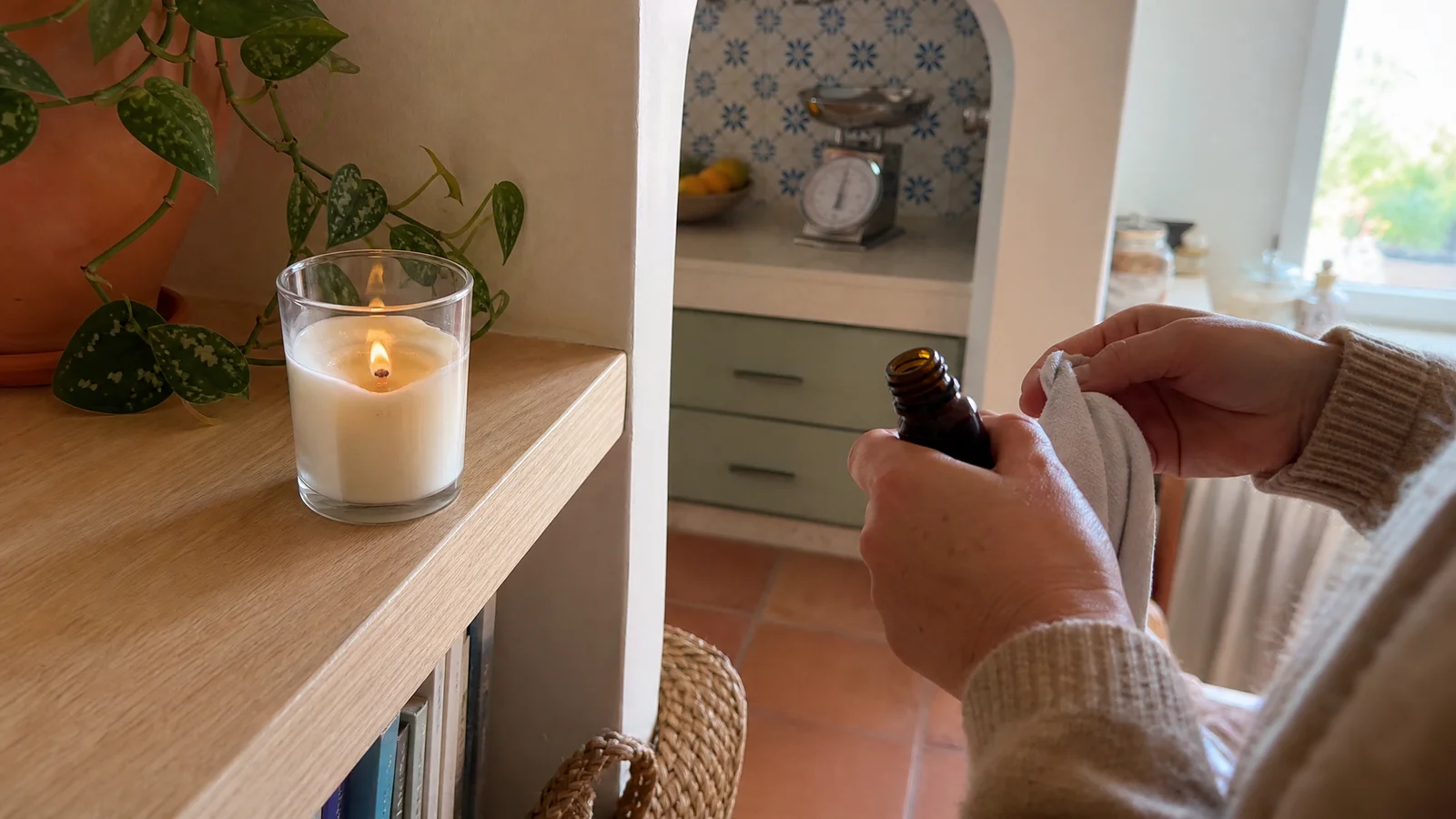
Why Your Birch Candle Has Weak Scent Throw: A Step-by-Step Fix
A birch candle with weak scent throw is usually a wick, melt-pool or timing problem before it is an oil problem, because methyl salicylate is detectable at very low concentrations: the compiled literature lists an odor threshold of 40 ppb in water. If you cannot smell a candle poured with a strong oil, something is stopping the oil leaving the wax. This page is a numbered diagnostic, in the order of cheapest check first, and it says where the evidence ends. Nothing here comes from a test of ours; the checks come from manufacturer sheets, supplier troubleshooting and arithmetic.
Step 0: say which throw is weak
Cold throw is the smell of the unlit candle; hot throw is the smell of the burning one. They fail for different reasons, so write down which one is weak and score it 0-5 at a fixed distance in a closed room. A candle with fine cold throw and no hot throw points to the wick and melt pool (steps 3 and 4). A candle with neither points to the oil quantity or timing (steps 1 and 2).
Step 1: confirm how much oil is in the wax
Weigh it back. At 4% of a 227 g wax fill the oil should be 9.1 g; at 2% it is 4.5 g. A drop-counted or volume-measured addition is the commonest way to end up at a fraction of the plan, and the AFI USA troubleshooting guide lists a load that does not match the wax among the causes of weak throw. If your intended load was 2%, the candle may simply be quiet by design: step up one rung of the 2-4-6% ladder in the candle making guide and change nothing else. Do not jump above 6%: no source tests methyl salicylate in wax, and extra fuel is a documented cause of sooting.
Step 2: check cure and test timing
Many weak-throw reports come from a smell test on day one. Cargill's soy sheet says to cool and cure at least 12 hours before handling, the generic soy sheet says test-burn after 48 hours, and Candle Science's paraffin lab note says fragrance was absorbed after 48 hours. Retailers often say one to two weeks, and no manufacturer sheet in our research says that. So do not wait two weeks on faith: score at day 2, day 7 and day 14. If the score rises between day 2 and day 14, cure was the issue for your wax; if it stays flat, move on.
One timing mistake can be found on the AFI USA page too: adding fragrance when the wax is too hot or too cool, and poor mixing, are on its list of causes. The old idea that oil above its flash point has "flashed off" is not supported by supplier sources; see flash point and load.
Step 3: look at the melt pool
The soy data sheet says burn pool size and depth greatly affect fragrance throw, and that too small a wick causes tunneling and a smaller flame. Candle Science's burn test says that at 3-4 hours the pool should reach within about 1/4 inch of the vessel edge, at a depth typically 1/4 to 1/2 inch. If your pool is smaller, the wax is not warm enough to release oil. Reasoning: methyl salicylate boils near 222 C with a vapor pressure of 0.0343 mmHg at 25 C, so it is not a flash-off top note; it leaves slowly and needs a warm, wide pool. Fix the wick using the wick guide before touching anything else.
Step 4: check the pairing of wax and oil
The soy sheet warns that some fragrances may react poorly with the wax, causing bleeding, objectionable surface finishes or poor flame quality, and says this is worse with fragrances designed for paraffin. For birch the question is not answered by any published test; that is why the split test in the wax comparison exists. If the same oil in a different wax throws, wax pairing was the cause.
Step 5: age and storage of the oil
PubChem records methyl salicylate as sensitive to light and heat, and heat is what a hot shelf in a workshop provides. Our bottles are amber glass and carry a still date, fill date and a lot reference; the product page says shelf life is typically 2 to 3 years kept tightly capped, cool and dark, and the published certificate shows a Best By of 06/02/2031 for its batch. Those two statements differ, and we have not reconciled them here. We have no data on how much methyl salicylate scent is lost over time, so we do not offer a loss figure. If the oil is old, sat on a hot shelf, or had a loose cap, check the dates on the bottle against when you bought it and test a newer lot beside it.
Step 6: purity, honestly
It is tempting to blame a weak candle on a diluted or synthetic oil. No source we located compares throw between natural and synthetic methyl salicylate, so the claim cannot be supported either way. What can be said is about paperwork. A 2022 survey of 27 commercial birch oils (by authors employed by a competing oil company) found none with the markers of genuine oil. Our published certificate lists density 1.183, refractive index 1.537 and optical rotation inactive; density sits inside the USP range for synthetic methyl salicylate (1.180-1.185) and neither refractive index nor optical rotation separates natural from synthetic, so it cannot settle origin. Per-lot methyl salicylate figures are available by request through contact; see the lab report guide for what to ask any supplier.
Decision list
- Cold throw weak and hot throw weak: check oil weight, then timing (steps 1 and 2).
- Cold fine, hot weak: check pool size and wick (step 3).
- Both fine in a test jar, weak in the sales vessel: the vessel diameter changed the wick and pool; re-wick for that vessel.
- Surface frosting or bleeding appears as you raise load: you are at the wax's limit; stop raising it and re-run the wax test (step 4).
- Nothing above moves it: ask whoever supplied the oil for lot figures, and test a second lot.
What this cannot tell you
This is a sourced explainer by the shop, not a lab report, and no chandler, chemist or safety professional has reviewed it. It does not cover sensitivity to the oil's own strong smell: if the candle gives you headaches, eye or throat irritation, stop burning it, because NOAA CAMEO describes the vapor mist as irritating to the eyes and airways. Ask a physician about persistent symptoms, and if you are pregnant ask before working with the undiluted oil.
Work through the steps in order, change one thing at a time and log the score each time. Most weak candles move at step 2 or step 3.
Birch Essential Oil
Birch Essential Oil from our own shop, in sizes from 1 oz to bulk.
From $15.99
Shop Now →Sources & Further Reading
- Leffingwell and Associates, n.d. Odor Thresholds (compiled literature values). leffingwell.com
- AFI USA (supplier), n.d. Why your candle scent isn't strong enough. afi-usa.com
- National Library of Medicine, PubChem record for methyl salicylate (CID 4133), accessed 2026. Flash point, boiling point, vapor pressure, GHS classification. pubchem.ncbi.nlm.nih.gov
- Dosoky NS, Poudel A, Satyal P, 2022. Authentication and Market Survey of Sweet Birch (Betula lenta L.) Essential Oil. Plants 11(16):2132. pmc.ncbi.nlm.nih.gov
- United States Pharmacopeia 32 / NF 27, 2009. Methyl Salicylate monograph (web mirror). drugfuture.com
- NOAA, CAMEO Chemicals datasheet, methyl salicylate, accessed 2026. cameochemicals.noaa.gov