Wax for Birch Oil Candles: Data Sheets and a Split Test
No published test ranks soy, coconut and paraffin for birch oil, and we have not run one, so any article that crowns a winner is working from other fragrances. What can be sourced is how the waxes differ in temperature, cure and fragrance handling on manufacturer and supplier sheets, and that is enough to design a three-wax split test you can run in a weekend. We do not sell wax and have no wax affiliate, so nothing here is steering you to a brand.
The sourced facts per wax, and the holes
Here is everything in our research that comes from a data sheet or a lab note rather than a forum post.
| Wax | Sourced handling data | What we could not source |
|---|---|---|
| Soy (Cargill NatureWax C-3/C-6) | Heat to 160-200 F (71-93 C); pour at 120-180 F (49-82 C) depending on room temperature; cool and cure at least 12 hours before handling (Cargill sheet) | The fragrance-addition and load text did not decode from the sheet |
| Soy (generic container wax) | Fragrance "up to 10-12%"; larger wicks than paraffin; test burn after 48 hours; some fragrances may cause bleeding or poor flame quality (supplier data sheet) | The issuer is not named in the document |
| Paraffin (IGI 1239 pillar and votive wax) | 3% recommended load; fragrance added at 190 F; pour 175-185 F; shrinkage at 24 hours; fragrance absorbed by 48 hours (Candle Science lab note) | This is a pillar wax, not a container wax; container paraffin sheets were not retrievable |
| Coconut blends | Nothing usable | No manufacturer sheet was retrievable; we give no figures |
| Beeswax | Nothing usable | Only retailer figures that disagree with each other; we give no figures |
The honest reading is that the sheets agree on one thing: wax is a system, and the load that works depends on the wax, wick, vessel and fragrance together. The soy sheet says each combination "must be tested for burn quality". Our load ladder for birch is in the candle making guide.
Claims we would not repeat
Three popular statements have weaker support than they sound.
- "Paraffin always throws better." The support we located is supplier opinion only. No peer-reviewed measurement of hot or cold throw by wax type turned up. The soy sheet notes that "burn pool size and depth greatly affect fragrance throw", which makes the wick and vessel as likely a cause as the wax.
- "Soy is the clean choice." A 2009 conference presentation by researchers at South Carolina State University argued paraffin candles emit more toluene, alkanes and alkenes than soy. The National Candle Association's 2017 response states that the data was not published or peer reviewed and that no scientific study has shown any candle wax to be harmful to human health. The NCA is an industry body, so weigh that accordingly; neither side has measured methyl salicylate.
- "Cure two weeks." Cargill's sheet says at least 12 hours, the generic soy sheet says 48 hours, and retailers say one to two weeks. The retailer figure has no manufacturer sheet behind it in what we read. This is the cheapest claim to test yourself, as the protocol below shows.
What is specific to birch in the wax choice
Reasoning from the facts, not from a test: methyl salicylate boils near 222 C and its vapor pressure is 0.0343 mmHg at 25 C, so it is a slow evaporator rather than a flash-off top note, and ScenTree classes it as a heart note. That favors a wax and wick pair that makes a full, hot melt pool, because a slow-evaporating oil needs warmth to leave the wax. It also means a wax that is slow to release at room temperature may give a quiet cold throw regardless of how much oil you add. No source tests this for methyl salicylate; treat it as the hypothesis your split test checks.
Wax melt temperatures matter as a safety issue too. At the top of the Cargill melt range, 93 C, the wax sits a few degrees under the 96 C closed-cup flash point of pure methyl salicylate, so add the oil with the heat off, as the flash point and load guide explains.
Run this split test (we have not run it)
This protocol gives you the throw table this page cannot. It uses arithmetic, a scale and a notebook.
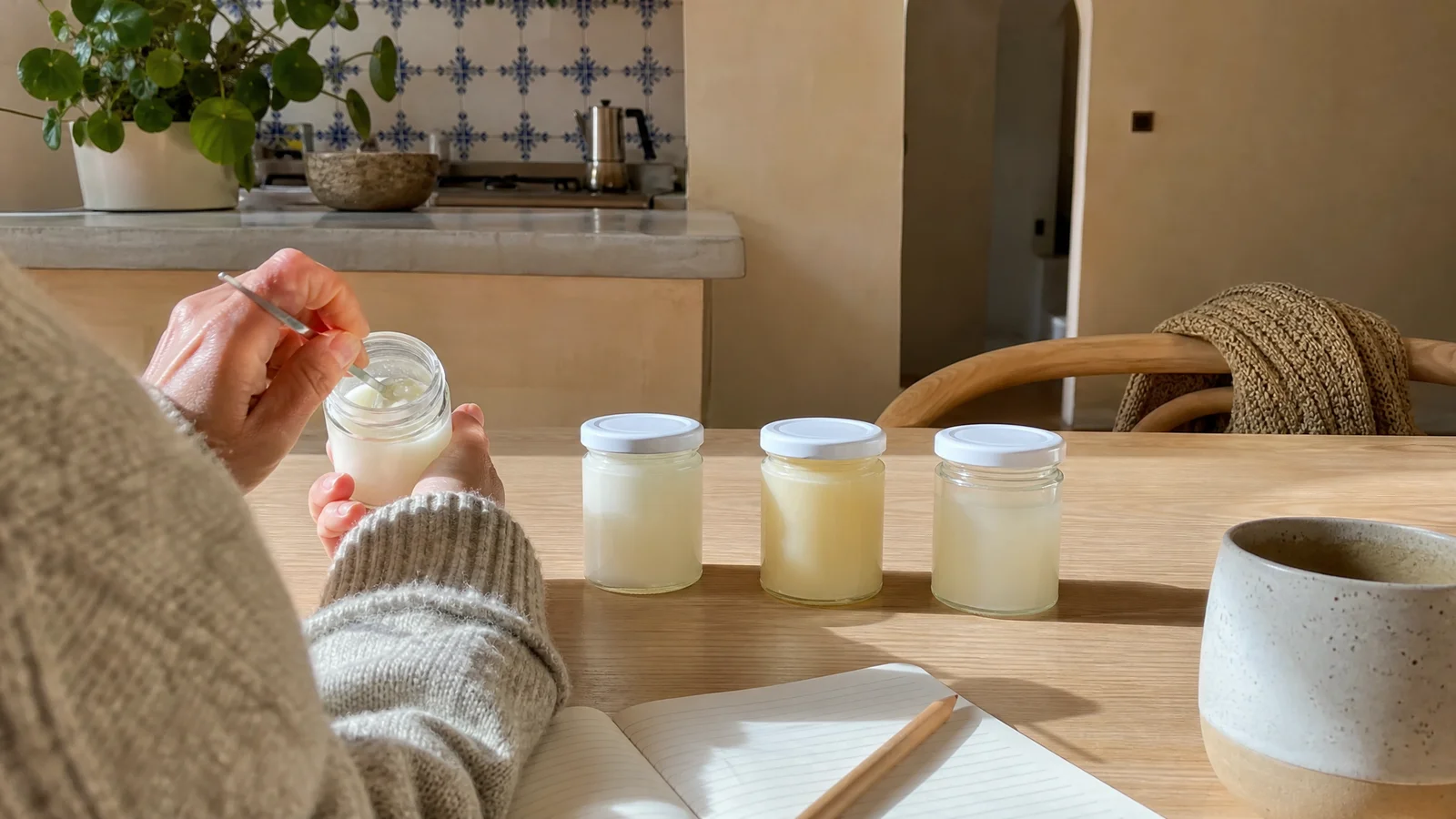
- Hold everything but wax constant. Same vessel, same wick type and size from your wick supplier's chart for each wax, same oil lot, same 4% load by weight (9.1 g of oil per 227 g wax fill).
- Follow each wax's own sheet for melt, oil addition and pour temperatures, and log the actual temperature at each step.
- Pour two candles per wax so one stays unlit for cold-throw checks. Cover and label by code, not by wax name, and have another person move them so you smell blind.
- Cold throw: sniff the unlit candle at 24 hours, 48 hours, 7 days and 14 days. Score 0-5 each time, with the same room and the lid off for ten seconds.
- Hot throw: burn the second candle for 3-4 hours, trim the wick to 1/4 inch first, and score at 1 hour and 3 hours in a closed room of known size. Record melt-pool edge distance, flame height and soot, following Candle Science's burn test procedure.
- Decide: a wax wins only if it beats the others on hot throw at 3 hours and shows no frosting, bleeding or sooting. If cold throw only rises between day 2 and day 14, the retailer lore is right for your wax; if it is flat from day 2, the manufacturer sheet is.
If your wicks are the variable, fix that first by reading the wick guide; if all three waxes are weak, go to the weak throw diagnostic before blaming wax.
Limits of this comparison
This is a sourced explainer by the shop, not a lab report, and no candle chemist or safety professional has looked at it. If you sell candles, a candle compliance consultant should review your labels and burn data. We sell birch oil only: no wax, wicks or jars, and no wax is endorsed here. Where a sheet printed a number, it is quoted; where it did not, we said so rather than fill the cell.
Pick the wax whose sheet you can read in full, log every temperature, and let your own three-candle table choose.
Birch Essential Oil
Birch Essential Oil from our own shop, in sizes from 1 oz to bulk.
From $15.99
Shop Now →Sources & Further Reading
- Cargill Industrial Specialties, 2016. NatureWax C-3 and C-6 Handling and Melting Instructions, Container Candles (reseller-hosted copy). cdn.shopify.com
- Soy Wax Container Technical Data Sheet v5.0, revised 26 August 2020 (supplier-issued, manufacturer not named in the document). cdn.shopify.com
- Candle Science (supplier), n.d. Lab Notes: IGI 1239 Paraffin Wax. candlescience.com
- National Candle Association, 2017. Response to Massoudi and Hamidi (SCSU, 2009 conference presentation). candles.org
- National Library of Medicine, PubChem record for methyl salicylate (CID 4133), accessed 2026. Flash point, boiling point, vapor pressure, GHS classification. pubchem.ncbi.nlm.nih.gov
- ScenTree, Methyl salicylate raw-material page, accessed 2026. scentree.co
- Candle Science (supplier), n.d. How to Conduct a Burn Test. candlescience.com