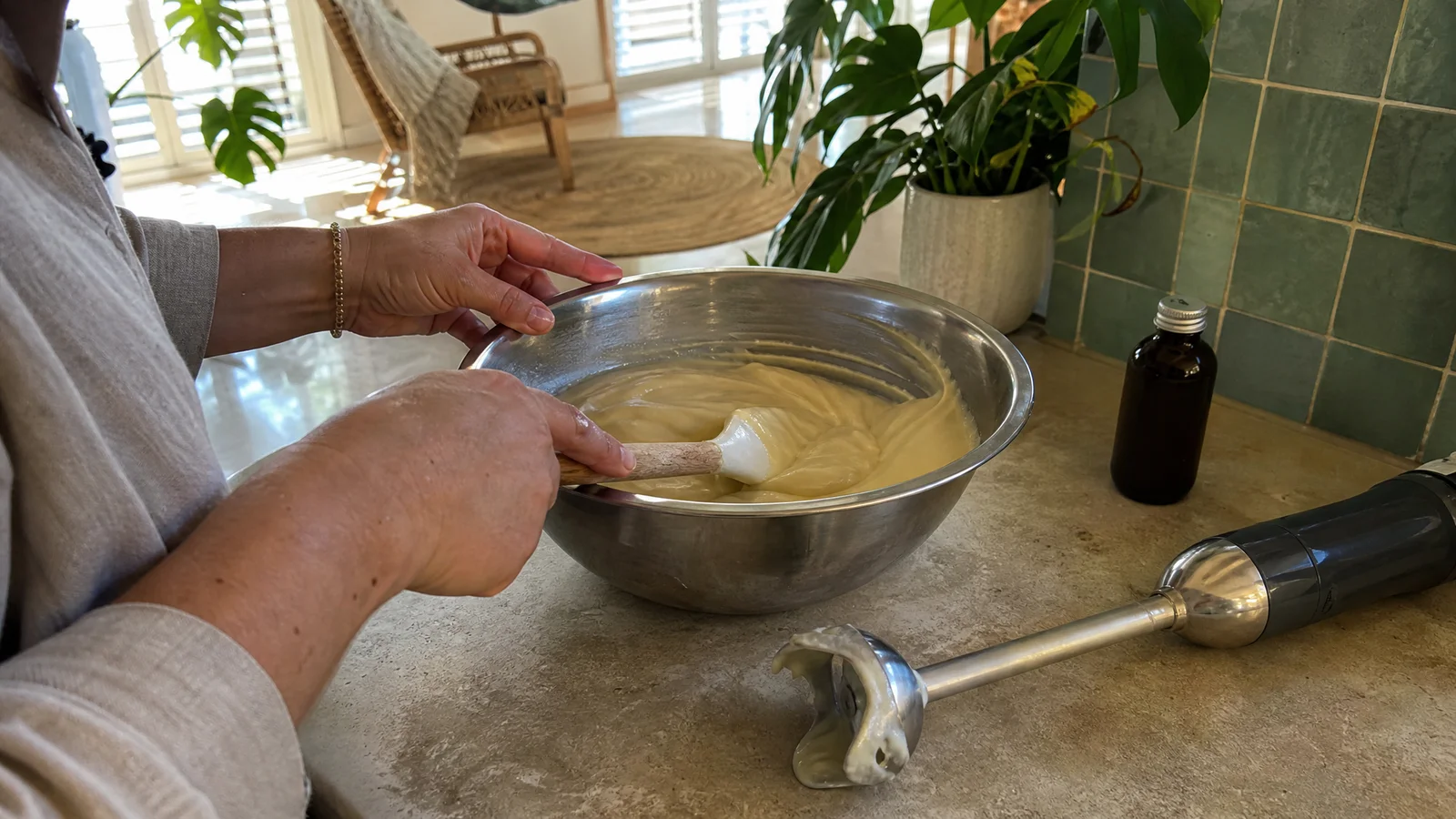
Does Birch Oil Speed Up Trace? What Sources Say, and a Test
No source we could find says that birch oil, wintergreen oil or methyl salicylate speeds up trace or browns soap. The accelerators that soap suppliers and educators actually name are clove and cinnamon oils, vanillin-heavy fragrance oils and some florals. We have not made soap with our oil, so this page reports what published sources say, adds arithmetic, and gives you a split-batch test to run yourself.
What the sources name as accelerators, and what they leave out
Soap Index calls eugenol and cinnamaldehyde "notoriously fast", pointing to clove and cinnamon oils, vanillin fragrance oils and floral fragrance oils such as rose and jasmine (Soap Index, 2026). The Soapery names cinnamon and clove and suggests mixing by spoon instead of a stick blender when using them (The Soapery). Wholesale Supplies Plus says acceleration, ricing, seizing and discoloration "come from the heat and the fragrance oil itself", and that browning "comes from vanillin" (Wholesale Supplies Plus, 2025).
None of those pages mentions wintergreen, birch or methyl salicylate. A forum thread titled about safe soap making with wintergreen exists, but we could not open it and cannot cite it. So "birch accelerates trace" is, on the evidence available, folklore: neither confirmed nor refuted. The claim that birch discolors soap deserves the same treatment. The Good Scents Company, a trade database and not a soap test, lists methyl salicylate as "non-discoloring in most media" (Good Scents). Modern Soapmaking says essential oils generally cause fewer color problems than fragrance oils (Modern Soapmaking).
The chemistry argument, and why the amount matters
There is one real chemical reason to ask the question. Methyl salicylate is an ester, and PubChem records that alkalis decompose it to methyl alcohol and salicylate (PubChem). A teaching-lab manual shows the reaction with 6 M sodium hydroxide, refluxed (Reed College), which is nothing like a cool batter. No source says how much happens in a cold process bar.
What you can do is bound it by arithmetic. Take the 500 g oil recipe on the cold process birch soap page: 74.35 g of lye covers all the oil, and 5% of that, 3.7 g or 0.093 mol, is the superfat buffer. Methyl salicylate is 152.15 g/mol (PubChem). Assume, as an upper bound, that every molecule consumes one sodium hydroxide:
| Birch oil in a 500 g oil batch | Moles | Share of the lye | Share of the 5% buffer |
|---|---|---|---|
| 0.37 g (0.05% of pour weight) | 0.0024 | 0.14% | 2.6% |
| 13 g (a high-load example) | 0.085 | 4.8% | 92% |
| 18.5 g (2.5% of pour weight) | 0.122 | 6.9% | 131% |
This is reasoning, not an observation. It says that at the recommended level the oil cannot move the lye balance. At the 13 g row it could, in theory, swallow most of the buffer. If a high-load birch bar felt harsh, the lye balance is a better suspect than trace speed.
A related myth: heat and "flashing off"
Soap makers often worry that gel-phase heat burns the scent away because an oil has a low flash point. Modern Soapmaking says gel-phase soap can reach 160, 180 or 200 F or higher, and that a flash point is a transport and storage safety figure, not the temperature at which scent leaves the bar. Its example is eucalyptus globulus, with a flash point of 118 to 120 F that still scents soap strongly (Modern Soapmaking). PubChem lists methyl salicylate's flash point at 205 F (96 C), closed cup (PubChem), while ScenTree gives 75 C, so sources differ. Neither figure tells you how much scent survives your batch.
Why a birch batch seized: a diagnostic order
If your batter thickened too fast, check these in order. They come from the supplier and educator pages above, not from birch-specific tests.
- The rest of the blend. Clove, cinnamon, cassia, vanillin fragrance oils, or a floral in the same jar is a better suspect than birch.
- Heat. Wholesale Supplies Plus says heat speeds each of these reactions; Soap Index suggests soaping at 70 to 80 F for fast fragrances.
- Your lye calculation. The same supplier lists an inaccurate lye calculation among the common causes of fast thickening (Wholesale Supplies Plus, 2026).
- Additives and blending. Over-blending to a thick trace before adding oil leaves no working time. Hand-stirring the oil in, as The Soapery advises for fast oils, costs nothing.
Run the split-batch test yourself
We have not run this test. It is a protocol, and a single pair of bars will not prove anything because batch-to-batch noise is large.
- Make one plain batch from the recipe and lye table, with no additives.
- At light trace, weigh the batter into two equal containers.
- Into one, stir half the table's birch amount for that batch. Into the other, stir in the same weight of olive oil, so both arms get the same added liquid.
- Hand-stir each for the same time. Write down batter temperature, and how thick each is at 5 minutes after you stop stirring.
- Pour into matching molds. Photograph both at 24 hours, 1 week and 4 weeks, the schedule Soap Index suggests.
- Repeat at least twice on separate days before you conclude anything.
Run it again at a higher rate only if you sell outside the EU and UK and have settled the limit question with a cosmetic chemist. The level math is in the dilution chart.
Questions soap makers ask
Why did my soap seize?
Supplier pages attribute seizing mainly to the fragrance oil and heat, with lye miscalculation also listed. Cinnamon, clove, vanillin and some floral oils are the named culprits. Check the other oils in your blend and your soaping temperature before blaming birch, which no source we reviewed names.
Does birch soap turn brown?
No source we reviewed says so. Browning is attributed to vanillin in fragrance oils. A trade database describes methyl salicylate as non-discoloring in most media, though it is not a soap test. Make a small split batch and photograph it over four weeks.
Does methyl salicylate survive lye?
Not fully, in principle: alkalis decompose the ester to methanol and a salicylate. No source says how much survives in a cold process bar, so no percentage can be given. Expect a faint scent and judge by your own cured bars.
This is a sourced explainer by the shop, not individual medical advice, and it has not had a clinician's review. Our wider guide is birch essential oil for soap making, and a melt and pour version sidesteps lye entirely.
Birch Essential Oil
Birch Essential Oil from our own shop, in sizes from 1 oz to bulk.
From $15.99
Shop Now →Sources & Further Reading
- ScenTree. Methyl salicylate. scentree.co
- Soap Index, 2026. Fragrance and Essential Oils: Usage Rates. soapindex.com
- The Soapery. Essential Oils for Soap Making. thesoapery.co.uk
- Wholesale Supplies Plus, 2025. Using Fragrance in Cold Process Soap. wholesalesuppliesplus.com
- Wholesale Supplies Plus, 2026. Saponification: How Soap Actually Works. wholesalesuppliesplus.com
- The Good Scents Company. Methyl salicylate (119-36-8). thegoodscentscompany.com
- Modern Soapmaking. What You Need to Know About Using Essential Oils When You Make Soap. modernsoapmaking.com
- NIH/NLM, 2026. PubChem: Methyl salicylate (CID 4133). pubchem.ncbi.nlm.nih.gov
- Reed College Chemistry 201/202 Lab Reference Manual. Saponification of methyl salicylate. blogs.reed.edu