Melt and Pour Birch Soap: A Recipe Scaled to the Legal Limit
Melt and pour is the easiest way to make birch soap, but it does not get around the scent limit. The base has already been saponified, so you never handle lye, yet methyl salicylate in a rinse-off bar is capped at 0.06% in the EU and UK. That works out to a fraction of a gram of oil per pound of base, far below the 3% usage rate suppliers print for ordinary fragrance oils.
The usual rate is 60 times too high for this oil
Wholesale Supplies Plus gives 3% as the standard fragrance and essential oil rate for melt and pour, added "right before you pour, at a temperature below 140 F", and says the IFRA rate overrides the product rate (Wholesale Supplies Plus). Bulk Apothecary uses a different yardstick, no more than 1 oz of fragrance oil per pound of base (Bulk Apothecary, 2025). Aussie Soap Supplies caps potent oils such as peppermint at 1.5% (Aussie Soap Supplies).
None of these figures was set for methyl salicylate. IFRA has no standard for it in the 51st Amendment index (IFRA, 2024), so "the IFRA rate" gives you nothing to follow. What does bind is EU Annex III entry 324 at 0.06% for rinse-off skin products (Regulation 2023/1545), mirrored in Great Britain by SI 2025/413 (SI 2025/413). Sweet birch oil is 93.24% to 99.84% methyl salicylate (Dosoky et al., 2022), so treat it as 100%. At 3%, the supplier rate is 60 times 0.05% (arithmetic). A base maker's own limit can only lower your ceiling, so check its sheet.
Birch oil per batch
This table uses 0.05% of base weight, the same margin as on the cold process page, with the 3% supplier rate beside it for contrast. The 3% column is not a recommendation.
| Melt and pour base | Birch oil at 0.05% | Generic 3% rate |
|---|---|---|
| 250 g | 0.12 g | 8 g |
| 500 g | 0.25 g | 15 g |
| 1000 g | 0.50 g | 30 g |
| 2000 g | 1.00 g | 60 g |
For 500 g of base that is 0.25 g, which needs a scale reading to 0.01 g. If you only have a 1 g scale, melt 1,000 g of base for 0.5 g, or stir the oil into a small weighed amount of melted base and fold that into the rest. The first batch will teach you the scale before it teaches you the scent.
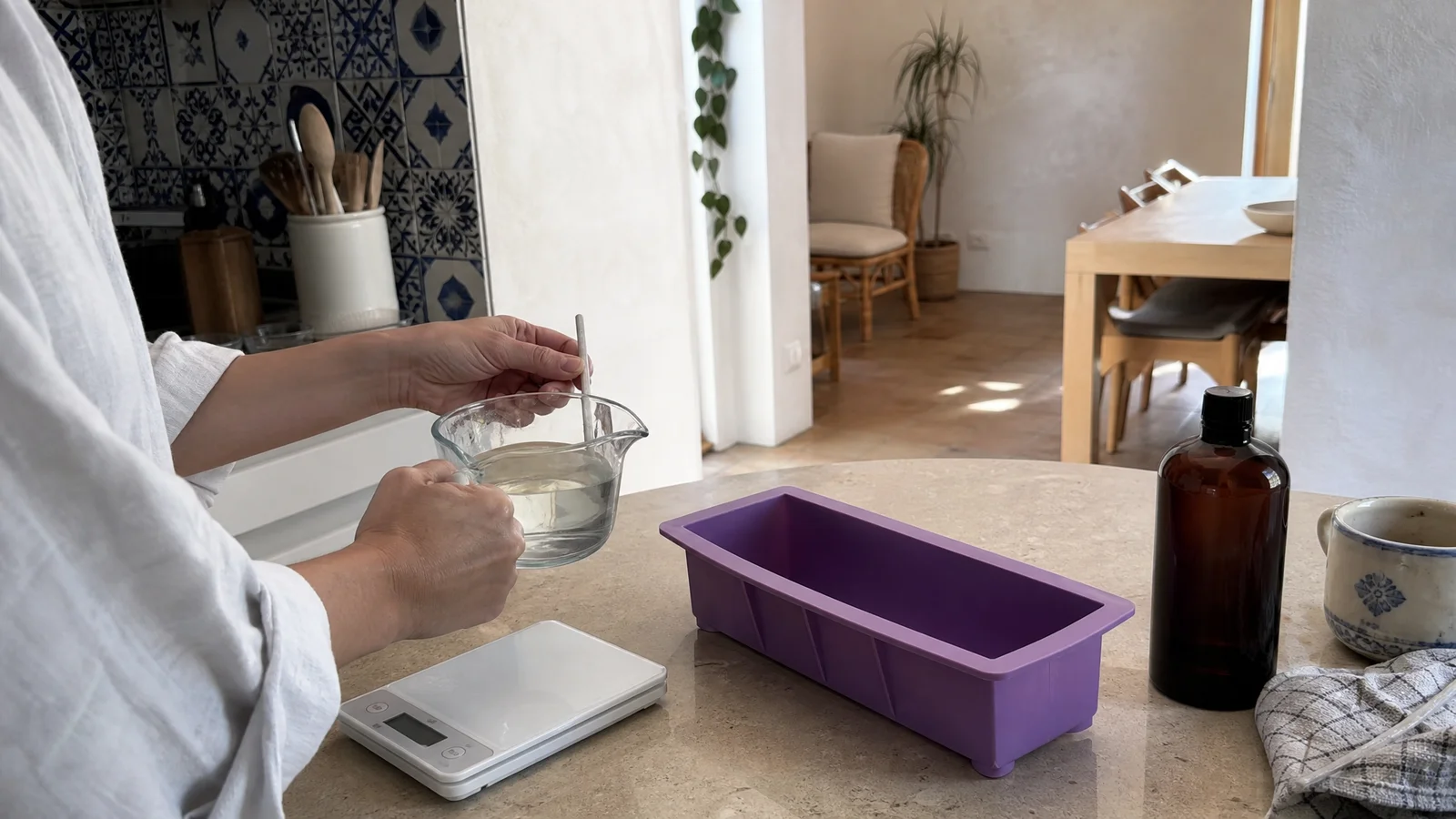
Make it
- Cut the base into small cubes and weigh it. Melt gently, in short bursts or over a water bath. Aussie Soap Supplies puts the best melt temperature at 55 to 65 C depending on the base, and says overheating causes sweating (Aussie Soap Supplies).
- Take the base off the heat. Weigh the birch oil on the 0.01 g scale in a small cup.
- Check that the base is below 140 F, then stir the oil in right before pouring, as the supplier above advises.
- Pour into a silicone mold. Let it set undisturbed.
- Unmold and wrap soon. The beads on glycerin bars are not sweat but moisture taken from the air, per Aussie Soap Supplies, which is why wrapping soon after setting helps.
Use a plain, uncolored base for the first run. Wholesale Supplies Plus notes that some essential oils tint a base and that vanilla fragrance oils can turn it cream to dark brown. It does not mention birch, and The Good Scents Company lists methyl salicylate as "non-discoloring in most media" (Good Scents), a trade database rather than a soap test. This soap has not been made by the shop, so watch your own first bar.
Why this is the beginner route, and where it stops
A supplier describes melt and pour as a base that lets you add fragrance, botanicals and color "without having to actually make the soap from the ground up" (Bulk Apothecary), and Wholesale Supplies Plus says the base maker already completed the lye reaction (Wholesale Supplies Plus, 2026). Both are suppliers, so read it as their view. The honest limit for birch is that being lye-free does not change methyl salicylate's rules, and a 0.05% bar will smell faint. A bar scented more strongly than the limit allows is not a beginner project.
On quantity, a 1 oz bottle is 28.35 g if "oz" means weight, enough for 113 batches of 500 g base at 0.25 g each (28.35 / 0.25). If the ounce is fluid, 29.57 mL x 1.183 g/mL is about 35 g, or 140 batches. We have not stated which ounce our sizes use, so check the label or ask. The smallest size is the right first order, and the shop's larger sizes are for production.
Who should skip it
Do not make birch soap for children, and do not use it in pregnancy or breastfeeding, if you take anticoagulants, or if you are sensitive to aspirin. That is our stated position on the origin page. The Tisserand Institute says the same and adds a caution about Reye's syndrome (Tisserand Institute). The EU entry bars the substance in preparations for children under 6. Anything sold in the EU must list methyl salicylate on the label above 0.01% in rinse-off products, and 0.05% exceeds that. Whether a melt and pour bar legally counts as "soap" or as a cosmetic in the US depends on what the base contains and how you label it (FDA); ask a regulatory consultant before selling.
This is a sourced explainer by the shop, not individual medical advice, and has not had a clinician's review. Ask a pharmacist or physician about your own situation. See the dilution chart, the full soap making guide and why trace is not the issue with birch.
The short version: weigh the oil in hundredths of a gram, keep the base below 140 F when it goes in, and let the first bar tell you what 0.05% smells like.
Birch Essential Oil
Birch Essential Oil from our own shop, in sizes from 1 oz to bulk.
From $15.99
Shop Now →Sources & Further Reading
- Wholesale Supplies Plus. Getting Started: Scenting MP Soap Base. wholesalesuppliesplus.com
- Bulk Apothecary, 2025. Melt and Pour Soap FAQs. blog.bulkapothecary.com
- Aussie Soap Supplies. Melt & Pour Soap FAQ. aussiesoapsupplies.com.au
- IFRA, 2024. The complete IFRA Standards up to and including the 51st Amendment (index). ifrafragrance.org
- Commission Regulation (EU) 2023/1545, 2023. Annex III entry 324, methyl salicylate. lawplayer.com
- UK Government, 2025. The Cosmetic Products (Restriction of Chemical Substances) Regulations 2025, SI 2025/413. legislation.gov.uk
- Dosoky NS, Poudel A, Satyal P, 2022. Authentication and Market Survey of Sweet Birch (Betula lenta L.) Essential Oil. Plants 11(16):2132. pmc.ncbi.nlm.nih.gov
- The Good Scents Company. Methyl salicylate (119-36-8). thegoodscentscompany.com
- Wholesale Supplies Plus, 2026. Saponification: How Soap Actually Works. wholesalesuppliesplus.com
- Tisserand Institute (Robert Tisserand), n.d. Methyl Salicylate: Essential Oil Constituents in Food Part 5. tisserandinstitute.org
- US FDA. Is It a Cosmetic, a Drug, or Both? (Or Is It Soap?). fda.gov