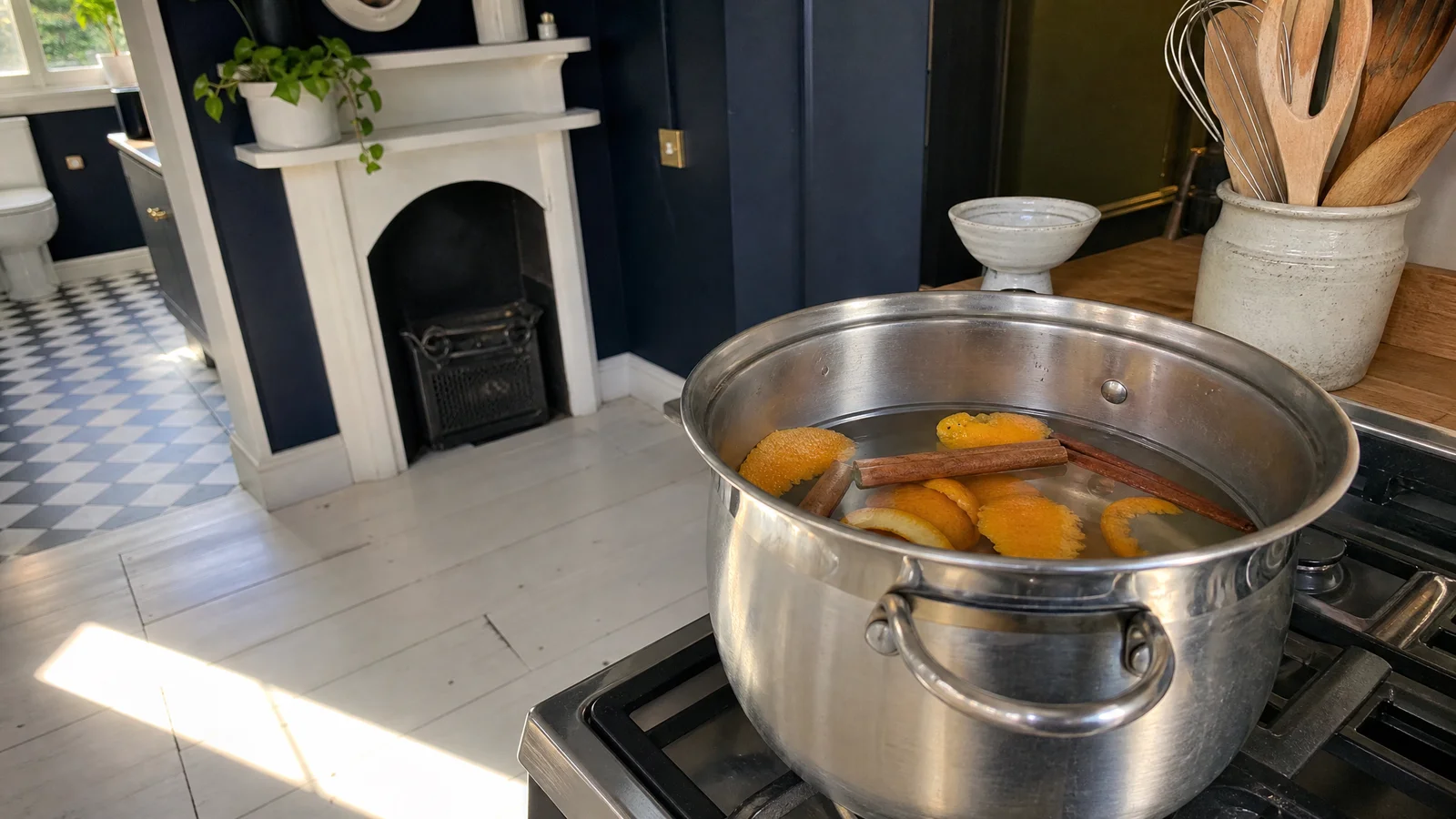
Birch Oil Simmer Pots: Why We Would Not Heat It in a Food Pot
We would not put birch essential oil in a simmer pot, and we are not publishing a recipe for one. Heat turns a liquid that is dangerous to swallow in small amounts into a steady vapor in a kitchen, the pot is a food vessel, and the temperature of a simmer sits inside the range of published flash points for the oil's main compound. That is our conclusion from the sources below; it is not a statement from a fire department or poison center, because none we located addresses the question.
What exists and what does not
We looked for a statement from a fire service, a poison center or a food-safety body about essential oils in stovetop simmer pots and did not find one. Searches surfaced only material about appliance faults and candle-heated potpourri dishes, which is a different hazard from oil on a stove, so we do not rely on it. We have no test pots, burn tests or photos of our own. What is left is the oil's own properties, and those are well documented.
Heat, steam and the kitchen air
Methyl salicylate, which makes up 93.24-99.84% of authentic sweet birch oil according to Dosoky and colleagues in 2022, boils at about 220-224 C, and its vapor pressure is 0.0343 mmHg at 25 C, according to PubChem's compilation of reference data. We have no published value at simmer temperature. What follows is reasoning: heat raises vapor pressure, and a pot at a simmer delivers that vapor for as long as it is on.
There is a sharper point. The same Dosoky paper made its authentic oil by hydro-distilling bark in water. A simmer pot with birch oil in it is a small still: water boils, steam carries the oil's vapor out of the pot, and nobody collects it. In a distillery that is the goal; in a kitchen it is the dose, and the person at the stove does not control it. The NOAA CAMEO datasheet for methyl salicylate says its vapor mist is irritating to the eyes, mucous membranes, upper respiratory tract and skin, and the ILO and WHO chemical safety card says that no indication can be given of how quickly a harmful air concentration is reached. There is no airborne number to design a recipe around.
A simmer is close to the flash point
Three sources disagree on the flash point of methyl salicylate. PubChem lists 205 F (96 C) closed cup from the NFPA guide and 101 C from the chemical safety card, and ScenTree gives 75 C. Water at a simmer is at or near 100 C. The flash point of the pure compound is not the flash point of our oil, which no source states, and we publish no safety data sheet; you can ask what we can provide through the contact page.
The fire picture is therefore mixed, and we will not overstate it. CAMEO calls the compound combustible, rates NFPA flammability 1 and says it must be preheated before ignition can occur, with an autoignition temperature of 847 F. A pot with water in it stays near 100 C. The risk rises when a pot boils dry or oil spatters toward a flame. The Consumer Council of Hong Kong's 2000 vaporiser alert tells people to put out the flame before adding oil to a vaporiser and to keep them from paper and cloth; its premise is that most essential oils have flash points below 60 C, which does not describe birch oil, but the advice about adding oil near a live flame is the sensible one to carry over. A gas burner is a live flame. Reasoning from all of this, fire is not our main objection, and it is a reason not to count on a margin.
A food pot and a swallowing hazard
This is the heart of it. Our oil is not a food or flavoring product and is never for internal use, and we keep oil bottles out of food contexts. A pot that cooks food is also a vessel a child can reach and a person can sip from. The CPSC requires child-resistant packaging for liquids with more than 5% methyl salicylate by weight (16 CFR 1700.14). Botma and colleagues in 2001 equated one teaspoon (5 mL) of oil of wintergreen to about 21.7 adult aspirin tablets, and a 2007 poison-center consensus guideline says more than a lick or taste of oil of wintergreen by a child under 6 warrants referral to an emergency department.
Here is arithmetic, with assumptions stated. At about 0.05 mL per drop, 3 drops in a liter of water is 0.15 mL, or roughly 0.18 g, and about 0.04 g in a 240 mL cup if it mixes evenly. That is about three-quarters of a drop of oil per cup, which is the same order as the "lick or taste" that the guideline does not quantify. The published water solubility is about 0.7 g per liter at 30 C, so at these amounts the oil could dissolve rather than float, and the cup number holds only if it mixes fully. As the pot boils down, the oil that remains is in less water, so later cups could be stronger; steam also carries some oil off, and we cannot say how much. This is a sketch, not a safety finding. It is why we do not treat a dilute pot as safe.
The oil also leaves a trace on the cookware. We have no source on how well methyl salicylate rinses out of a pot, and "wash it well" is not a standard we can verify. Poison Control's guidance for children and pets is to lock essential oils up and, if there are young children, to consider discarding them; a bottle on the counter beside a pot is the opposite of that.
People and animals around the stove
Everything here is a sourced explainer by the shop, not medical or veterinary advice, and no clinician has reviewed it. For the home, ask a physician, pharmacist or veterinarian. The pet sources, such as the Merck Veterinary Manual, say wintergreen and birch oils can produce aspirin toxicosis, and ASPCA Pro advises not using an essential oil diffuser where birds live. Neither addresses a stovetop, so pet exposure from a simmer pot is extrapolation, and the kitchen, where animals often wander, is a poor place to rely on it. Our own site's stance applies to the whole household: not for people who are pregnant or breastfeeding, who take anticoagulants, or who are sensitive to aspirin. For the broader picture, see the safety guide and the pets piece.
What we would do instead
- If you want birch scent in a room: use an ultrasonic diffuser at 2-4 drops per 100 mL tank with the ventilation and household limits in the diffusing guide, and see winter blends for building one.
- If you want the stovetop ritual: simmer the food ingredients alone, such as orange peel and cinnamon sticks, with no oil in the pot, and keep the oil bottle out of the kitchen.
- If a recipe elsewhere says to add birch or wintergreen oil to a pot: skip that line. We know of no source showing it is safe.
- If someone swallows from a pot or the bottle: call Poison Help at 1-800-222-1222 or use poison.org, and call 911 if the person collapses, has a seizure or trouble breathing. Do not induce vomiting.
Our oil is not the answer to a simmer pot. It is a concentrated, undiluted craft material, and a pot of steaming water is one use where we would rather you chose another scent.
Birch Essential Oil
Birch Essential Oil from our own shop, in sizes from 1 oz to bulk.
From $15.99
Shop Now →Sources & Further Reading
- Dosoky NS, Poudel A, Satyal P, 2022. Authentication and Market Survey of Sweet Birch (Betula lenta L.) Essential Oil. Plants 11(16):2132. pmc.ncbi.nlm.nih.gov
- National Library of Medicine. PubChem, methyl salicylate (CID 4133), including HSDB and ILO-WHO ICSC data. pubchem.ncbi.nlm.nih.gov
- NOAA. CAMEO Chemicals datasheet, methyl salicylate. cameochemicals.noaa.gov
- ScenTree. Methyl salicylate. scentree.co
- Consumer Council (Hong Kong), 2000. Consumer alert on essential oils and vaporisers. consumer.org.hk
- US Consumer Product Safety Commission. 16 CFR 1700.14, Substances requiring special packaging. law.cornell.edu
- Botma M, Colquhoun-Flannery W, Leighton S, 2001. Laryngeal oedema caused by accidental ingestion of Oil of Wintergreen. Int J Pediatr Otorhinolaryngol 58(3):229-32. pubmed.ncbi.nlm.nih.gov
- Chyka PA, Erdman AR, Christianson G, et al, 2007. Salicylate poisoning: an evidence-based consensus guideline for out-of-hospital management. Clin Toxicol 45(2):95-131. pubmed.ncbi.nlm.nih.gov
- Merck Veterinary Manual, 2025. Toxicoses From Essential Oils in Animals. merckvetmanual.com
- ASPCApro. Are Essential Oils Dangerous to Pets? aspcapro.org
- Poison Control (National Capital Poison Center). Essential oils: poisonous when misused. poison.org