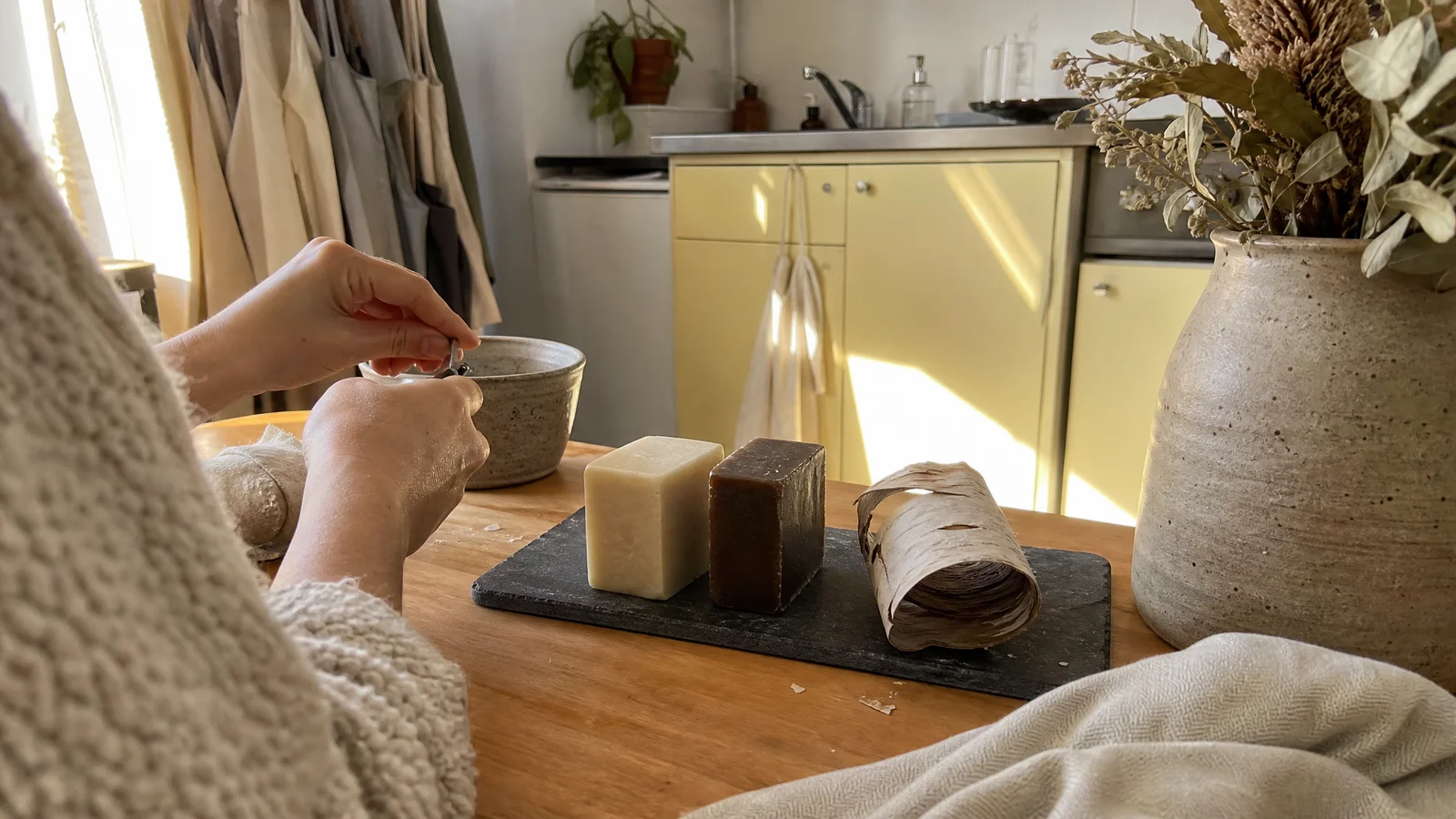
Birch Tar Soap vs Sweet Birch Soap: Two Different Oils
Birch tar soap and sweet birch soap are not two strengths of one idea. They start from different materials, made by different processes, with different chemistry and different rules. We sell only sweet birch essential oil (Betula lenta). We do not sell birch tar, so this page compares them from published sources and does not steer you to us for tar.
Start with what is in the bottle
Sweet birch oil is steam-distilled from bark and twigs and is almost all methyl salicylate: 93.24% to 99.84% across 21 authentic samples in a 2022 survey by researchers at a competing oil company (Dosoky et al., 2022). Birch tar oil comes from dry distillation, which heats bark or wood in an oxygen-poor setting (the birch tar oil article on this site covers the process). A chemical data entry for rectified birch tar oil lists phenol, cresol, xylenol, guaiacol, creosol and pyrocatechol, and no methyl salicylate (drugfuture.com).
| Question | Sweet birch oil (Betula lenta) | Rectified birch tar oil |
|---|---|---|
| How it is made | Steam distillation of bark and twigs | Dry (destructive) distillation, then rectification |
| Main constituents | Methyl salicylate, 93.24% to 99.84% | Phenols and related compounds; no methyl salicylate listed |
| Density | 1.183 on our COA; 1.184 at 25 C in PubChem | 0.886 to 0.950 (specific gravity) |
| Main trees named | Betula lenta, eastern North America | Often Betula pendula or B. pubescens (a commercial birch tar soap names B. pendula twig oil) |
| IFRA | No standard for methyl salicylate in the 51st Amendment index | "Birch wood pyrolysate" is an index entry marked prohibition/specification (2013) |
| Soap-relevant limit | EU/UK cosmetic entry 324: 0.06% in rinse-off products | Not entry 324; read the IFRA standard text for your product |
The legal frames differ, and that decides a lot
For sweet birch, the number is the cosmetic limit. EU Annex III entry 324 sets 0.06% methyl salicylate in rinse-off skin products (Regulation 2023/1545), and Great Britain's SI 2025/413 does the same for adults (SI 2025/413). Our own recipe uses 0.05% of pour weight, covered on the cold process birch soap page.
Birch tar sits under a different rule. The IFRA 51st Amendment index lists "Birch wood pyrolysate" as a Prohibition/Specification entry from 2013 (IFRA, 2024). We could not open the standard text for this page, so we do not repeat its limits. The label "specification" means conditions attach to the material, and a supplier's claim that tar is fine to use needs checking against that text. Wording on supplier pages has varied, which is a reason to read the standard itself.
None of this is legal advice. If you sell soap, a regulatory consultant or attorney who knows your market should read these entries.
How the soap behaves, from what is published
The shop has produced neither bar, and no source located compares them. What exists is a product page for a clear birch tar soap from a German maker: coconut and olive oil base, sodium olivate and sodium cocoate on the label, birch tar oil at roughly 1%, from Betula pendula, with "Betula pendula twig oil" in the ingredient list (Manufactum, Klar Seifen). It is a retailer's marketing page, and we cite it only for the formulation facts. Note the contrast: about 1% of tar oil there, against a methyl salicylate ceiling of 0.06% for sweet birch. The levels do not transfer between the two materials because the limits come from different places (reasoning).
Scent is the obvious difference, and tar is usually described as smoky and leathery. We have no primary source that measures that, so read it as description, not data. Methyl salicylate's record in PubChem is a liquid with "the characteristic odor of wintergreen" (PubChem).
Which are you buying? A kitchen check
Because the two oils differ so much in density, a scale tells them apart. Draw exactly 10 mL into a syringe and weigh it on a 0.01 g scale. Sweet birch oil at about 1.18 g/mL should weigh near 11.8 g. Rectified tar oil at 0.886 to 0.950 should weigh 8.9 to 9.5 g. This is arithmetic from the figures above, not a certification, and it cannot tell natural from synthetic methyl salicylate, which sit in nearly the same density range (see how to read birch oil lab reports). Wear gloves and keep both away from eyes, children and pets.
What our own paperwork can and cannot say here
Our published COA lists a relative density of 1.183 at 20 C, a refractive index of 1.537 and optical rotation reported as optically inactive. Those readings are plainly not a tar oil, whose density is far lower. They do not prove the oil is natural, because synthetic methyl salicylate has nearly the same constants; the owner states that per-batch independent analysis, including isotope and profile work, covers that question, and the methyl salicylate figure for any lot is available on request through our contact page. That is a statement of what the shop says it holds, not something the COA itself shows.
What we would do if you asked us
- Decide which scent you want first. A wintergreen bar means sweet birch, kept to the legal rate. A smoky bar means tar, from a supplier we cannot recommend.
- For tar, ask the supplier for the Latin name of the tree, whether the oil is rectified, density, and polycyclic aromatic hydrocarbon (PAH) data, then read the IFRA entry.
- For sweet birch, start with the smallest bottle. At 0.37 g per 500 g batch, a bottle goes a long way.
- Do not blend the two in one bar to get both notes without checking each limit separately.
This comparison does not support blending tar oil into a sweet birch bar without checking each limit separately. For more on the trees and the third "birch" oil, see white birch vs sweet birch oil and the broader soap making guide. This is a sourced explainer by the shop, not a clinician's review or medical advice; ask a toxicologist or physician about skin and exposure questions.
In short, pick the material for the scent you want and the rule you can meet, since the two oils share a tree genus and little else.
Birch Essential Oil
Birch Essential Oil from our own shop, in sizes from 1 oz to bulk.
From $15.99
Shop Now →Sources & Further Reading
- Dosoky NS, Poudel A, Satyal P, 2022. Authentication and Market Survey of Sweet Birch (Betula lenta L.) Essential Oil. Plants 11(16):2132. pmc.ncbi.nlm.nih.gov
- drugfuture.com chemical data. Birch Tar Oil, Rectified. drugfuture.com
- Commission Regulation (EU) 2023/1545, 2023. Annex III entry 324, methyl salicylate. lawplayer.com
- UK Government, 2025. The Cosmetic Products (Restriction of Chemical Substances) Regulations 2025, SI 2025/413. legislation.gov.uk
- IFRA, 2024. The complete IFRA Standards up to and including the 51st Amendment (index). ifrafragrance.org
- Manufactum, product page for a clear birch tar soap (Klar Seifen). manufactum.com
- NIH/NLM, 2026. PubChem: Methyl salicylate (CID 4133). pubchem.ncbi.nlm.nih.gov