How to Tame Birch: A Dilution Ladder for a Dominant Note
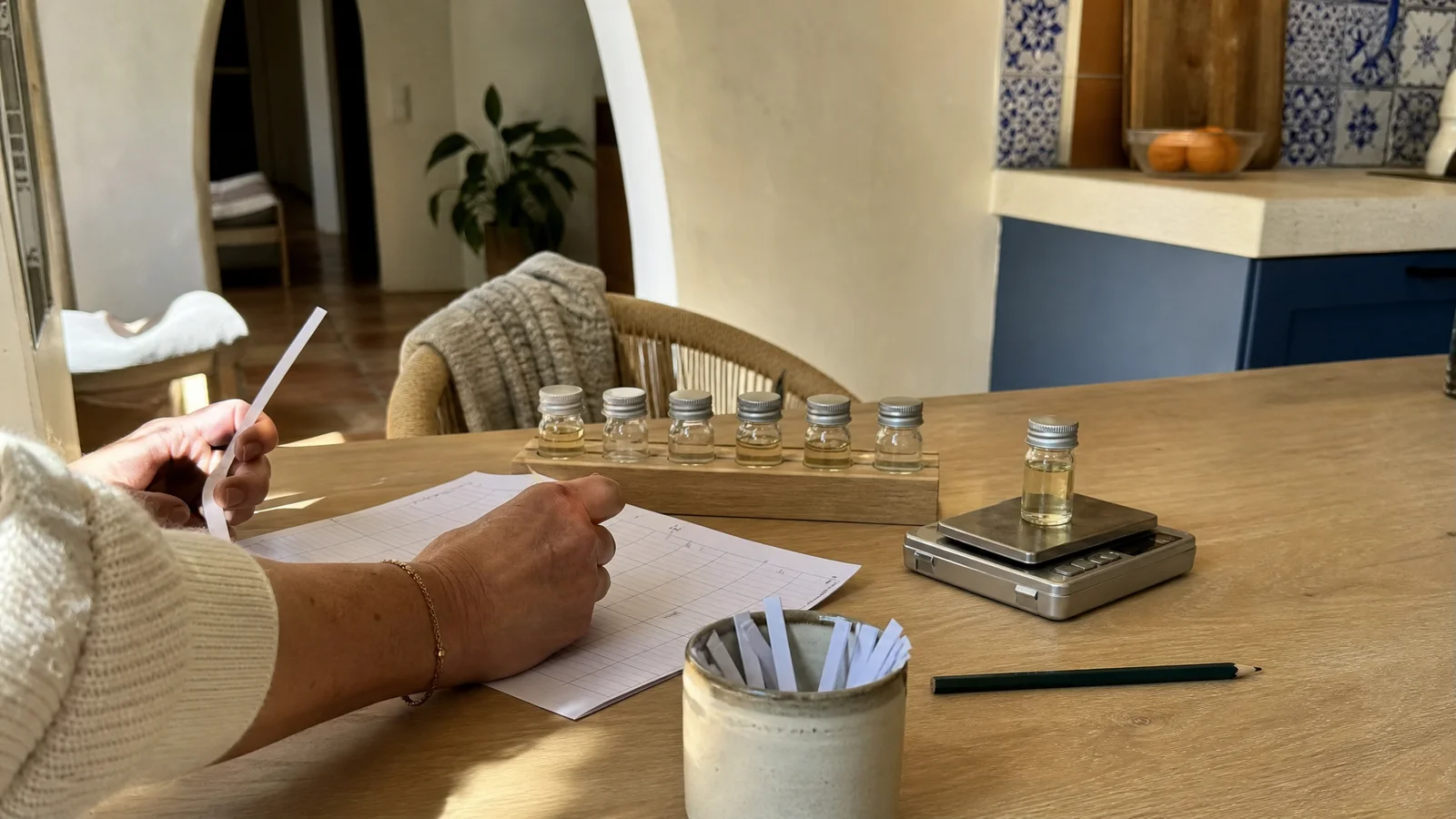
When birch takes over a blend, the usual advice is to add something sweeter to cover it. A better fix is to find the dose at which birch stops being the first thing you smell, and that takes a dilution ladder, five or six small vials of the same blend with birch stepped up in measured grams. The ladder below is built from sourced limits and arithmetic, and we have not run it ourselves, so treat the decision rule at the end as a starting point for your own notes.
Find the cause first: is birch too loud, or is the rest too quiet?
Work through this before you touch a dropper. Each step costs a blotter.
- Smell the blend without birch. Make a control with the same ingredients and a matching weight of diluent in place of the birch. If the control is already thin, the problem is a weak frame, not a loud birch.
- Smell the full blend at 20 minutes, not at once. A candle supplier notes that middle notes can take 10 to 20 minutes to fully develop on a blotter (CandleScience), and ScenTree classes methyl salicylate as a heart note (ScenTree). A blend judged at ten seconds is judged on its top.
- Rest your nose. A 2017 review found that habituation to odors "is relatively fast" (Pellegrino et al., 2017). If you have been sniffing for several minutes and keep adding birch because you cannot smell it, stop and come back later.
- Check the dose against the limit. If the birch exceeds the cosmetic cap for your product (below), the answer is to cut it, whatever it smells like.
If the control is fine and birch still leads at 20 minutes with a rested nose, birch is too loud. Continue.
Why this oil dominates
Three facts from the references explain it. A compilation of odor thresholds lists methyl salicylate at 40 parts per billion in water (Leffingwell and Associates), a water measurement and not an air one, but in line with ScenTree's description of it as "a very powerful compound" needing "a very low dilution." Authentic sweet birch oil is 93.24% to 99.84% methyl salicylate (Dosoky, Poudel and Satyal, 2022), so there is no weaker material hiding in the bottle. And the Good Scents Company recommends smelling methyl salicylate "in a 10.00 % solution or less," which suggests the neat material is too strong to judge by smell (Good Scents Company). Dose is the lever; the pairing comes second (see the pairing map).
Set your ceiling before you build the ladder
The top rung of the ladder is the legal and safety cap for your product, and nothing goes above it. There is no IFRA Standard for methyl salicylate through the 51st Amendment (IFRA, 2024), so there is no IFRA number to use. The limits that exist are cosmetic law: 0.06% in leave-on and rinse-off skin products and 0.6% in hydroalcoholic fragrance and in hand wash in the EU and UK (Regulation (EU) 2023/1545, SI 2025/413). In the US we could find no numeric cosmetic rule. The Tisserand Institute gives a topical maximum of 2.5% for sweet birch (Tisserand Institute), roughly 40 times the EU skin figure. For a product you sell, use the lower. Candles and room scents are not cosmetics and are covered in their own guides. The dilution chart tabulates the caps by use.
Build the ladder
Everything is weighed in grams on a scale. Droppers are not precise enough at these doses, and the numbers below are arithmetic assuming the oil is 100% methyl salicylate, the conservative end of Dosoky's range.
- Make a 10% stock. Weigh 1.00 g of birch oil into 9.00 g of the diluent your finished product uses (dipropylene glycol is the diluent in the 10% description on Good Scents; methyl salicylate is miscible with alcohol per PubChem). Label it. For a 0.06% cap, make a 1% stock by weighing 1.00 g of the 10% stock into 9.00 g more diluent.
- Prepare the base blend, every ingredient except birch, in a quantity large enough for all vials.
- Fill six vials to 20.00 g each. Weigh the stock into each vial first, then top up with base blend to a total of 20.00 g. Vial 0 is the control and gets the highest rung's weight of plain diluent instead of stock, so the diluent is not a variable.
| Rung (share of your cap) | Cap 0.6%: oil in finished blend | Cap 0.6%: g of 10% stock | Cap 0.06%: oil in finished blend | Cap 0.06%: g of 1% stock |
|---|---|---|---|---|
| Control (diluent only) | 0% | 0 (1.20 g diluent) | 0% | 0 (1.20 g diluent) |
| 10% | 0.06% | 0.12 g | 0.006% | 0.12 g |
| 25% | 0.15% | 0.30 g | 0.015% | 0.30 g |
| 50% | 0.30% | 0.60 g | 0.03% | 0.60 g |
| 75% | 0.45% | 0.90 g | 0.045% | 0.90 g |
| 100% (the cap) | 0.60% | 1.20 g | 0.06% | 1.20 g |
The check on the arithmetic: 1.20 g of a 10% stock is 0.12 g of oil, and 0.12 g in a 20.00 g vial is 0.6%. On a scale that reads to 0.01 g, the worst-case rounding error is 0.005 g, about 4% of the lowest 0.12 g rung and under 2% of the next, which is acceptable for a ladder. If yours reads only to 0.1 g, make 100 g vials and multiply every weight by five. The whole ladder uses 3.12 g of stock, which at 10% is 0.31 g of oil, about 1% of a 1 oz bottle if the ounce is a weight ounce of 28.35 g.
Run it
This is the part that gives you the original data we do not have. Do it blind.
- Ask a second person to label the vials with random codes and keep the key. This matters for two reasons. Your expectation shapes what you smell, and Arctander's note, quoted on Good Scents, is that the most reliable judges of this odor are people who are not used to it as a candy or toothpaste flavor, so a helper who does not associate wintergreen with candy is useful as a second nose.
- Dip a blotter in each vial. Evaluate at about 20 minutes, again at 1 hour, and again at 24 hours. Pause between samples and do not smell more than about six in one sitting. The six-vial limit is our protocol choice to limit fatigue, not a sourced figure.
- For each blotter at 20 minutes write down three things: Is birch recognizable? Is it the first thing you notice? Do the other ingredients survive?
- Unblind and mark the first rung where you or the second judge name birch first.
The decision rule is ours, from reasoning, not from a source: choose the rung just below the first one where birch is named first, and recheck it at 24 hours with a rested nose. A 2005 paper that cites human work says a more intense odorant may be perceived to have "different qualitative properties," not just greater intensity (Wright et al., 2005). The paper's own experiment was on honeybees, so treat it as a reason to judge character, not only volume, at each rung.
If the ladder does not solve it
- Still loud at the lowest rung. Birch may be the wrong material for this blend. A fragrance oil with a supplier's compliance paperwork can give a less sharp wintergreen impression; the fragrance oil comparison sets out the trade-off.
- Too quiet at the cap. You are at the legal ceiling for a skin product and cannot raise it. Strengthen the other notes, accept birch as an accent, or move the idea to a non-cosmetic use.
- Tempted to mask it. A 2023 paper says masking an unpleasant odor with a pleasant one "is idiosyncratic and temporary" (Huang et al., 2023). It tested a different odor, so read it as a caution and lower the dose instead.
- Tempted to add wintergreen. That is more of the same compound counted against the same total.
Who should not run this
Do not make test vials for use on skin if you are pregnant or breastfeeding, take anticoagulants or are sensitive to aspirin, or for children; those are our written exclusions, and the Tisserand Institute's guidance matches them. The 10% stock is a concentrated material: label it, cap it, keep it away from children and pets, and never taste it. The EU's scientific committee calls methyl salicylate "a weak skin sensitiser in humans and eye irritant" (SCCS/1633/21). Blotter work does not need skin contact. This is a sourced explainer by the shop, not individual medical advice, and has had no clinician review; ask a pharmacist or physician about your own medications, and a cosmetic chemist or regulatory consultant about a product you will sell.
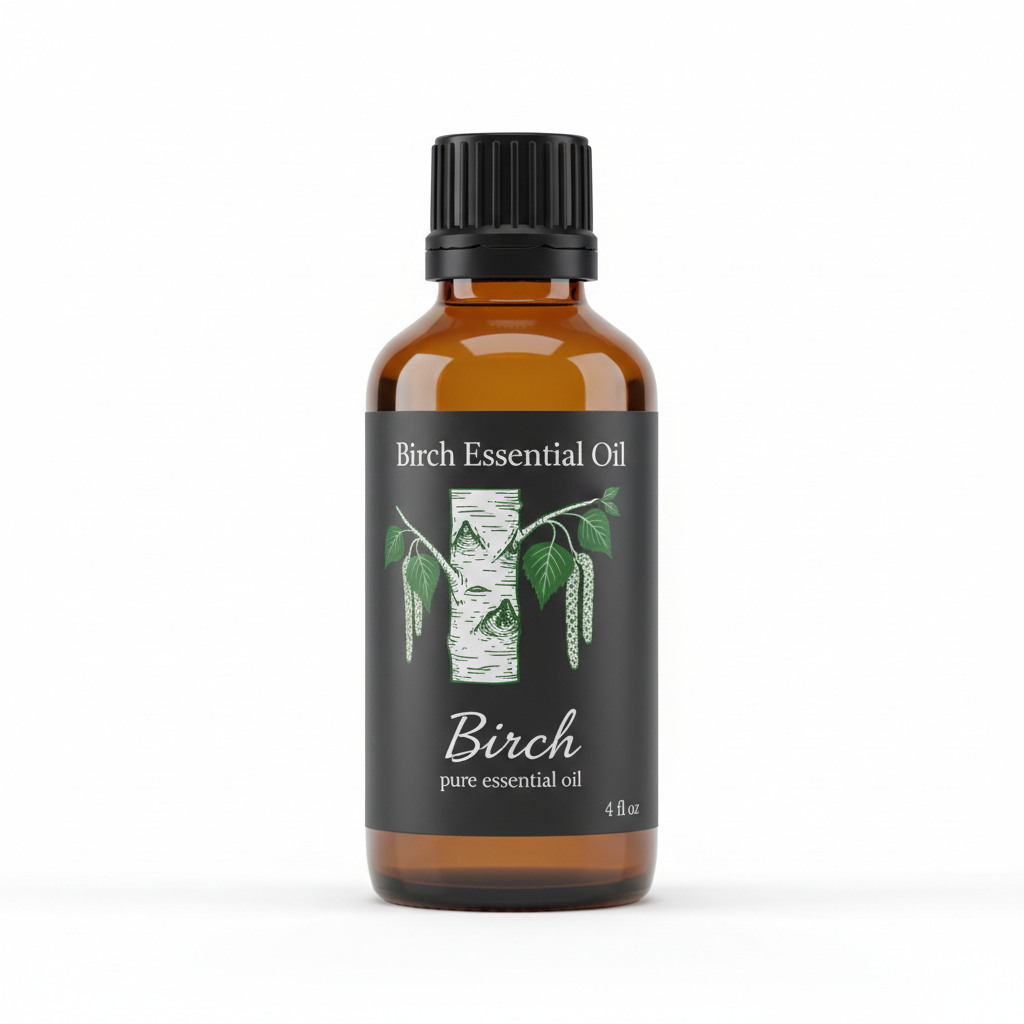
Our smallest size is 1 oz, undiluted sweet birch in amber glass, and the arithmetic above shows a ladder needs a fraction of it. The published COA lists physical constants, not a methyl salicylate percentage; the owner states the figure for any lot is available on request through the contact page, which is the number to use in your own calculations. Sizes are on the shop page, and the perfumery guide has the full dosing table.
Birch Essential Oil
Birch Essential Oil from our own shop, in sizes from 1 oz to bulk.
From $15.99
Shop Now →Sources & Further Reading
- CandleScience. How to Evaluate Fragrance Oils. candlescience.com
- ScenTree. Methyl salicylate. scentree.co
- Pellegrino R, Sinding C, de Wijk RA, Hummel T, 2017. Habituation and adaptation to odors in humans. Physiology and Behavior 177:13-19. research.wur.nl
- Leffingwell and Associates. Odor and flavor detection thresholds in water. leffingwell.com
- Dosoky NS, Poudel A, Satyal P, 2022. Authentication and Market Survey of Sweet Birch (Betula lenta L.) Essential Oil. Plants 11(16):2132. pmc.ncbi.nlm.nih.gov
- The Good Scents Company. Methyl salicylate. thegoodscentscompany.com
- IFRA, 2024. The complete IFRA Standards, 51st Amendment. ifrafragrance.org (CDN)
- European Commission, 2023. Regulation (EU) 2023/1545, Annex III entry 324 (text mirror). lawplayer.com
- UK Government, 2025. SI 2025/413. legislation.gov.uk
- Tisserand Institute. Methyl Salicylate: Essential Oil Constituents in Food Part 5. tisserandinstitute.org
- NIH/NLM, PubChem. Methyl salicylate (CID 4133). pubchem.ncbi.nlm.nih.gov
- Wright GA et al., 2005. Proc Biol Sci 272:2417-2422. pmc.ncbi.nlm.nih.gov
- Huang J et al., 2023. Odor masking. Chemical Senses 48. pubmed.ncbi.nlm.nih.gov
- European Commission SCCS, 2021. Opinion on methyl salicylate, SCCS/1633/21. health.ec.europa.eu