How to Blend Birch with Conifers, Citrus, and Mint
Birch essential oil has a distinctive character: sharp, clean, slightly sweet, with a whisper of wintergreen and fresh bark. It is polarizing in the best possible way. Used alone, it can feel singular and austere. Blended thoughtfully, it opens into something genuinely surprising. The forest note you didn't know your diffuser was missing.
This guide walks you through exactly how to blend birch oil with three of its most compatible scent families: conifers, citrus, and mint. You will find material lists, step-by-step instructions, suggested ratios, and the common mistakes that flatten an otherwise promising blend. Whether you are building a diffuser blend, a room spray, or a personal fragrance oil, the approach is the same: start slow, keep notes, and let the birch lead.
Before diving into the pairings, it helps to understand what birch actually brings to a blend. For a deeper look at its aromatic profile and extraction methods, the birch in perfumery ultimate guide covers the full picture. And if you are working with a fragrance oil rather than a true essential oil, it is worth reading about birch fragrance oil vs. birch essential oil before you begin, since their blending behaviors differ in important ways.
Materials You Will Need
- Birch essential oil (steam-distilled bark or bud; label should specify)
- Your chosen companion oils: at least one from the conifer, citrus, or mint families (see options below)
- A carrier oil for skin-safe applications (fractionated coconut oil, jojoba, or sweet almond)
- Small glass dropper bottles or vials (2 ml to 5 ml for testing)
- A ceramic or glass mixing bowl or a small glass beaker
- Pipettes or droppers (one per oil to avoid contamination)
- Scent testing strips (perfumer's blotter strips)
- A notebook or blending journal
- A timer or clock
- Labels and a fine-tip marker
Keep your workspace cool and away from direct sunlight. Heat and UV exposure degrade essential oils quickly, and you want accurate sensory feedback during testing.
Understanding Birch as a Blending Note

In classical perfumery terms, birch tends to function as a heart-to-top-note bridge. It has more staying power than a true top note like lemon or peppermint, but it does not anchor a blend the way a base note does. Think of it as a mid-layer that carries the forest quality upward without weighing the blend down.
Birch blends well with oils that either contrast its sharpness (warm spices, vanilla, cedar) or reinforce its freshness (conifer needles, eucalyptus, cold-pressed citrus). Mint is interesting because it can do both, depending on the variety. Spearmint softens birch; peppermint amplifies its crispness.
The natural methyl salicylate content in birch essential oil gives it that recognizable wintergreen facet. This means it already carries a slight medicinal-adjacent sharpness before you add anything. Your companion oils should either complement that quality or balance against it intentionally.
Part One: Birch and Conifers
Why This Pairing Works
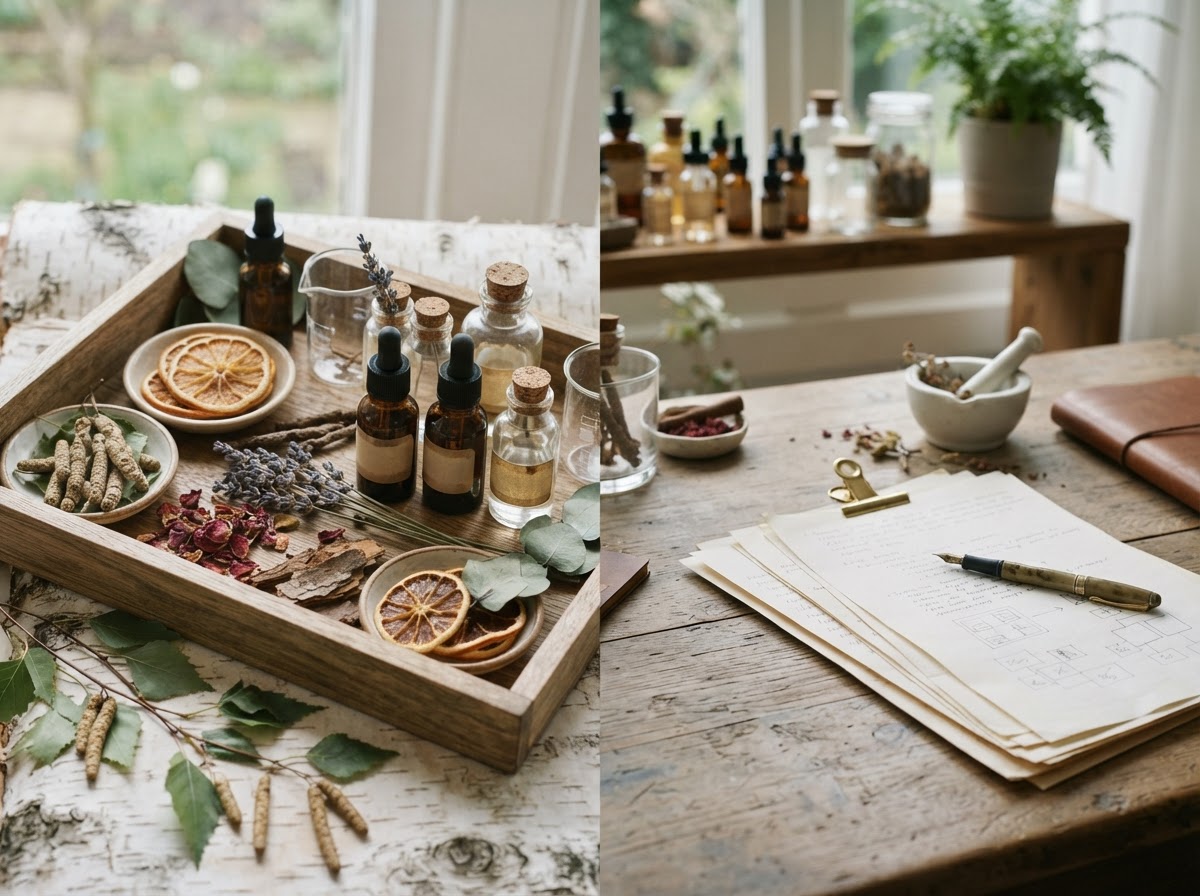
Conifers (pine, spruce, fir, cedarwood, juniper) share the same woodland ecosystem as birch. They reinforce each other without fighting for attention. The result is a layered, outdoor-air quality that works beautifully in diffuser blends for a morning work session or an evening wind-down ritual.
Recommended Conifer Partners
- Scots pine or Virginia cedarwood: Adds depth and grounding warmth
- Siberian fir: Crisp and slightly balsamic; lifts the blend
- Black spruce: Sharp, almost herbaceous; pairs best with smaller amounts of birch
- Juniper berry: Bright and slightly fruity; bridges conifer and citrus families
Step-by-Step: Birch and Conifer Diffuser Blend
- Start with a test ratio on paper. Before you touch a dropper, write down your intended ratio. A good starting point for a birch-conifer blend: 30% birch, 50% conifer (Siberian fir works well here), 20% juniper berry.
- Transfer to a test vial. Using a total of 10 drops, apply your ratio: 3 drops birch, 5 drops Siberian fir, 2 drops juniper berry. This small volume lets you evaluate without wasting material.
- Apply to a blotter strip and wait. Set a timer for 10 minutes. Do not smell the strip immediately. Fresh oils smell different than oils that have had a moment to interact and settle.
- Evaluate in rounds. After 10 minutes, take three slow inhalations from the strip. Note what you smell first (top impression), then what lingers. Write it down. Return in 30 minutes and evaluate again. The dry-down often reveals whether birch is sitting harmoniously in the blend or pushing forward too aggressively.
- Adjust and re-test. If birch feels overpowering, reduce it by one drop and add one more drop of fir. If the blend feels flat and one-dimensional, a single drop of juniper berry often reintroduces sparkle.
- Scale up only after confirming the ratio. Once you are satisfied, multiply proportionally for your diffuser or roller bottle.
Common mistake: Using cedarwood in too high a proportion. Cedarwood is a strong base note and can muffle birch almost entirely. Keep cedarwood at 15% or below in a birch-forward blend.
Part Two: Birch and Citrus
Why This Pairing Works
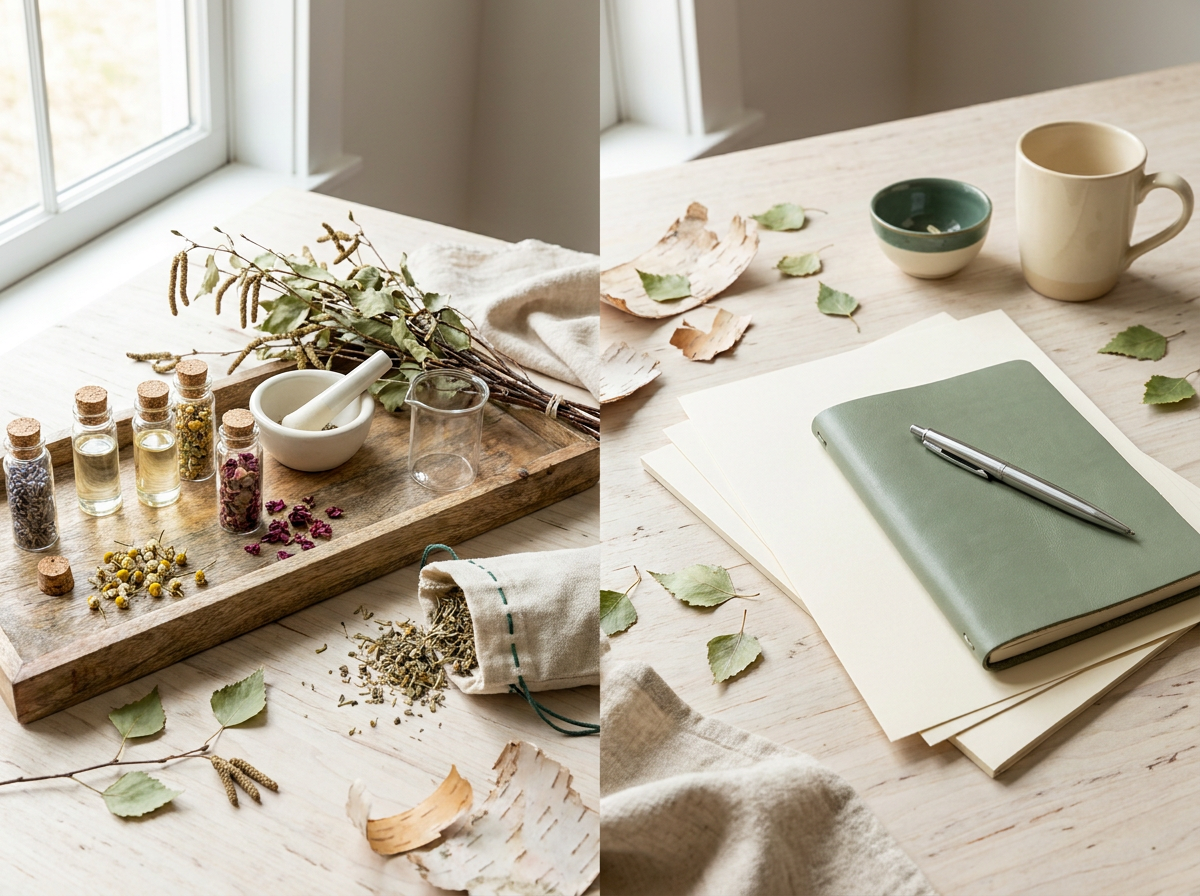
Citrus oils are bright, fast-moving top notes. They lift the opening of a blend dramatically. Paired with birch, they create a contrast between the juicy, solar quality of cold-pressed peel oils and the cool, bark-forward character of birch. The result is a clean, invigorating aromatic profile that many people associate with crisp mornings in autumn or the feeling of stepping outside into sharp air.
Recommended Citrus Partners
- Bergamot: Floral-citrus with slight warmth; the most sophisticated pairing
- Lemon (cold-pressed): Bright and clean; reinforces birch's freshness without complication
- Grapefruit: Slightly bitter and effervescent; pairs well when you want an uplifting, airy result
- Lime: More tart and assertive than lemon; use sparingly
Step-by-Step: Birch and Citrus Room Spray
- Choose your solubilizer. Citrus and birch oils do not mix with water on their own. For a room spray, you will need a solubilizer (polysorbate 20 or a natural alcohol base). Use at least 190-proof food-grade alcohol or a dedicated essential oil solubilizer at a ratio of roughly 1:1 with your total oil volume.
- Build your blend separately. In a small vial, combine your oils first: 4 drops birch, 4 drops bergamot, 2 drops lemon. Test this concentrate on a blotter strip before adding it to your spray base.
- Evaluate the concentrate. Wait 10 minutes, then assess. Citrus opens loudly. What you want to check is whether birch is still perceptible in the heart of the dry-down, or whether the citrus has overtaken it entirely. If birch disappears, increase it by one or two drops in your formula.
- Mix into your spray base. Once satisfied with the concentrate ratio, add it to your alcohol or solubilizer base at a total usage rate of 2% to 3% for a room spray. That is roughly 20 to 30 drops per 100 ml of base.
- Shake and test in the air. Spray once into the open room (not directly at your face) and walk through the mist. This gives you the full diffusion experience rather than a concentrated strip impression.
Common mistake: Adding too many citrus varieties at once. Two citrus oils maximum in a birch blend. More than that creates a muddled, indistinct opening that competes with birch rather than framing it.
Part Three: Birch and Mint
Why This Pairing Works
Mint and birch are both cool-register oils with sharpness in common. But they express that sharpness differently. Birch is woody and slightly sweet. Mint is herbal and menthol-forward. Together, they can create something that reads as deeply fresh without tipping into an overwhelming or one-note impression.
The key is choosing the right mint and using it conservatively. Mint is assertive. In most birch blends, mint should function as an accent, not an equal partner.
Recommended Mint Partners
- Spearmint: Softer and slightly sweeter than peppermint; the most forgiving choice for birch blending
- Peppermint: Bold, cool, and fast; use at 10% or below or it will dominate
- Cornmint: Sharper than peppermint; use in very small amounts as a finishing accent
Step-by-Step: Birch and Mint Personal Inhaler Blend
- Gather your materials. For a personal inhaler (aromatherapy stick), you will work with the cotton wick directly. You will use approximately 15 to 20 drops of your total blend per wick.
- Build your ratio at micro-scale first. On a blotter strip, test: 2 drops birch, 1 drop spearmint. That is a 2:1 ratio heavily favoring birch. Evaluate after 5 minutes. This is a starting point, not a final formula.
- Decide on your third note. A two-oil blend can feel thin in an inhaler. Consider adding one drop of Siberian fir (which links back to the birch's woodland quality) or one drop of lemon (which brightens the whole accord). This creates a simple but cohesive triad.
- Finalize your 15-drop formula. A well-balanced example: 8 drops birch, 4 drops spearmint, 3 drops Siberian fir. Apply to your cotton wick, cap the inhaler, and let it rest for one hour before evaluating.
- Evaluate after resting. Open the cap and inhale slowly from a few inches away, not directly at the wick opening. Assess: Does the birch read clearly? Does the mint feel present but not overwhelming? Does the blend feel cohesive from top to dry-down?
- Adjust for future batches. Inhalers are personal and easy to iterate. Keep your notes and tweak one variable at a time.
Common mistake: Using cornmint in place of spearmint without adjusting downward. Cornmint has a higher menthol content and will run over birch in a matter of minutes. If you prefer cornmint, cap it at 5% of your total blend.
Safety Notes for All Birch Blends
Important: Birch essential oil is potent. It contains methyl salicylate, which can cause skin sensitization if used undiluted. For any skin-contact application (roller bottles, body oil), dilute to a maximum of 1% in carrier oil. That is roughly 6 drops per 30 ml of carrier. Always perform a patch test on a small area of skin and wait 24 hours before broader application. Avoid use during pregnancy or while nursing without first consulting a qualified healthcare provider. Keep all essential oils away from children and pets. These guidelines apply to all companion oils in your blends as well, particularly peppermint and citrus oils, which carry their own sensitization and phototoxicity considerations (citrus oils, especially cold-pressed bergamot, may increase photosensitivity; avoid sun exposure on treated skin).
Building Your Blending Practice
The three pairings above: conifers, citrus, and mint, give you a solid foundation for understanding how birch behaves across different scent families. But the real skill is in developing your own sensory language around it. What does birch smell like to you on a cold strip versus a warm skin? Where does it fall in your blend's story?
As you get more comfortable, you can start layering across families. A birch-fir-bergamot blend, for example, uses all three of the pairings covered here in a single accord. Some perfumers also find that a small addition of vanilla or benzoin helps smooth and prolong birch blends considerably. For that direction, the vanilla-birch blending guide walks through exactly how to balance sweetness against birch's sharpness without losing either.
Keep your journal close. Blending is iterative, and the batch you create six months from now will be better than today's, simply because you will have more sensory memory to draw on. Birch is a patient teacher. It rewards the blender who slows down and listens to what the formula is asking for.