
Vanilla Birch: Blending a Sweet and Woody Signature Scent
Some scent combinations feel inevitable. Birch's crisp, slightly smoky woodiness and vanilla's warm, resinous sweetness seem made to find each other, like a forest path that winds past a crackling hearth. The vanilla birch fragrance oil world is rich with commercial options, but blending your own from quality raw materials gives you something no bottle off a shelf can match: a scent that is entirely, specifically yours.
This guide walks you through building a signature vanilla birch blend using birch essential oil as the backbone, sweet birch or birch tar absolute for depth, natural vanilla CO2 extract for warmth, and one carefully chosen frankincense to anchor the whole composition. That frankincense is Boswellia serrata, the Indian variety, and its inclusion here is not arbitrary. It is the key to making this blend feel complete.
Why Frankincense Serrata? The Aroma Case
Frankincense comes in several distinct species, and each carries its own personality. Frankincense serrata, steam-distilled from the resin of Boswellia serrata trees native to the dry forests of India, is warmer and softer than the sharper, more citrus-edged Boswellia carterii from East Africa. It carries a gentle balsamic sweetness beneath its woody, slightly earthy base, with almost none of the bright, terpene-forward brightness you find in sacra or frereana.
That balsamic warmth is exactly what a vanilla birch blend needs. Vanilla can tip sweet very quickly, and birch can tip sharp or medicinal if it is not properly anchored. Serrata sits between them, nudging vanilla toward something richer and more complex while smoothing birch's brighter edges. The result is a sweet woody scent blend that breathes. It does not collapse into gourmand sweetness, and it does not get lost in bark and smoke.
Serrata is also one of the more sustainably cultivated frankincense species, with established harvest traditions in Rajasthan and Madhya Pradesh. For a blend you will make repeatedly, that provenance matters.
If you are new to birch in fine fragrance contexts, the full birch in perfumery guide is worth reading before you blend. It covers the difference between birch tar, sweet birch, and birch leaf oils, which will help you choose the right birch material for this recipe.
The Full Recipe: Vanilla Birch Signature Blend
This formula is designed for a 10 mL personal fragrance rollerball diluted to approximately 10% in a carrier oil, appropriate for pulse-point application on most adults. The drop measurements are based on a standard 20-drops-per-mL essential oil dropper. Always verify your dropper yield before scaling up.
Ingredients
| Ingredient | Role in Blend | Drops | Milliliters (approx.) |
|---|---|---|---|
| Sweet birch essential oil (Betula lenta) | Top/heart note, crisp woody core | 8 | 0.40 mL |
| Frankincense serrata essential oil | Heart/base note, balsamic bridge | 6 | 0.30 mL |
| Vanilla CO2 extract (10% dilution in carrier) | Base note, warmth and sweetness | 6 | 0.30 mL |
| Cedarwood atlas essential oil | Base note, creamy woody depth | 4 | 0.20 mL |
| Benzoin resinoid (50% in DPG) | Fixative, vanilla amplifier | 4 | 0.20 mL |
| Fractionated coconut oil (carrier) | Diluent | To fill 10 mL | approx. 8.60 mL |
Total essential oil/extract content: 28 drops in 10 mL, yielding roughly 9% aromatic concentration. This falls within the standard 5-12% range recommended for pulse-point roller blends by the International Fragrance Association guidelines for leave-on skin products.
Equipment
- 10 mL glass roller bottle (amber or cobalt)
- Small glass beaker or shot glass for blending
- Pipette or dropper for carrier oil
- Calibrated essential oil droppers
- Labels and a fine-tip marker
- Notebook for recording your ratios
Step-by-Step Blending Instructions
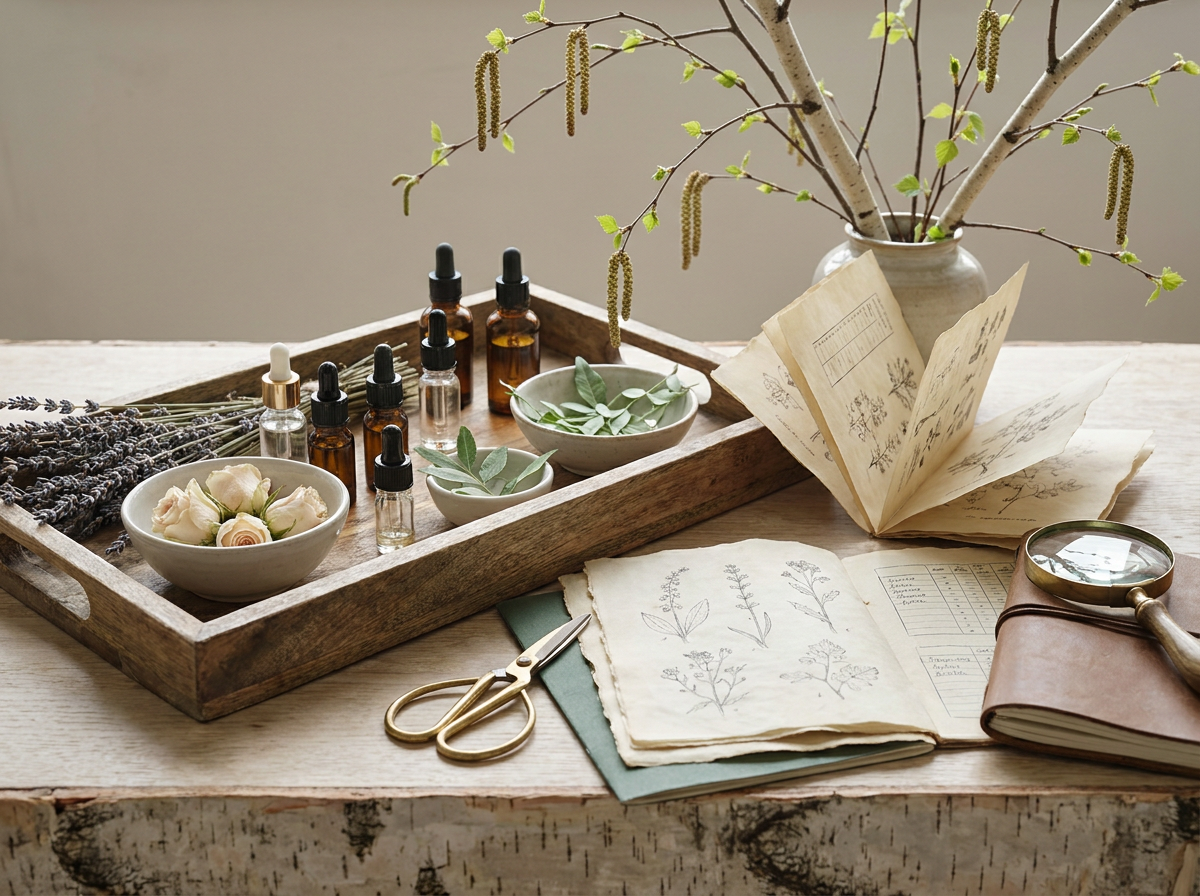
- Prepare your workspace. Work on a clean, non-porous surface. Have all bottles open and ready but capped loosely to prevent rapid evaporation. Good ventilation matters.
- Add aromatic materials first. Into your small glass beaker, add sweet birch first (8 drops), then frankincense serrata (6 drops), then the vanilla CO2 (6 drops), cedarwood atlas (4 drops), and benzoin (4 drops). Adding the heaviest, most viscous materials later helps them incorporate more evenly.
- Swirl gently. Stir the concentrate with a glass rod or simply swirl the beaker for 20-30 seconds. Do not stir vigorously. You want the molecules to begin acquainting themselves, not to introduce air bubbles.
- Rest the concentrate. Cover the beaker loosely with a small piece of plastic wrap and let it sit for 10 minutes. This brief resting period allows the aromatic profile to begin settling. Take a strip of perfumer's blotter, dip it briefly, and evaluate the scent. Adjust if needed before adding carrier.
- Transfer to roller bottle. Using a pipette, draw up the concentrate and transfer it into your 10 mL roller bottle.
- Add carrier oil. Fill the remaining space with fractionated coconut oil, leaving just enough room for the roller ball insert. Fractionated coconut stays liquid, absorbs cleanly, and has a very long shelf life compared to other carrier oils.
- Insert the roller ball and cap. Press the ball insert firmly into place and cap tightly.
- Roll to blend. Hold the capped bottle between your palms and roll it back and forth for 30 seconds. This integrates the carrier and concentrate without introducing air.
- Label immediately. Write the blend name, date, and full ingredient list. This is non-negotiable for safety and reproducibility.
- Rest before use. Set the bottle aside for 24-48 hours before your first application. The vanilla birch blend rounds out considerably as the components settle together.
Dilution Ratios and Safety Notes
Sweet birch essential oil contains a very high concentration of methyl salicylate, the same compound found in wintergreen oil. It is potent and requires careful attention to dilution. The 9% concentration in this recipe is the upper limit recommended for a pulse-point roller used in small quantities. Do not increase the sweet birch proportion without reducing overall aromatic concentration accordingly.
Patch Testing Protocol: Before using any new blend on pulse points or larger skin areas, apply a small amount (one or two rolls) to the inside of your forearm. Leave it unwashed for 24 hours and observe for any redness, itching, or unusual sensitivity. If you notice any reaction, discontinue use and wash the area with mild soap and water.
Contraindications and precautions to know before blending:
- Sweet birch and benzoin are known sensitizers for some individuals. If you have known sensitivities to salicylates or balsamic materials, consider swapping sweet birch for silver birch leaf oil (Betula pendula), which has a milder profile, and replacing benzoin with a small amount of labdanum absolute.
- This blend is formulated for adult use only. Keep away from children under 10 years old.
- Not suitable for use during pregnancy without prior consultation with a qualified healthcare provider.
- Avoid application to broken, irritated, or recently sun-exposed skin.
- If you are currently under the care of a healthcare provider or taking prescription medications, consult with them before incorporating new aromatic products into your daily routine.
Storage and Shelf Life
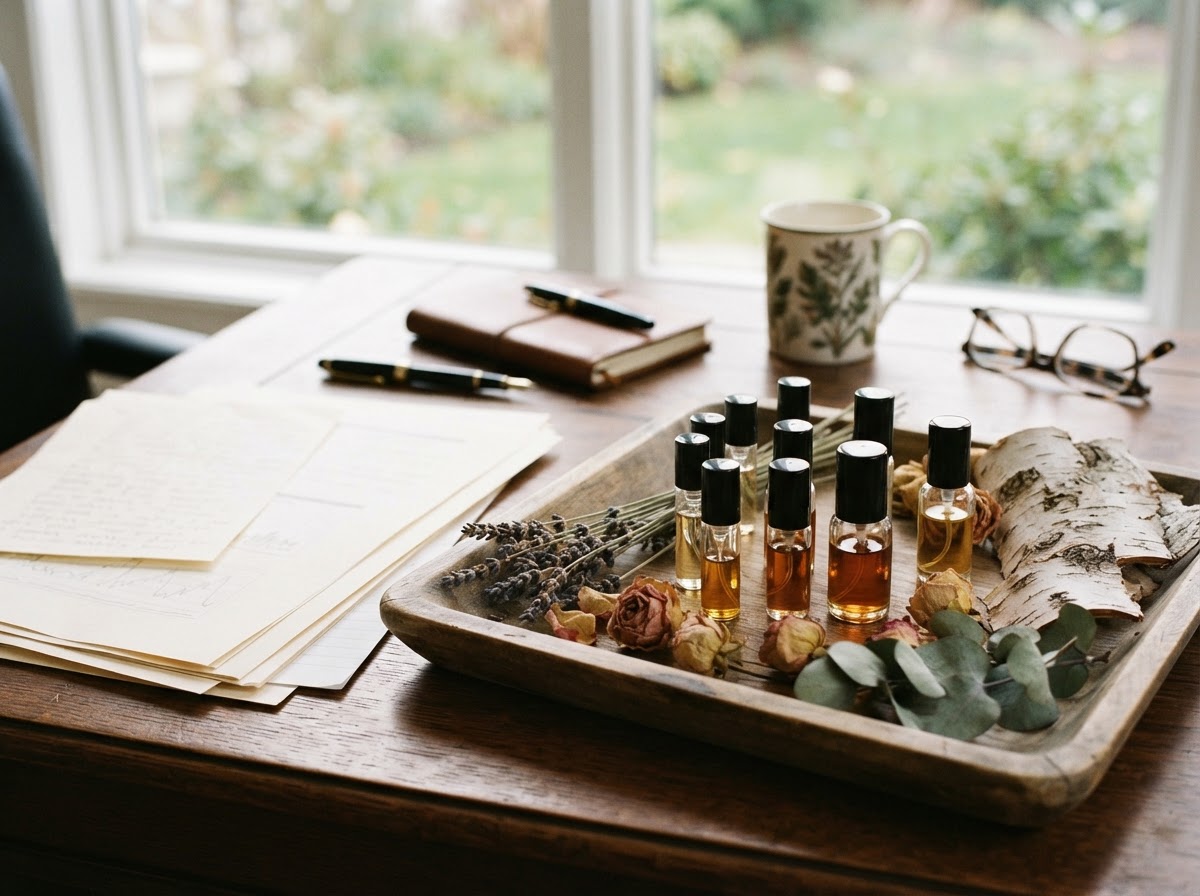
Store your finished vanilla birch blend in its amber or cobalt glass roller bottle, away from direct sunlight and heat. A drawer, cabinet, or small dark box works well. Avoid bathroom storage: the humidity and temperature swings common in bathrooms accelerate oxidation.
With fractionated coconut as the carrier, this blend should remain fresh for 12 to 18 months. The vanilla CO2 and benzoin both act as natural fixatives with some mild antioxidant character, which may extend the top notes slightly compared to blends without resinous base materials.
Trust your nose. If the blend begins to smell noticeably flat, sour, or just different from how it smelled when fresh, it is time to make a new batch. Good notes to keep in your blending journal: the scent on the day of making, the scent after 48 hours of resting, and the scent at three months.
Variations to Explore
Variation 1: Smoky Vanilla Birch (Deeper, More Atmospheric)
Replace 2 drops of sweet birch with 2 drops of birch tar essential oil (heavily diluted, 1% in carrier). Birch tar adds a leather-and-smoke dimension that works beautifully for evening wear or cool-weather rituals. Reduce frankincense serrata to 4 drops and add 2 drops of vetiver to reinforce the earthy base. The resulting sweet woody scent blend skews toward a cozy, fireside character. For more inspiration in that direction, the crackling birch candle scents guide covers how to echo these notes in a home fragrance format.
Variation 2: Bright Vanilla Birch (Lighter, Fresher)
Reduce cedarwood atlas to 2 drops and add 2 drops of bergamot FCF (furanocoumarin-free, safe for skin application). Swap benzoin for 4 drops of amyris essential oil, which offers a softer, slightly milky woodiness without the heavy balsamic quality. This version of the vanilla birch fragrance oil blend is better suited to warmer months and daytime wear. It opens with more citrus brightness before settling into the warm wood and vanilla base.
Variation 3: Spiced Vanilla Birch (Bold and Grounding)
Add 3 drops of black pepper essential oil to the base formula. Black pepper and birch have a particular synergy worth exploring, especially for those who find pure vanilla birch a little too soft. The pepper adds a dry, almost mineral edge that lifts the blend into something more assertive without overpowering the sweetness. The birch and black pepper blend guide goes deeper into this pairing if you want to understand the rationale before committing to a full batch.
Making It Your Own
Perfumery is patient work. The first batch of any vanilla birch blend is rarely the final version. Write everything down: every substitution, every extra drop, every change in carrier. Your notes from batch three will feel invaluable by batch seven.
What makes this particular formula a strong starting point is its balance of familiar and unexpected. Most people recognize vanilla and wood as warm, inviting scent territory. Frankincense serrata is the element that makes people pause and ask what that is. That pause, that moment of recognition-without-naming, is exactly what a good signature scent produces. Start here, and then make it yours.