How to Identify Sweet Birch: Bark, Twigs and Lookalikes
A wintergreen smell from a scratched twig narrows a tree to a short list, not to one species. Sweet birch (Betula lenta) shares that scent with yellow birch, so the smell has to be paired with bark, buds and leaf shape before you call it. This guide runs the checks in the order that removes the most lookalikes first. We have no field photographs of our own, so it points to university pages that carry good ones.
What the scratch test proves, and what it does not
The test is real and the sources agree on it. The Virginia Tech dendrology fact sheet lists a "wintergreen smell when cut" among the tree's features, and the Berkshire Natural Resources Council puts the logic plainly: "If it is a birch you are struggling with, and it smells like wintergreen, then it is a black or yellow birch" (Berkshire Natural Resources Council, 2018; Virginia Tech Dendrology, n.d.).
Notice what that sentence does not say. It narrows to two eastern birches, and only after you already know you are holding a birch. It also leaves out plants outside the eastern woods: a 2020 comparison of eight birch species classed four as high methyl salicylate producers, including Japanese cherry birch (B. grossa) and a Caucasian species (B. medwediewii), so an ornamental planting can smell right and still not be our tree (Singewar et al., 2020, PLoS ONE). Reasoning from that paper, scent identifies a group of birches, and the other checks below pick the species.
Step 1: confirm it is a birch
Start with the parts that do not depend on smell. The leaves are alternate and simple, 2 to 4 inches long, egg-shaped with a pointed tip and a heart-shaped base, and sharply toothed, either singly or doubly. The fruit is a brown, cone-like cluster 1 to 1.5 inches long holding two-winged nutlets (Virginia Tech Dendrology, n.d.).
In winter, look for catkins. Northern Woodlands notes that the drooping male catkins persist through winter and the female cones stand erect, which settles the birch question even on a bare tree (Center for Northern Woodlands Education, 2008). Virginia Tech also notes there is no terminal bud and that the lateral buds are two-toned, a check you can make on a snipped twig.
Step 2: scratch or snap a twig and read the answer
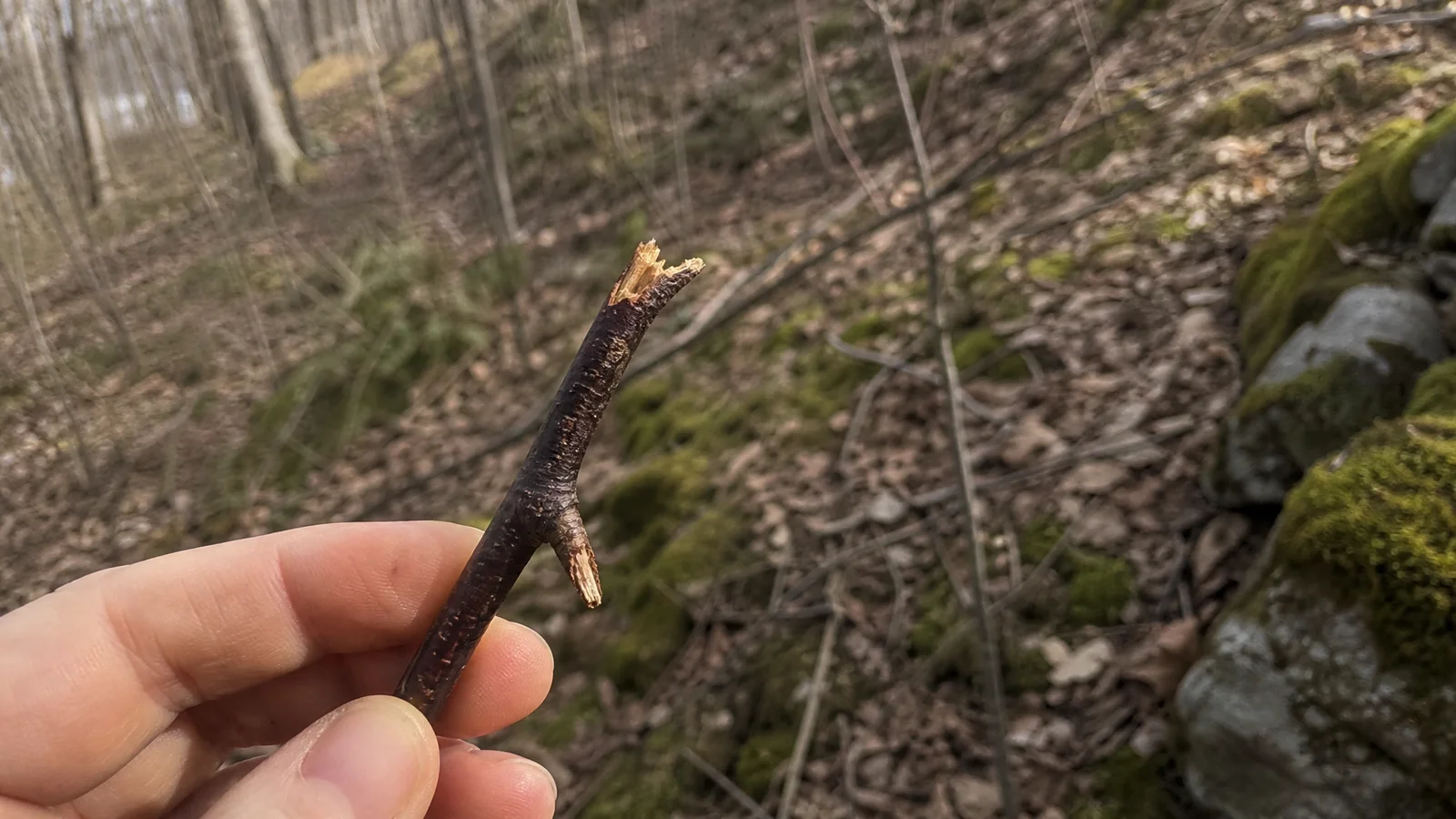
Take a twig no thicker than a pencil, from a branch you are allowed to touch (see the land rules below). Scratch through the outer bark with a thumbnail, or snap it, and smell the exposed surface. Three outcomes:
- Clear wintergreen. You have a black or yellow birch (Berkshire Natural Resources Council, 2018). Go to Step 3.
- No wintergreen. It is probably not either one. A white-barked tree is more likely paper birch (a different story from wintergreen oil, which comes from a low-growing plant as well as from birch), which the USDA Forest Service Silvics entry describes with white mature bark and no mention of a wintergreen scent (USDA Forest Service, Silvics of North America). Absence of a mention is not proof of absence, so treat that as a lead only.
- A different smell on a tree with cherry-like bark. Stop. Black cherry is the main lookalike, and Northern Woodlands calls the cherries "toxic" while using exactly this test to tell them apart from black birch (Lord, Northern Woodlands, 2013).
Step 3: separate sweet birch from yellow birch
Yellow birch (B. alleghaniensis) is the one that fools people, because the scent is the same and the two grow together. The Silvics entry for yellow birch describes its inner bark as aromatic with a wintergreen character, and says the two species can hybridize, while the sweet birch entry says natural hybrids have not been verified. Treat crosses as possible and unconfirmed (USDA Forest Service, Yellow Birch; USDA Forest Service, Sweet Birch).
| Feature | Sweet birch (B. lenta) | Yellow birch (B. alleghaniensis) |
|---|---|---|
| Mature bark | Non-peeling, lustrous reddish-black (National Park Service); dark, breaking into small squarish patches (Ohio State) | Yellowish-bronze, peeling in curling sheets (Silvics; Ohio State) |
| Young bark | Smooth, dark red, with horizontal lenticels (Northern Woodlands; Virginia Tech) | Not described in the sources we read |
| Range | Southern Maine to northern Georgia and Alabama, west to eastern Ohio (Silvics) | Newfoundland to southeastern Manitoba, south in the Appalachians to eastern Tennessee and northeastern Georgia (Silvics) |
| Catch | Mixed stands with yellow birch are common | Variety fallax has dark brown bark that peels less and resembles sweet birch (Silvics) |
The catch row matters. A dark-barked yellow birch variety exists, so "dark and non-peeling" is a strong clue and not a verdict. If bark and scent still leave you split, a regional tree guide or your county extension office can settle it from a leaf and twig sample. Sources for the table: National Park Service, Shenandoah, n.d.; Ohio State dendrology, n.d..
The rarer lookalikes
Virginia Tech lists yellow birch, paper birch, hornbeam and hophornbeam as similar species. Hornbeams are not birches, and the catkin and fruit checks in Step 1 separate them.
One regional case is worth a sentence. Virginia round-leaf birch (B. uber) was once classed as a variety of sweet birch and was officially listed as endangered in 1978, with a known population in Smyth County, Virginia (Silvics, sweet birch). If you are in that corner of the state and the leaves look unusually round, do not collect anything and tell a botanist.
For a wider look at how the tree fits the oil, see our guide to the sweet birch tree. For how it differs from white birch and from birch tar, see sweet birch, white birch and birch tar compared.
Where to look, and where it is less common
Sources frame the range differently. The Silvics entry puts the tree on moist, sheltered north- or east-facing slopes, from near sea level on the New England coast to 4,000 to 4,500 feet in the southern Appalachians, with the greatest abundance in Massachusetts, Connecticut, New York and Pennsylvania. Northern Woodlands calls it "uncommon in northern New England and northern New York state", while Yale's nature walk page calls it a dominant tree of northern Appalachian hardwoods. Those do not match, so check a regional flora before assuming the tree is common in your area (Yale Nature Walk, n.d.).
The tree also turns up fast after disturbance. At the Arnold Arboretum, black birch made up about 75 percent of stems over 1 cm in diameter ten years after hemlock removal (Orwig and Del Tredici, 2016, Harvard Forest). Young stands are therefore a likely place to practice the checks above.
Do not taste it, and check who owns the land
This identification test is a smell test only. Do not chew, steep or swallow bark, twigs or leaves to confirm a tree. North Carolina State Extension says oil from the bark can be toxic, and Poison Control describes wintergreen oil as very dangerous if more than a tiny amount is swallowed (NC State Extension Gardener Plant Toolbox, n.d.; Poison Control, National Capital Poison Center). Northern Woodlands has published columns on twig tea, and we are not endorsing them: neither source we read gives a dose or a contraindication list. If someone has swallowed bark or oil, call Poison Help at 1-800-222-1222.
On public land, scratching one twig is not the same as gathering. In National Park System units, 36 CFR 2.1 prohibits removing or disturbing plants "or the parts or products thereof", with a narrow exception for designated fruits, berries and nuts, and it bars sale or commercial use of natural products (36 CFR 2.1, Legal Information Institute copy). On National Forests, the Forest Service says commercial gathering of special forest products, a list that includes bark, always requires a permit and personal use may, so ask the local ranger district first; the page we read is the Alaska Region's, and we did not find eastern-forest quantity limits or state forest rules (USDA Forest Service, Special Forest Products). We also found no official harvest guideline for sweet birch bark or twigs. The Silvics entry notes only that the bark is extremely thin and the tree is easily damaged by fire.
Limits of this guide
This is a sourced explainer by the shop, not individual medical advice and has had no review by a forester or a clinician. It is written from published descriptions, not from our own field work, and a wrong identification of a plant you intend to handle is a mistake a regional naturalist, county extension agent or forester can catch in minutes. Ask one before acting on anything here, and ask a physician or poison center about any exposure.
Our oil is distilled from Betula lenta, and the owner states that each batch is analyzed to confirm the species rather than wintergreen oil sold under the birch name. In the woods, the same discipline applies: smell, bark, buds, leaves, range, then a second opinion.
Birch Essential Oil
Birch Essential Oil from our own shop, in sizes from 1 oz to bulk.
From $15.99
Shop Now →Sources & Further Reading
- Berkshire Natural Resources Council, 2018. Fragrant Trees. bnrc.org
- Virginia Tech Dept. of Forest Resources and Environmental Conservation, n.d. Dendrology fact sheet: Betula lenta. dendro.cnre.vt.edu
- Singewar K, Moschner CR, Hartung E, Fladung M, 2020. Identification and analysis of key genes involved in methyl salicylate biosynthesis in different birch species. PLoS ONE 15(10):e0240246. pmc.ncbi.nlm.nih.gov
- Center for Northern Woodlands Education, 2008. Black Birch (Betula lenta). northernwoodlands.org
- USDA Forest Service. Silvics of North America: Paper Birch. research.fs.usda.gov
- Lord B, 2013. Black Birch Tea: A Delicate Winter Brew. Northern Woodlands. northernwoodlands.org
- USDA Forest Service. Silvics of North America: Yellow Birch. research.fs.usda.gov
- USDA Forest Service. Silvics of North America: Sweet Birch. research.fs.usda.gov
- National Park Service, n.d. Sweet Birch, Shenandoah National Park. nps.gov
- Ohio State University, n.d. Sweet birch (Betula lenta), dendrology. dendro.ohioplants.org
- Yale Nature Walk, n.d. Black Birch. naturewalk.yale.edu
- Orwig D, Del Tredici P, 2016. Black birch dynamics following hemlock removal on Hemlock Hill at the Arnold Arboretum. Harvard Forest symposium abstract. harvardforest2.fas.harvard.edu
- NC State Extension, n.d. Betula lenta, Extension Gardener Plant Toolbox. plants.ces.ncsu.edu
- National Capital Poison Center (Poison Control). Essential oils: Poisonous when misused. poison.org
- US Code of Federal Regulations. 36 CFR 2.1, Preservation of natural, cultural and archeological resources. law.cornell.edu
- USDA Forest Service. Special Forest Products permits (Region 10). fs.usda.gov