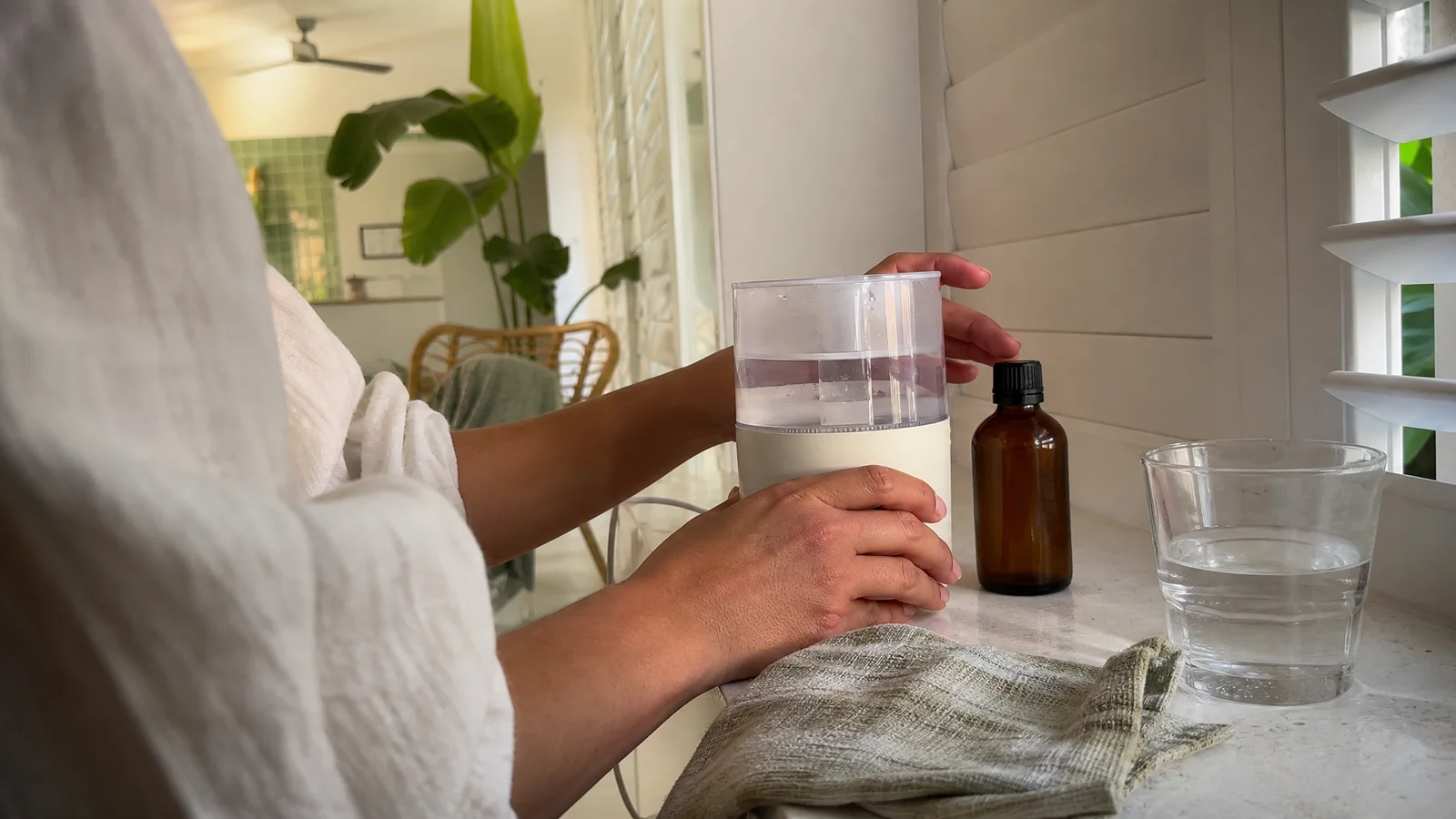
Ultrasonic vs Nebulizing Diffusers for Birch Oil
For sweet birch oil, which is almost entirely methyl salicylate, a water-based ultrasonic diffuser is the more conservative choice, and a nebulizer is the type to skip unless you have a specific reason to want undiluted oil in the air. Nobody has published a test of either type with birch or methyl salicylate, and we have not tested any diffuser, so this comparison rests on how the devices work and on the emissions studies that do exist for other oils. We do not sell diffusers and have no affiliate arrangement with any maker, so there is nothing to steer you toward.
What has and has not been measured
The closest peer-reviewed work is a chamber study of ultrasonic diffusers by Schwartz-Narbonne, Du and Siegel (Indoor Air, 2021). It ran lemon, lavender, eucalyptus and grapeseed oils. Over 15 minutes the most abundant volatile compound from the eucalyptus oil was eucalyptol at 3.5 +/- 0.4 mg, and from the lemon oil d-limonene at 2.6 +/- 0.7 mg. Particle emission (PM1) came to about 2 mg per hour for lemon, 0.1 mg per hour for lavender and eucalyptus, and 3 mg per hour for grapeseed oil, which has no scent at all.
Two findings from that paper matter more than the numbers. First, using tap water instead of deionized water gave about five times the PM1 for eucalyptus, so part of what a diffuser puts into the air is the water. Second, the authors' modelling suggests typical use can substantially add to indoor particulate matter. Methyl salicylate and birch oil were not among the oils tested, so none of these figures transfers to our oil.
Other data points are narrower. A 2023 field study of 60 UK homes (Warburton and colleagues) found that in the homes with the lowest air exchange, a plug-in diffuser raised fragrance compounds significantly (alpha-pinene median from 9 to 15 ug/m3). That was a heated plug-in device, not an ultrasonic or nebulizing one, but it shows that a room's air exchange changes what a diffuser leaves behind. A Well Living Lab summary (copyright 2017-2018) reports that all tested devices emitted both gases and particles, and that the tabletop ultrasonic unit had minimal impact on volatile compounds and particulates, and only briefly. We read only the extractable text of that PDF, so treat it as a pointer, not a full source.
What the two designs do differently (reasoning, not a test)
An ultrasonic unit is designed to take oil dropped into a tank of water. The MUJI 100 mL unit's page says "Use 2-4 drops of essential oil in the water." A nebulizing unit is designed to atomize the oil itself, without a water tank. Reasoning from those two designs, the nebulizer has nothing to dilute the oil, so for the same minutes of running it can put more oil into the air than an ultrasonic unit loaded with a few drops. Check your own unit's manual before relying on that, because we have not seen a source that measures it for either type.
What is sourced is that neither type is safe by design. The Merck Veterinary Manual (2025) says active diffusers, "nebulizing or ultrasonic", emit microdroplets or particles of oil into the air, and that droplets can settle on fur or feathers and be swallowed during grooming. Passive devices such as reed diffusers do not emit droplets, so their main hazard is respiratory irritation. The Manual lists birch and wintergreen oils as able to cause aspirin toxicosis in animals.
For people, NOAA CAMEO describes methyl salicylate vapor mist as irritating to the eyes, mucous membranes, upper respiratory tract and skin. We did not find an airborne exposure guideline for diffused birch oil. The absence of a published number is not a safety margin.
Plastics: what we could not confirm
Two common claims, that methyl salicylate attacks diffuser plastics and that it is fine in any diffuser, have no source we could verify. NOAA CAMEO lists only oxidizers and strong bases as incompatible, and the safety data sheets we looked at do not address polystyrene or polycarbonate. The product pages we read do not settle it either: MUJI's page describes a polypropylene resin body and gives no oil-compatibility warning, and Mountain Rose Herbs describes its Maui diffuser as a glass cover on a BPA-free plastic base with no oil warning either.
Reasoning only: methyl salicylate is an ester, and some esters soften some plastics. We have no source that this one does, but the question is cheap to ask. Email the maker and ask in writing whether the unit is rated for an ester-rich oil that is more than 90% methyl salicylate. If the answer is vague, or the tank is clear plastic, expect to watch for cloudiness, tackiness or crazing after the first uses, and stop if you see it.
How we would decide, in order
- Check the household first. Birds in the house: the ASPCA's professional site says do not use an essential oil diffuser in the house if birds are present. Cats, pets with asthma or respiratory disease, children under 6, pregnancy, aspirin sensitivity or anticoagulant use: do not diffuse birch oil. Our pet safety article and safety guide cover why.
- If everyone clears step 1, choose ultrasonic. Use a unit with a visible fill line, an automatic shut-off. Skip nebulizers for this oil.
- Dose to the manufacturer's range, at the low end. For the one unit whose page we read, that is 2-4 drops per 100 mL tank. Our diffusing guide covers room-size ratios; use its low numbers, not its high ones.
- Use deionized or distilled water. The 2021 chamber study is the reason: tap water raised particle output about fivefold for one oil.
- Run it in short sessions in a ventilated room. The Merck Manual advises short runs, ventilating afterward and keeping animals out of the room.
- Keep the bottle locked away. Reasoning: a bottle within a child's or pet's reach, or a tipped tank, is a bigger exposure than the mist, because the oil is undiluted. The Chyka 2007 poison-center guideline treats more than a lick of wintergreen-type oil in a child under 6 as a reason for emergency referral.
Where our oil fits and where it does not
Our oil is undiluted Betula lenta, sold in amber glass from 1 oz to 16 oz for retail and from 5 lb up for bulk. For diffusing, the 1 oz bottle is the size we would point a first-time user to: at a few drops per session it lasts far beyond the 2 to 3 years our product page gives as typical shelf life when kept tightly capped, cool and dark. The bulk sizes make no sense for a diffuser. If you share a home with a cat, a bird, a baby or someone who is pregnant, this oil is not the right choice for a diffuser at all, and the honest alternative is a different scent for that room. For blending ideas that keep birch at a low share, see the winter diffuser blends.
Limits of this comparison
This is a sourced explainer by the shop, not individual medical or veterinary advice, and no clinician has looked it over. We have no device tests, no air measurements and no photographs of any diffuser. Questions about a pet should go to your veterinarian or a pet poison line, questions about a person to a physician, pharmacist or Poison Help at 1-800-222-1222. The extension from other oils to birch oil is our reasoning, not a finding.
If a household clears every check above, a small ultrasonic unit with a low dose and a ventilated room is the lowest-intensity way to use this oil in the air. If it does not, skipping the diffuser is the right answer.
Birch Essential Oil
Birch Essential Oil from our own shop, in sizes from 1 oz to bulk.
From $15.99
Shop Now →Sources & Further Reading
- Schwartz-Narbonne H, Du B, Siegel JA, 2021. Indoor Air 31(6):1982-1992, ultrasonic essential oil diffuser emissions. doi.org
- Warburton T and colleagues, 2023. Environmental Science: Processes & Impacts 25(4):805-817, plug-in diffusers in UK homes. doi.org
- Well Living Lab, 2017-2018. The impact of scent diffusers on indoor air quality. welllivinglab.com
- Merck Veterinary Manual, 2025. Toxicoses From Essential Oils in Animals. merckvetmanual.com
- NOAA, CAMEO Chemicals. Methyl salicylate datasheet. cameochemicals.noaa.gov
- MUJI USA. Ultrasonic aroma diffuser product page. muji.us
- Mountain Rose Herbs. Maui Ultrasonic Diffuser product page. mountainroseherbs.com
- ASPCA Professional. Are Essential Oils Dangerous to Pets? aspcapro.org
- Chyka PA and colleagues, 2007. Salicylate poisoning: an evidence-based consensus guideline for out-of-hospital management. Clin Toxicol 45(2):95-131. pubmed.ncbi.nlm.nih.gov