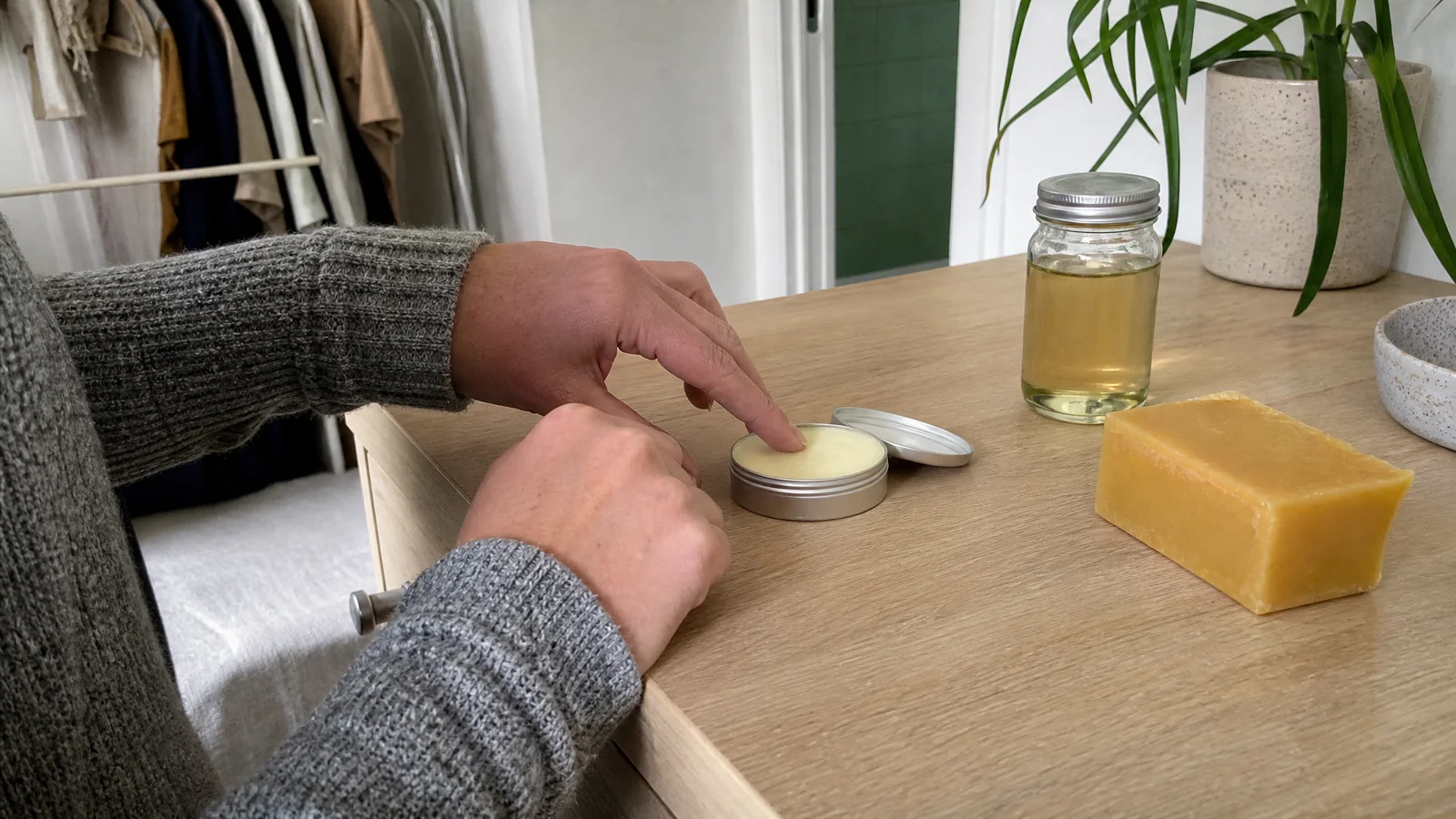
Solid Perfume With Birch Oil: A Trace-Dose Recipe and Its Limit
Birch oil is a poor fit for a solid perfume that is meant to smell of birch. A solid perfume is worn on skin and left on, which puts it under the strictest limit that exists for methyl salicylate, 0.06% in leave-on cosmetics in the EU and UK. At that level a 15 g tin holds about 9 mg of oil, far less than a typical fragrance load, so the honest recipe below is a solid perfume with a trace of birch in it, plus a plain statement of what to do if you wanted more.
Why the usual fragrance load does not work
Recipes for solid perfume load the fragrance at the top of the formula. A supplier says that "general fragrance oil percentages for solid perfumes are 10 - 15 %", and an expert Q&A gives wax 1 part to carrier oil or butter 2 to 3 parts, with fragrance at 5 to 15% of the combined weight. Both are about fragrance oils, which are blends, and say nothing about methyl salicylate. If birch oil were the whole 10% load, the finished balm would be about 10% methyl salicylate, since authentic oil runs 93.24-99.84% (Dosoky et al., 2022).
Here is what that 10% would sit next to, all arithmetic from the limits below:
- The EU limit for leave-on skin products is 0.06%, and 10% is about 167 times that. Methyl salicylate is also barred in EU cosmetics for children under 6 (toothpaste excepted).
- The Tisserand Institute's topical maximum for sweet birch is 2.5%, and 10% is 4 times that. (Robert Tisserand's 2012 blog post said he "would not like to see it used at more than 5%", so even the author's own figures moved between 2012 and the later institute page.)
- 10% is the bottom of the 10 to 60% range for methyl salicylate in FDA's OTC monograph M017 for external analgesic drug products. That is a drug framework, and it is a reason not to build a product at that strength. The FDA says that intended use decides whether a product is a cosmetic or a drug.
The US has no equivalent numeric cosmetic rule and IFRA's 51st Amendment has no Standard for methyl salicylate, so no US source tells you a number. We recommend the EU figure as the anchor for anything left on skin. The Tisserand Institute's higher figure sits well above it; for a leave-on balm, we work to the lowest verified number.
The recipe, at the limit
This is a 15 g tin. We have not made it, so there is no scent report, only arithmetic. The base ratios follow the supplier and Q&A figures above.
| Ingredient | Weight | Note |
|---|---|---|
| Beeswax | 3.9 g | Wax to oil about 1 to 2.5 once the stock's jojoba is counted |
| Jojoba oil | 8.8 g | Reduced from 9.6 g because the stock below carries jojoba |
| Birch stock (1% birch oil in jojoba) | 0.8 g | Contains 8 mg of birch oil |
| Your other fragrance materials | 1.5 g | About 10% of the tin; each material has its own limits that you must check |
Total 15.0 g. Birch oil is 8 mg of 15,000 mg, or 0.053%, under 0.06%. It is 0.5% of the 1.5 g fragrance load, which is the practical meaning of "trace".
The stock is what makes the weighing possible. Nine milligrams is about 7.6 microliters at the 1.183 g/mL density on our certificate, which no dropper meters. Mix 1 g of birch oil into 99 g of jojoba and weigh 0.8 g of that into each tin. If your scale reads to 0.1 g, rounding alone can put each weighing off by 0.05 g. At 0.8 g of stock the worst case is 0.85 g of a 1.05% stock, which is 8.9 mg and still under the 9 mg limit; aiming for 0.9 g would not be.
Melt the wax and jojoba together, take it off the heat, and add the stock and the rest of the fragrance as late and as cool as the base allows, because PubChem's record lists methyl salicylate as "sensitive to light and heat". We have no sourced temperature for that step. Pour into the tin and let it set undisturbed.
Whether a trace is worth doing
Reasoning from the limit, not from a test, birch here is an accent. If you smell it at all, it is as a faint wintergreen edge on a blend that is mostly something else, and we cannot tell you whether that is audible in your blend. Run it as a split test on paper strips first: the same base with and without the stock, judged side by side.
Cost and quantity point the same way. One ounce, the smallest size we sell, is about 28 g if the ounce is by weight, enough for about 3,500 tins at 8 mg each. The 100 g of stock above makes about 125 tins. If solid perfume is your only use, you do not need a bottle of ours; a shared bottle or another project to use it in makes more sense.
What to do instead if you wanted wintergreen
Take the oil off the skin. Candles, room sprays and diffusers are not cosmetics, and IFRA's guidance puts candles in category 12, where it says the ingredient concentration "is not restricted" for the skin endpoints it assesses (IFRA Guidance, 2023); that is a statement about skin exposure, not a claim that anything is safe to inhale. Our candle guide and sachet project are the better homes for a wintergreen-led scent. The blending guide covers what to put around it.
Who should not wear this
Our written safety stance, from our own pages: do not use if pregnant or breastfeeding, on children, if you take anticoagulants or are sensitive to aspirin, never on broken skin. The EU's scientific committee describes methyl salicylate as "a weak skin sensitiser in humans and eye irritant." The limits above apply to EU and UK cosmetics, and also trigger an ingredient-list duty above 0.001% in leave-on products; if you sell the tin, ask a regulatory consultant about labeling in your market, and keep muscle or mood claims off it, since FDA reads those as drug claims. The safety guide and dilution chart go further. This is a sourced explainer by the shop, not individual medical advice, and no clinician has reviewed it; a pharmacist or cosmetic chemist can check a formula for your situation.
If you try the recipe, treat 0.06% as a ceiling to stay under, not a target to reach.
Birch Essential Oil
Birch Essential Oil from our own shop, in sizes from 1 oz to bulk.
From $15.99
Shop Now →Sources & Further Reading
- Wholesale Supplies Plus. DIY Solid Perfume Recipe. wholesalesuppliesplus.com
- MySkinRecipes, 2017. Solid Perfume Formulation and Making Guide (expert Q&A). myskinrecipes.com
- Dosoky NS, Poudel A, Satyal P, 2022. Authentication and Market Survey of Sweet Birch (Betula lenta L.) Essential Oil. Plants 11(16):2132. pmc.ncbi.nlm.nih.gov
- European Commission, 2023. Commission Regulation (EU) 2023/1545, amending Annex III to Regulation (EC) No 1223/2009 (compiled mirror of the Official Journal text). lawplayer.com
- Tisserand Institute. Methyl Salicylate: Essential Oil Constituents in Food Part 5. tisserandinstitute.org
- Robert Tisserand, 2012. Wintergreen oil safety (blog post). roberttisserand.com
- US FDA, 2023. Over-the-Counter Monograph M017: External Analgesic Drug Products for OTC Human Use. accessdata.fda.gov
- US FDA. Is It a Cosmetic, a Drug, or Both? (Or Is It Soap?). fda.gov
- IFRA, 2024. The complete IFRA Standards, up to and including the 51st Amendment. ifrafragrance.org
- NIH/NLM, PubChem. Methyl salicylate (CID 4133). pubchem.ncbi.nlm.nih.gov
- IFRA, 2023. Guidance for the use of IFRA Standards (51st Amendment). ifrafragrance.org
- European Commission SCCS, 2021. Opinion on methyl salicylate (SCCS/1633/21). health.ec.europa.eu