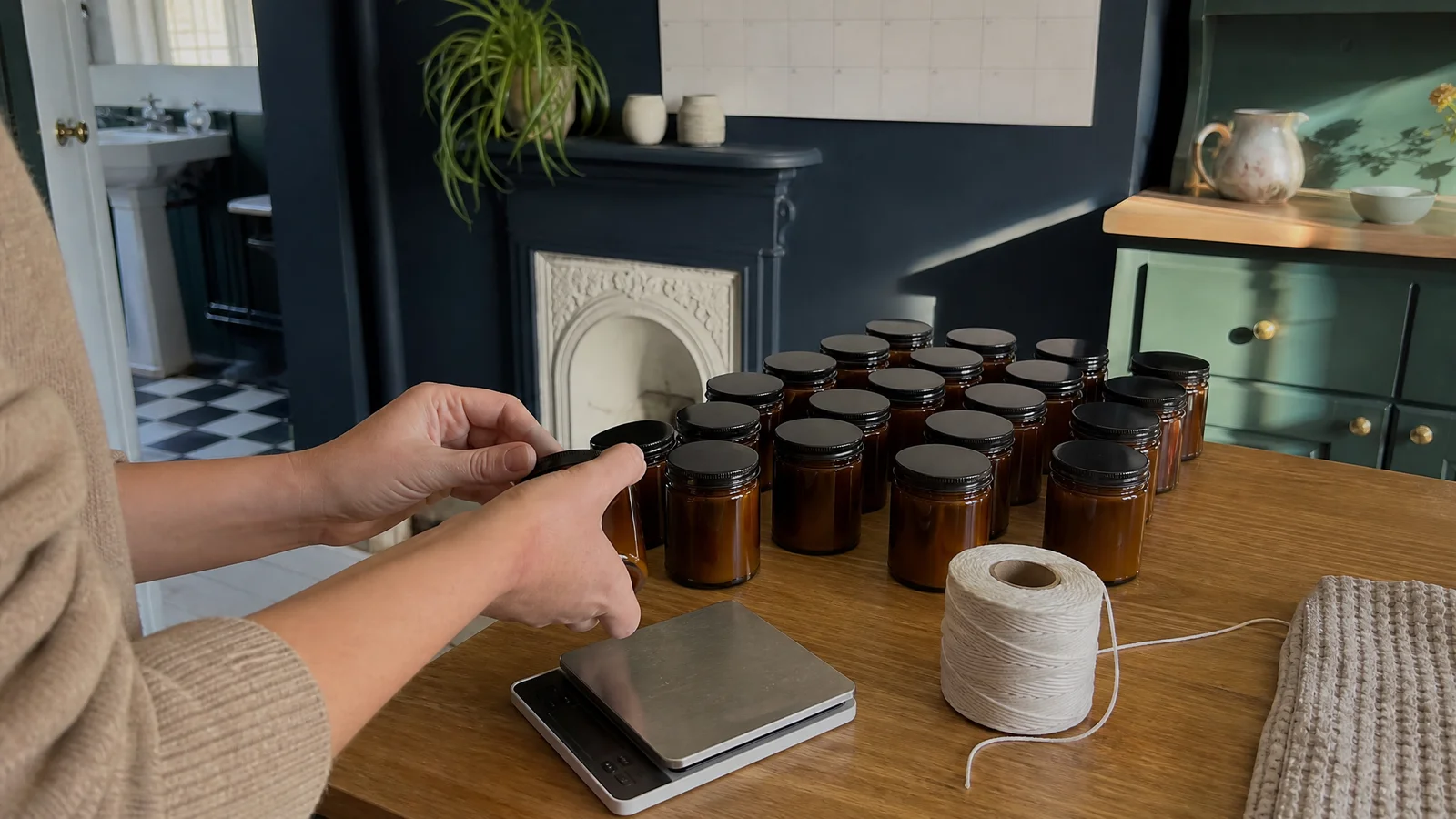
Holiday Candle Line With Birch: A Production Calendar
It is October 20, 2026, and a holiday candle line that you have not started is still possible this season if you can accept one adjustment round and a short cure, and it is a clean plan for next season if you cannot. The schedule below is built from published wax-resting and burn-test times, not from a studio's calendar, because we are not a candle studio and have poured no candles ourselves.
Start from the date candles must be ready
Work backward from one date and do not add scents after the first round. The sourced time constants are small: Cargill's handling sheet for its soy waxes asks for at least 12 hours of cooling and curing before further handling (Cargill NatureWax C-3 and C-6 handling sheet, 2016); a soy container wax data sheet advises a test burn after the candle has sat 48 hours (soy wax container technical data sheet v5.0, 2020); and a supplier burn-test procedure (Candle Science burn test procedure) calls for at least 24 hours of cure, burns of no more than four hours, and at least five hours of cooling between burns. Retail and forum advice often claims 1 to 2 weeks of cure for soy, but no wax manufacturer statement of that was found, so keep it as an optional extra week, not a fixed cost.
The same data sheet says that every combination of container, wax, dye, fragrance and wick must be tested for burn quality. That is why this calendar puts two test rounds ahead of production.
This season: 38 days to Black Friday
Thanksgiving falls on Thursday, November 26, 2026, so Black Friday is Friday, November 27: 38 days from today. December 25 is 66 days out. The schedule below fits the first date if your other supplies arrive about a week after you order them.
| Date | Step | Why that long |
|---|---|---|
| Tue Oct 20 | Order oil, wax, wicks, jars and labels. We ship orders within 1 to 2 business days; carrier time is not something we state. | Everything else waits on this. |
| Tue Oct 27 | Round 1: pour three jars per scent from one melt (see the split tests on the root beer and fireside pages). | Allows about a week for delivery, which is a guess, not a promise. |
| Thu Oct 29 | Cold smell and first test burns, 48 hours after pouring. | The soy data sheet advises a test burn after 48 hours; Cargill asks for at least 12 hours before handling. |
| Mon Nov 2 | Round 2: repour with the adjusted birch share. | One adjustment round only. |
| Wed Nov 4 | Burn-test round 2 and lock the formulas by Fri Nov 6. | Same 48-hour rule. |
| Mon Nov 9 to Mon Nov 16 | Production pours in batches. | Calendar time depends on how many jars you can pour a day. |
| Wed Nov 25 | Last pours have cured at least 48 hours. | Ships for Fri Nov 27, 38 days from today. |
If you are not set up to start pouring by October 27, aim for December 25 and give yourself the full two rounds. Do not skip the burn test to save the 48 hours; that is the one step that tells you whether the candle is safe on a table.
Next season: the weeks-before plan
The dates below are one example. Slide the whole column to fit your own date. The week counts are reasoning, with room for two test rounds, about four weeks of production pours and about two weeks of packing; they are not a studio's measured timings.
| Weeks before | Date | Task |
|---|---|---|
| 16 | Mon Jul 12, 2027 | Choose three or four scent ideas; order samples of oil and any companion oils, plus wax, wicks and jars. |
| 14 | Mon Jul 26, 2027 | Round 1 split-test pours. |
| 13 | Mon Aug 2, 2027 | Test burns after the 48-hour minimum; record whether a week of rest changes your notes. |
| 12 | Mon Aug 9, 2027 | Round 2 pours with adjusted ratios. |
| 10 | Mon Aug 23, 2027 | Lock formulas; draft warning labels against the ASTM labelling standard. |
| 9 | Mon Aug 30, 2027 | Size and place the production oil order (see the quantity table below). |
| 8 | Mon Sep 6, 2027 | Production pours start, in batches. |
| 4 | Mon Oct 4, 2027 | Production finished; the last candles keep curing. |
| 2 | Mon Oct 18, 2027 | Pack, label, photograph, list. |
| 0 | Mon Nov 1, 2027 | Candles ready. |
How much oil a line uses (and why bulk is often the wrong answer)
Assume a line of four scents in 8 oz candles (8 oz of wax by weight), 250 candles of each. Two scents use birch at the ceiling of 0.5% of wax weight: root beer and fireside. That is 500 birch candles at 0.04 oz of oil each (8 oz x 0.005), so 500 x 0.04 = 20 oz of birch for the whole line. The other two scents use no birch in this example.
| Option | Arithmetic | Cost | Oil bought |
|---|---|---|---|
| 16 oz + 4 oz | 79.99 + 34.99 | $114.98 | 20 oz |
| 5 lb | one container | $281.99 | 80 oz |
The 16 oz and 4 oz bottles cost $114.98 for 20 oz, or $5.75 per ounce; the 5 lb size costs $281.99 for 80 oz, or $3.52 per ounce. The 5 lb size only wins if you actually use 56.4 oz of it (281.99 / 4.999, where $4.999 is the 16 oz per-ounce price). At 20 oz a season, three seasons use 60 oz, just above that break-even, and two seasons use 40 oz, below it. Our product page gives a typical shelf life of 2 to 3 years for tightly capped, cool, dark storage, and the bottle carries a still date and a fill date, so count your seasons from the date on the bottle, not the date you ordered. Bulk pays off when the schedule is clearly bigger than this one; the cost-per-candle breakdown has the full table, and our bulk buying guide covers 25 lb, 400 lb and larger quantities. These prices change, so check the shop page for the current price.
Scent ideas, and the reasoning behind each
- Root beer, birch-led: fragrance databases tag methyl salicylate with "root beer" (The Good Scents Company), so birch is the logical anchor. Starting ratios are on the root beer candle page.
- Fireside, birch as an accent: a woodsy build where fir and cedarwood do most of the work and birch adds sweetness; see the fireside builds. We do not sell fir or cedarwood.
- Wintergreen and peppermint: this one is the least certain, and it is reasoning, not a finding. Birch does not supply the cold sensation people link with wintergreen candy: a 1989 psychophysics paper found methyl salicylate enhanced warming and did not affect cooling (Green and Flammer, 1989, tested on skin, not as an inhaled scent). A peppermint oil is 30-55% menthol (EFSA, 2025), which is a likelier source of the cool note. Keep birch under 0.5% in any blend.
- A sampler: two small candles in one box; our gift ideas page covers more.
Labels, fire safety and who to ask
The National Candle Association describes ASTM F2058 as the standard for the warning label that cautions consumers to always burn a candle within sight, and the labelling standard text is sold by ASTM; a lawyer or compliance consultant should confirm what label your product needs. The CPSC, 2001 advice is to never leave burning candles unattended and to keep combustibles away. It also reported that nearly half of candle fires began in bedrooms and that deaths rose from 20 in 1980 to 170 in 1998; the data are from 1998, so treat them as old. Holiday decorations, paper and dried greens are combustibles.
Birch oil has its own limits. The oil is more than 93% methyl salicylate (Dosoky, Poudel and Satyal, 2022, researchers at a competing oil company), no IFRA Standard exists for it (51st Amendment, 2024), and we hold it to 0.5% of wax weight by our own reasoning. Candle labels should not suggest the candle is for children or pets, and keep the undiluted bottle locked away. This is a sourced explainer by the shop, not individual medical advice, and it has had no clinician's review. A pharmacist or poison center (Poison Help, 1-800-222-1222) is the right person to ask about exposure.
Pick your date today, choose no more than four scents, and put the first split-test pour on the calendar before you order anything else. If it is already too late for this season, the table above is next season's starting point.
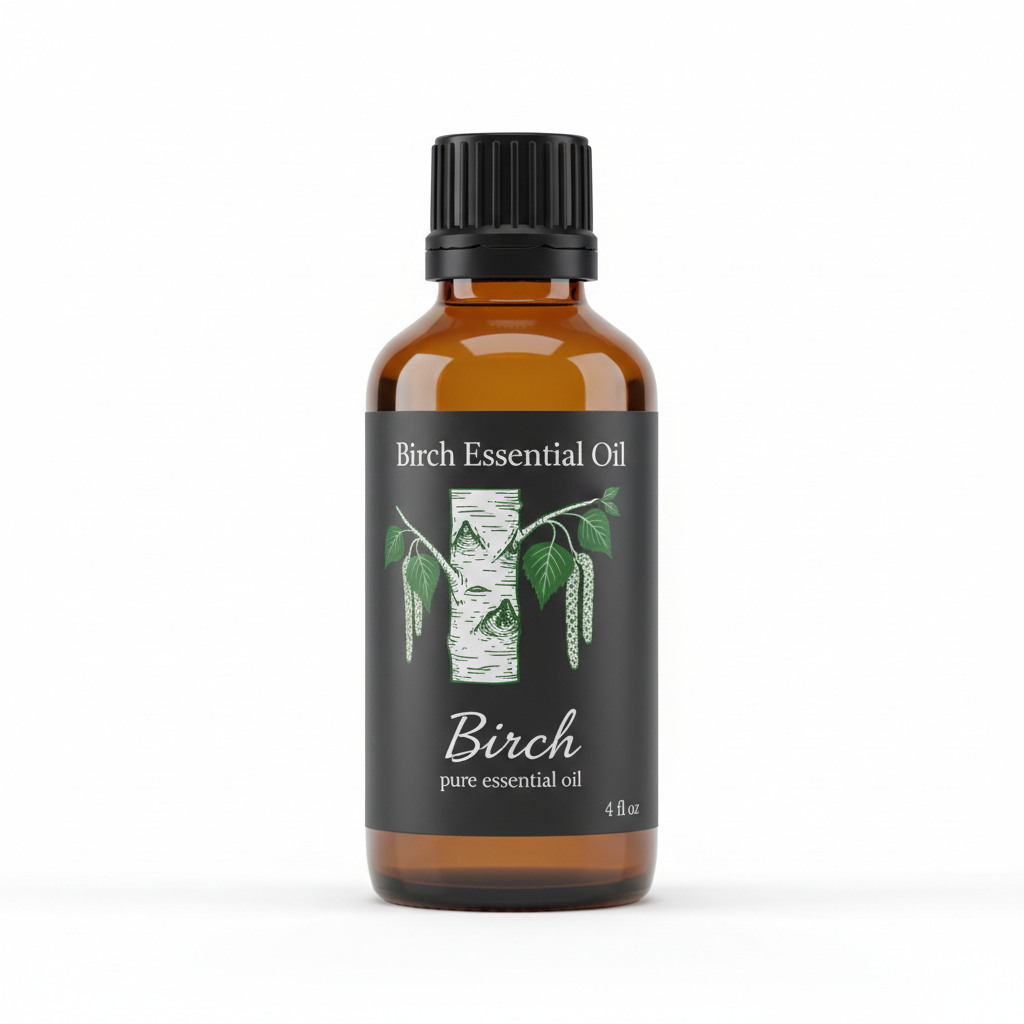
Birch Essential Oil
Birch Essential Oil from our own shop, in sizes from 1 oz to bulk.
From $15.99
Shop Now →Sources & Further Reading
- Cargill Industrial Specialties, 2016. NatureWax C-3 and C-6 Handling and Melting Instructions. cdn.shopify.com
- Soy Wax Container Technical Data Sheet v5.0, 2020. cdn.shopify.com
- Candle Science, undated. How to Conduct a Burn Test. candlescience.com
- National Candle Association, 2026. Understanding Safety Standards. candles.org
- US Consumer Product Safety Commission, 2001. CPSC releases new report on residential fires. cpsc.gov
- The Good Scents Company, undated. Methyl salicylate (119-36-8) entry. thegoodscentscompany.com
- Green BG, Flammer LJ, 1989. Methyl salicylate as a cutaneous stimulus: a psychophysical analysis. Somatosensory and Motor Research 6:253-274. pubmed.ncbi.nlm.nih.gov
- EFSA FEEDAP Panel, 2025. Safety and efficacy of peppermint oil as a feed additive. EFSA Journal 23(1). ncbi.nlm.nih.gov
- Dosoky NS, Poudel A, Satyal P, 2022. Authentication and Market Survey of Sweet Birch (Betula lenta L.) Essential Oil. Plants 11(16):2132. pmc.ncbi.nlm.nih.gov
- International Fragrance Association, 2024. The complete IFRA Standards, 51st Amendment (index; no entry for methyl salicylate). cloudfront.net