
Root Beer Candle Recipe With Birch Oil: A Starting Formula
Fragrance databases tag methyl salicylate with the descriptor "root beer", and sweet birch oil is more than 93% methyl salicylate, so a very small amount of it can carry the root beer part of a candle scent over a vanilla base. The formula below caps birch at 0.5% of the wax weight and makes up the rest of a 6% fragrance load from other oils. It is a starting ratio built from published loads. We have not poured it, and you should treat it as a first test jar.
Why root beer smells like birch, and why that is a constraint
Root beer was once flavored with sassafras. In 1960 the US Food and Drug Administration declared food containing added oil of sassafras or safrole adulterated; the regulation, 21 CFR 189.180, describes sassafras oil as about 80% safrole. Flavor chemists then needed another source of the same sweet, rooty character, and methyl salicylate is one of the molecules that carries it. The Good Scents Company, a fragrance-industry database, lists methyl salicylate's odor descriptors as "Sweet, salicylate, root beer, wintergreen, aromatic, slightly phenolic and camphoreous" (The Good Scents Company, methyl salicylate entry, citing a 1995 Perfumer and Flavorist article).
The constraint is that the same molecule makes birch the strongest single material in the recipe: authentic samples measured 93.24-99.84% methyl salicylate in a 2022 survey (Dosoky, Poudel and Satyal, researchers at a competing oil company). Its only published odor threshold, 40 parts per billion, is for water (Leffingwell and Associates compilation) and no air figure was found, so we cannot give you a tipping point in parts per million. What it suggests, as reasoning, is that a small share is enough. That is why the formula below treats birch as an accent, not as the main fragrance. For the history of the scent itself, see our piece on birch and root beer.
The starting formula
Weigh everything in grams. The 6% total comes from a candle-supplier wick guide that tells makers to wick up above about 1 oz of fragrance per pound of wax, which is 6.25% (Candle Science wick guide); we stay just under that line so the wick size in your wax maker's chart still applies. The soy wax data sheet we read allows fragrance up to 10-12% (soy wax container technical data sheet v5.0, 2020), so 6% is well inside it. Use fragrance oils made for candles and for your wax type: that data sheet warns that some fragrances "may react poorly with the wax causing bleeding, objectionable surface finishes or poor flame quality."
| Component | Share of wax weight | Per 100 g wax | Per 8 oz wax (226.8 g) | Per 1 lb wax (453.6 g) |
|---|---|---|---|---|
| Birch essential oil | 0.5% of wax | 0.50 g | 1.13 g | 2.27 g |
| Vanilla-type fragrance oil rated for candles | 3.5% | 3.50 g | 7.94 g | 15.88 g |
| Sweet-spice or anise-type fragrance oil rated for candles | 2.0% | 2.00 g | 4.54 g | 9.07 g |
| Total fragrance | 6.0% | 6.00 g | 13.61 g | 27.22 g |
Arithmetic for the 8 oz column: 226.8 g x 0.06 = 13.61 g of fragrance in total; birch is 226.8 x 0.005 = 1.13 g, which is 8% of the fragrance by weight, and the other two oils are 226.8 x 0.035 = 7.94 g and 226.8 x 0.02 = 4.54 g. We do not sell the vanilla-type or spice-type oils, and any supplier you trust will do; ask them for the candle-use documentation for each. The accord shares between the non-birch oils are our reasoning about a root beer profile, not tested ratios. You can run a similar cost check on our cost per candle page.
Run this split test before you pour a batch
No test pours stand behind this formula, so the right amount of birch for your wax, jar and wick is unknown. Pour three jars from the same melt, changing only the birch share and keeping the 6% total by adjusting the vanilla-type oil.
| Jar | Birch share of wax weight | Birch per 8 oz wax | Birch as share of the 6% fragrance |
|---|---|---|---|
| A | 0.25% | 0.57 g | 4% |
| B | 0.40% | 0.91 g | 7% |
| C | 0.50% | 1.13 g | 8% |
- Melt the wax, add the fragrance blend and stir, then pour in the range your wax maker gives. For Cargill's C-3 and C-6 soy waxes the handling sheet says pour at 120 to 180 F, with the warmer end for cooler rooms (Cargill NatureWax C-3 and C-6 handling sheet, 2016).
- Let the jars sit. Cargill's sheet asks for at least 12 hours before further handling; the soy data sheet says to test burn after 48 hours. Retailers and forums often say 1 to 2 weeks, and no wax manufacturer statement of that was found, so record the day you burn each jar.
- Smell each jar cold, then burn it. A supplier procedure (Candle Science burn test procedure) trims the wick to 1/4 inch, burns for no more than four hours, cools at least five hours, and repeats until about 1/4 inch of wax is left. The melt pool should reach to within about 1/4 inch of the jar edge by hour three or four.
- Write down which jar you can smell from across the room and which one turns sharp, like a cough drop, near the flame. Keep the lowest birch share that still reads as root beer, not the highest you can tolerate.
The wick is a separate decision, and it is tied to the jar: too small gives tunneling, too large gives sooting, according to the soy data sheet. That data sheet also says every combination of container, wax, dye, fragrance and wick must be tested for burn quality.
Limits, and the safety points that apply to this oil
Birch oil is not a cosmetic here, so the cosmetic limits do not apply, but nothing replaces them either. The International Fragrance Association (IFRA, 2023 guidance) puts candles in its Category 12 and does not restrict ingredient concentration there, but its standards contain no entry at all for methyl salicylate, so there is no IFRA number to follow. The cap of 0.5% is ours, chosen by reasoning, to keep the airborne load of a very strong material low.
- Flash point: methyl salicylate's closed-cup flash point is about 96 to 101 C (205 to 214 F) (PubChem, methyl salicylate). Wax poured at 120 to 180 F (49 to 82 C) is below that. A burning wick is an open flame, so this is not a reason to relax: never leave a candle unattended (CPSC, 2001 found candle deaths rose from 20 in 1980 to 170 in 1998).
- Vapor: NOAA CAMEO Chemicals states that methyl salicylate vapor mist is irritating to the eyes, mucous membranes, upper respiratory tract and skin. Burn in a ventilated room, and stop if anyone coughs or complains of irritated eyes.
- Children, pregnancy, pets: do not burn it in a nursery, and keep it out of rooms with pet birds. No study of birch oil in candles and animals exists; that advice is extrapolated from general guidance for essential oils. If you are pregnant or take blood thinners, ask a pharmacist or physician before regular exposure.
- The undiluted bottle: the poison-center guideline of Chyka and colleagues, 2007 treats more than "a lick or taste" of 98% methyl salicylate in a child under 6 as a reason for emergency referral. Store the oil locked, away from kitchens and food. In the US, call Poison Help at 1-800-222-1222.
This is a sourced explainer by the shop, not individual medical advice, and it has had no clinician's review. A pharmacist or poison center is the right person to ask about exposure.
Pour one set of three jars first, record what you smell, and only then scale the formula, with the oil weighed to the hundredth of a gram. When the root beer reads right, move on to the fireside blends, or read the candle making guide and how to dose a birch-dominant note.
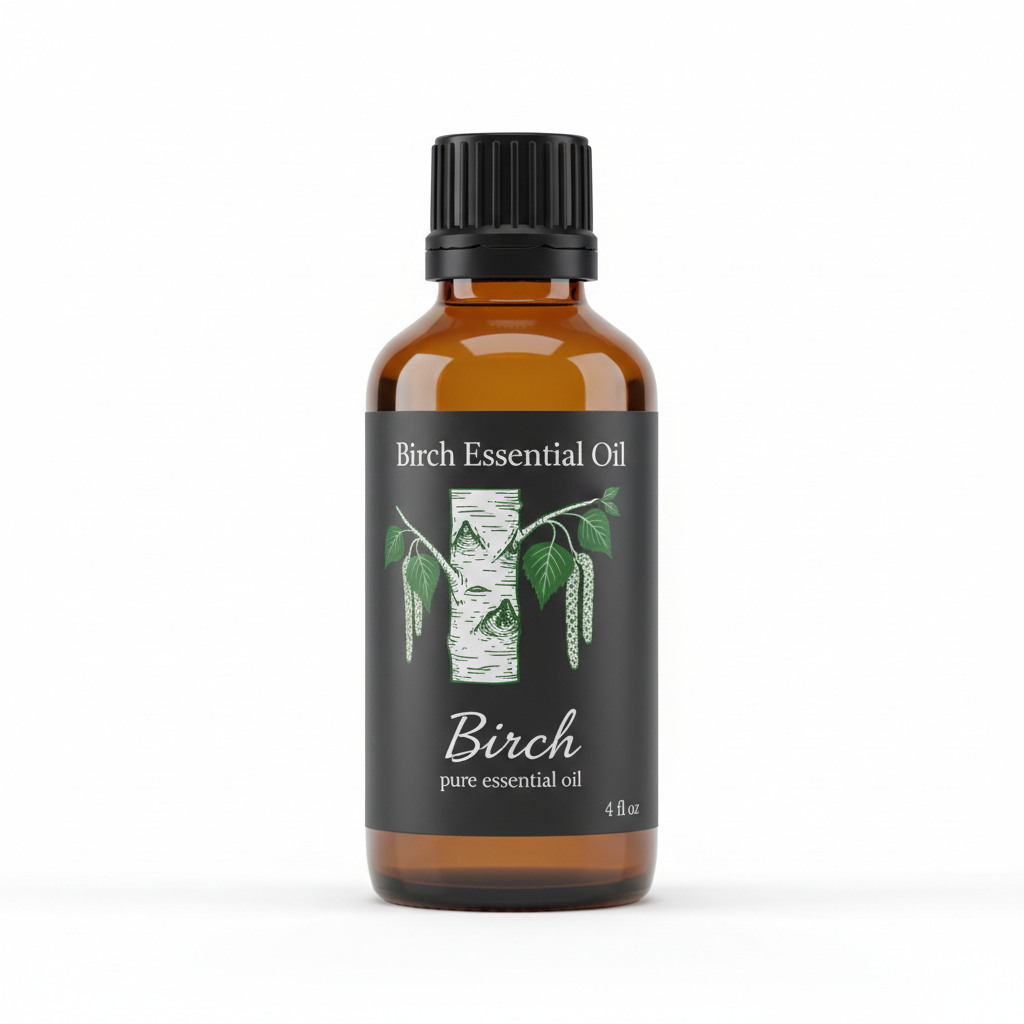
Birch Essential Oil
Birch Essential Oil from our own shop, in sizes from 1 oz to bulk.
From $15.99
Shop Now →Sources & Further Reading
- US Code of Federal Regulations, 21 CFR 189.180: Safrole and oil of sassafras. law.cornell.edu
- The Good Scents Company, undated. Methyl salicylate (119-36-8) entry. thegoodscentscompany.com
- Leffingwell and Associates, undated. Odor and flavor detection thresholds in water. leffingwell.com
- Dosoky NS, Poudel A, Satyal P, 2022. Authentication and Market Survey of Sweet Birch (Betula lenta L.) Essential Oil. Plants 11(16):2132. pmc.ncbi.nlm.nih.gov
- Candle Science, undated. How to properly wick container candles. candlescience.com
- Candle Science, undated. How to Conduct a Burn Test. candlescience.com
- Soy Wax Container Technical Data Sheet v5.0, 2020. cdn.shopify.com
- Cargill Industrial Specialties, 2016. NatureWax C-3 and C-6 Handling and Melting Instructions. cdn.shopify.com
- PubChem (US National Library of Medicine), undated. Methyl salicylate, flash point data. pubchem.ncbi.nlm.nih.gov
- NOAA, undated. CAMEO Chemicals datasheet, methyl salicylate. cameochemicals.noaa.gov
- US Consumer Product Safety Commission, 2001. CPSC releases new report on residential fires. cpsc.gov
- Chyka PA and others, 2007. Salicylate poisoning: an evidence-based consensus guideline for out-of-hospital management. Clinical Toxicology 45(2):95-131. pubmed.ncbi.nlm.nih.gov
- International Fragrance Association, 2023. Guidance for the use of IFRA Standards (51st Amendment), Table 12. ifrafragrance.org