How to Identify Sweet Birch: The Scratch and Sniff Test
Scratch a twig on a woodland walk, lift it to your nose, and catch a sudden whiff of wintergreen. It is one of the small delights of the eastern forest, and it is the reason sweet birch (Betula lenta) has its name. The smell narrows the field a lot, but not quite to one tree, so here is how to finish the job with bark, buds and leaves.
What the scratch test tells you
The test is real, and the sources agree. Virginia Tech's dendrology fact sheet lists a wintergreen smell when the twig is cut among the tree's features, and the Berkshire Natural Resources Council puts the logic plainly: if you are puzzling over a birch and it smells like wintergreen, it is a black or yellow birch. Sweet birch goes by black birch too, along with cherry birch and mahogany birch.
So the smell sorts birches into a small group; it does not name the species. It also assumes you already know you are holding a birch, which is where we start.
First, is it a birch?
Leaves are alternate and simple, 2 to 4 inches long, egg-shaped with a pointed tip and a heart-shaped base, and sharply toothed. The fruit is a brown, cone-like cluster about an inch long. In winter, look for catkins: Northern Woodlands notes that the drooping male catkins stay on all winter, which marks a birch even when the tree is bare. Virginia Tech adds that sweet birch has no terminal bud and that its side buds are two-toned, green and brown.
Then scratch and sniff
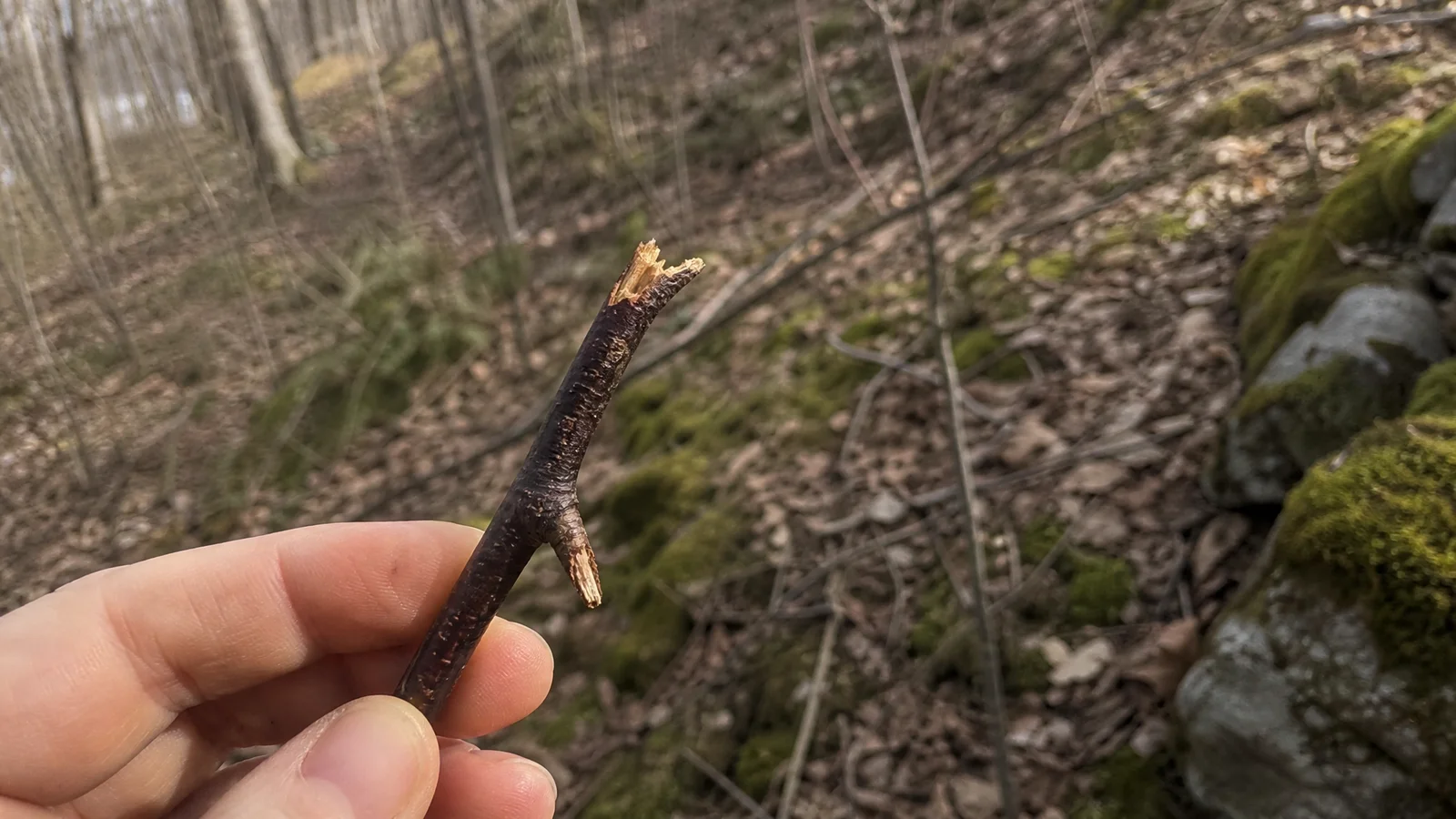
Take a twig no thicker than a pencil from a branch you are allowed to touch (see the note on land rules below). Scratch through the outer bark with a thumbnail and smell the exposed surface. Three outcomes are possible:
- Clear wintergreen: black or yellow birch. Move on to the next step.
- No wintergreen: probably neither of them. A white-barked tree is more likely paper birch.
- Almond or a different smell on a tree with cherry-like bark: stop. Black cherry is the classic lookalike, and Northern Woodlands, which uses exactly this test to tell the two apart, calls the cherries toxic.
Sweet birch or yellow birch
Yellow birch (B. alleghaniensis) is the tree that fools people. It grows in the same woods and smells the same, and the USDA Forest Service describes its inner bark as aromatic with a wintergreen flavor. The difference is mostly the bark.
| Feature | Sweet birch | Yellow birch |
|---|---|---|
| Bark | Smooth, lustrous and dark red when young; black with loose, curled, scaly plates when old, much like black cherry | Yellowish-bronze and exfoliating, the feature the tree is named for |
| Range | Southern Maine to northern Georgia and Alabama, west to eastern Ohio | Newfoundland to Manitoba, south through the Appalachians |
The Forest Service notes that sweet birch can be crossed with yellow birch by hand, but that no natural hybrids have been verified. If bark and scent still leave you undecided, a regional tree guide or your county extension office can settle it from a leaf and twig sample.
Where to look
Sweet birch likes moist, sheltered slopes in the Appalachians and the hills around them. Sources describe its range a little differently: the Forest Service gives its heartland as Massachusetts, Connecticut, New York and Pennsylvania, while Northern Woodlands calls it uncommon in northern New England and northern New York, so check a regional flora before assuming it grows near you. It also moves in quickly after disturbance. At the Arnold Arboretum, black birch made up about 75 percent of stems over 1 cm in diameter ten years after hemlock removal, so young regrowth stands are a good place to practice. For the tree and the oil together, see our post on the northern tree behind sweet birch oil, and for how it compares with other birches, white birch versus sweet birch.
Make a slow walk of it
This is a nice thing to do without hurrying. Choose a cool, dry day, wear shoes you do not mind getting muddy, and bring a notebook, a small hand lens if you have one, and a regional tree guide. Take a photo of the whole tree, then the bark, then a leaf, then a twig, so you can compare them later at home. If you can, go back in a different season. A tree you could not place in summer can be easy to recognize in winter, once the leaves are gone and the buds and catkins show.
Take your time at each tree and treat the woods gently. A single scratched twig is plenty, and the tree will be there for the next person who wants to smell it.
Smell it, do not taste it
Treat this as a smell test only. Do not chew or swallow bark, twigs or leaves to confirm a tree: Poison Control describes wintergreen oil as very dangerous when more than a tiny amount is swallowed. If someone has swallowed bark or oil, call Poison Help at 1-800-222-1222. Our post on birch and wintergreen explains the connection between the two scents.
Finally, scratching a twig is not the same as gathering. In National Park System units, 36 CFR 2.1 prohibits removing plants or their parts, and bars the sale or commercial use of natural products. For a national forest, the Forest Service says commercial gathering of special forest products always needs a permit, so ask the local ranger district first.
Smell, bark, buds, leaves, range, then a second opinion from a local naturalist: that sequence works for any tree. Our own oil is sold as sweet birch, and the batch on our Certificate of Analysis names Betula lenta.
Birch Essential Oil
Birch Essential Oil from our own shop, in sizes from 1 oz to bulk.
From $17.99
Shop Now →Sources & Further Reading
- Berkshire Natural Resources Council, 2018. Fragrant Trees. bnrc.org/story/fragrant-trees
- Virginia Tech Dendrology, Betula lenta fact sheet. dendro.cnre.vt.edu
- Barlow V, 2008. Black Birch: Betula lenta. Northern Woodlands. northernwoodlands.org
- Lord B, 2013. Black Birch Tea. Northern Woodlands. northernwoodlands.org/knots_and_bolts/black-birch-tea
- USDA Forest Service, Silvics of North America: Sweet Birch. research.fs.usda.gov/silvics/sweet-birch
- USDA Forest Service, Silvics of North America: Yellow Birch. research.fs.usda.gov/silvics/yellow-birch
- Orwig D, Del Tredici P, 2016. Black birch dynamics following hemlock removal at the Arnold Arboretum. Harvard Forest. harvardforest2.fas.harvard.edu
- National Capital Poison Center, Essential oils. poison.org/articles/essential-oils
- 36 CFR 2.1, Preservation of natural, cultural and archeological resources. law.cornell.edu/cfr/text/36/2.1
- USDA Forest Service, Special Forest Products permits (Region 10). fs.usda.gov