Birch in a Barbershop Fougere: Just a Pinch
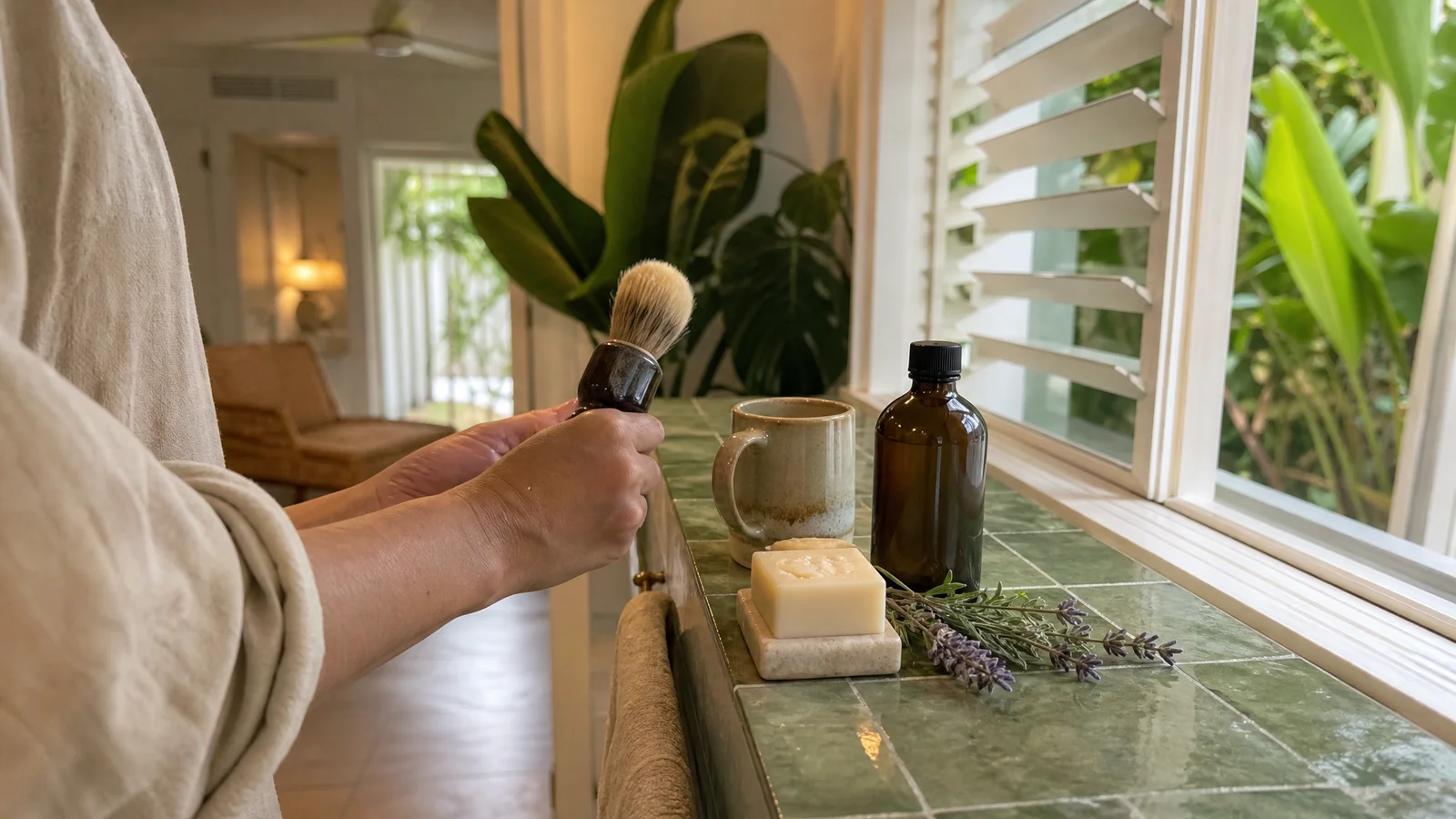
Picture a barber's chair: lavender, a little soap, a cool shot of something minty-sweet from the aftershave. Birch is not a traditional fougere ingredient, but its cool, candy-sweet wintergreen character is oddly at home in that picture, as long as you treat it as a seasoning and not a main note.
What makes a fougere a fougere
The family takes its name from Houbigant's Fougere Royale, made by Paul Parquet in the early 1880s (Wikipedia). The classic skeleton is lavender up top, geranium and a floral heart, and an oakmoss and coumarin base that smells like warm hay. "Barbershop" is looser: shaving soap, talc, lavender-forward colognes, a clean, slightly medicinal-smelling cool.
Birch fits that cool. Methyl salicylate, the molecule that makes up nearly all of sweet birch oil, sits in the heart of the perfume pyramid and is described by ScenTree as powerful enough that "a very low dilution" is all you need (ScenTree). In a lavender and oakmoss frame, a trace of it can lift the top and brighten the heart without announcing itself. That placement is our reasoning from how the molecule behaves, not a documented classic formula, so treat it as a place to explore.
Set the scene before you mix
It helps to have a picture in mind. Imagine a small shop with a leather chair, a mug of shaving soap, warm towels and a bottle of tonic on a glass shelf. Now decide which of those you want your accord to smell like. Talc and soap, lavender and a little green, a sharp cold lift at the top. Birch belongs in the last of those, as a flash of cold, not as the soap or the leather.
Write three words for the mood on the front of your notebook page and check each trial against them. If a rung drifts away from the picture, it has too much birch in it, no matter how interesting it smells.
The ceiling decides the dose, not taste
Here is the part that makes birch interesting to a perfumer: the amount is capped by rules before it is capped by your nose. IFRA's Standards carry no entry for methyl salicylate (IFRA, 51st Amendment), so cosmetic law supplies the number. EU Annex III entry 324 allows 0.6% in hydroalcoholic fragrance and 0.06% in other leave-on skin products, and the UK regulations of 2025 carry the same pair (Regulation (EU) 2023/1545; SI 2025/413). The substance has to be named in the ingredient list above 0.001% in leave-on products, and it is not permitted in preparations for children under 6. The US has no numeric equivalent, so we suggest working to the EU figure wherever you sell.
Because birch oil is close to all methyl salicylate, the oil must stay at or under those percentages of the finished product. In an alcohol fragrance at a 15% concentrate, that works out to no more than 4 parts birch per 100 parts of concentrate, which is 0.6 g of birch oil in 100 g of finished fragrance. Switch to an oil-based roll-on and the ceiling is ten times lower: 0.4 parts per 100 of concentrate at the same strength. It is a trace of a trace.
A ladder worksheet
The most useful way to find the right amount is to climb a ladder and stop early. Build your lavender, geranium and oakmoss-style base first with no birch. Divide it into four equal portions and add birch at 0, 1, 2 and 4 parts per 100 parts of concentrate. Diluted to a 15% finished fragrance, those rungs land at 0, 0.15, 0.3 and 0.6% birch in the bottle, with the top rung sitting exactly on the alcohol ceiling. Smell on paper strips, not skin, at a few intervals, and note the first rung where the character of the accord shifts. Methyl salicylate is strong, so the answer is likely to be low on the ladder. For an oil-based format, stop at 0.4 parts per 100 and judge whether the accord still reads at that level.
Weigh everything. At these amounts a drop is a big step, so a 1% stock of birch in ethanol makes the arithmetic easier; the dilution chart shows how, and our piece on dosing a dominant note explains the thinking.
Reading your strips
When you compare the rungs on paper, smell each strip at arm's length first and bring it closer slowly. Pay attention to the moment you first notice the cool, sweet edge. If you can find it right away, it is probably already too much. If you cannot find it at all, but the strip without birch feels flatter when you compare the two, that is the rung worth keeping. It is a bit like salt in cooking: the best amount is the one you only notice when it is missing.
When wintergreen is the whole point
If you want birch to be the star, a worn fragrance is not the best vehicle under these numbers. A candle or room scent, which are not cosmetics, gives it room; see the candle guide. For the wider perfumery picture, our perfumery guide is the place to continue, and the shaving soap recipe carries the barbershop idea into soap.
Who should sit this one out
The EU's scientific committee describes methyl salicylate as a weak skin sensitiser and eye irritant, and notes that exposure from other sources adds up (SCCS opinion, 2021). We recommend that anyone pregnant or breastfeeding, anyone on anticoagulants or sensitive to aspirin, and anyone making something for children skip birch on skin, and that it never touch broken skin. If you plan to sell what you make, FDA treats intended use as the deciding factor between cosmetic and drug (FDA), so keep claims to scent. We sell the oil only; lavender, geranium, oakmoss-type bases and ethanol come from perfumery suppliers.
Used this way, birch is a pinch in the accord rather than a note you can point to, and the fun is finding the smallest amount that still changes the blend.
Birch Essential Oil
Birch Essential Oil from our own shop, in sizes from 1 oz to bulk.
From $17.99
Shop Now →Sources & Further Reading
- Wikipedia. Fougere (fragrance family). en.wikipedia.org
- ScenTree. Methyl salicylate. scentree.co
- IFRA, 2024. IFRA Standards, 51st Amendment. ifrafragrance.org
- European Commission, 2023. Commission Regulation (EU) 2023/1545 (text mirror). lawplayer.com
- UK Government, 2025. The Cosmetic Products (Restriction of Chemical Substances) Regulations 2025, SI 2025/413. legislation.gov.uk
- European Commission SCCS, 2021. Opinion on methyl salicylate (SCCS/1633/21). health.ec.europa.eu
- US FDA. Is It a Cosmetic, a Drug, or Both? (Or Is It Soap?). fda.gov