Blending Birch Oil With Conifers, Citrus and Mint
Most blending advice for birch is a list of friendly oils. A more useful way to think about it is speed: birch is a slow, strong, sweet note, and what you pair it with decides whether the blend smells like a single wintergreen sweet or like a walk in the woods. Sort the partners by how fast they leave the air, and the recipe more or less writes itself.
Start with what the blend is for
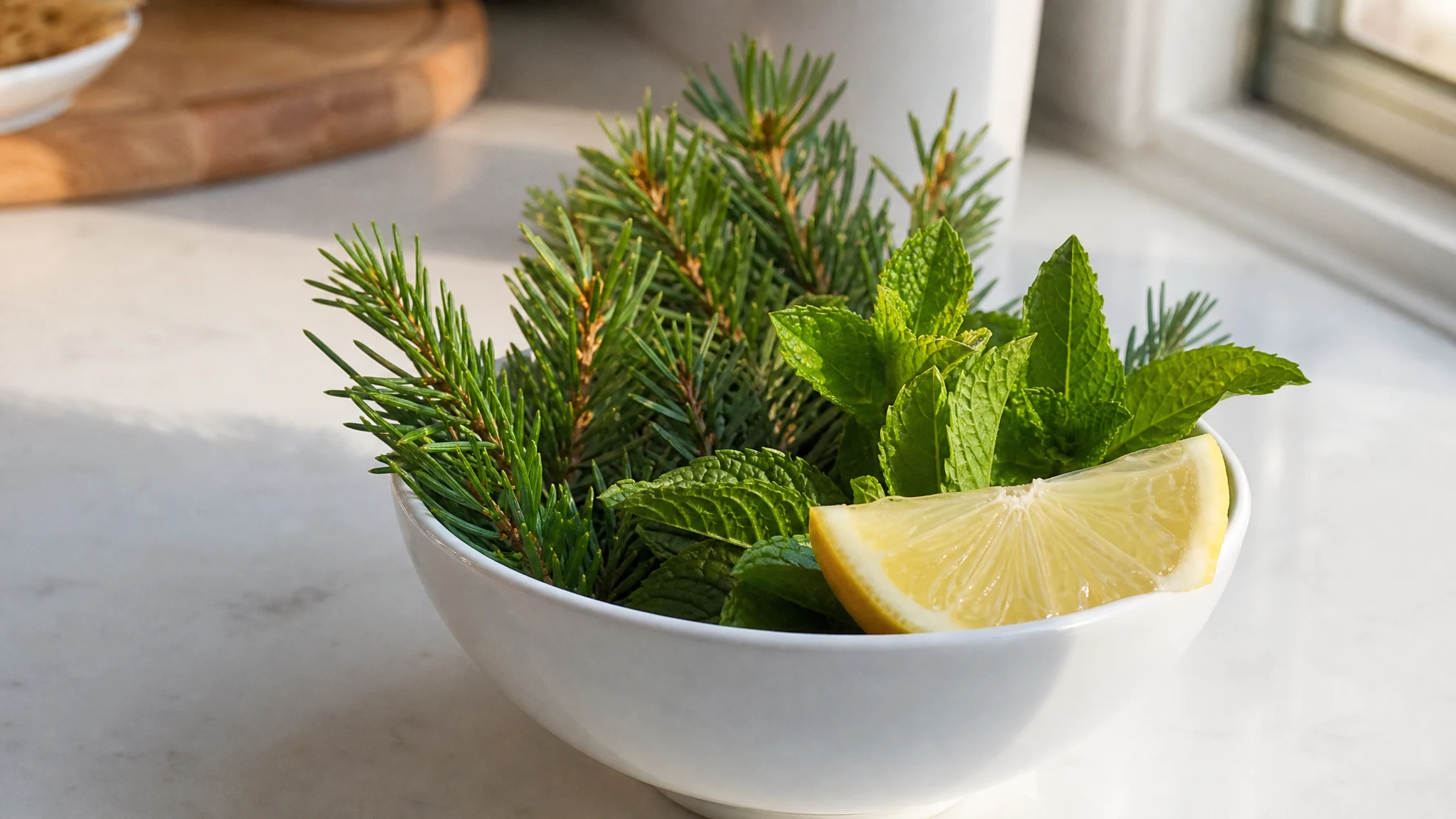
Three jobs, three partners. For a woodland scent, reach for conifers and woods: we suggest fir, cedarwood, vanilla, pine, spruce and sandalwood alongside birch. For a bright opening on a woody blend, put citrus on top, birch in the middle and a wood underneath. For a clean, cold blend, use mint with birch as the sweetener. Citrus and mint are our reasoning rather than classics, so read those sections as ideas to explore.
Who leaves the room first
Vapor pressure, how readily a molecule escapes into the air, gives a handy ranking. These are figures for single compounds from PubChem, not for whole oils, so use them as a guide and not a prediction.

| Molecule (found in) | Vapor pressure, mmHg at 25 C | Versus methyl salicylate |
|---|---|---|
| alpha-Pinene (conifers) | 4.75 | about 140 times higher |
| D-Limonene (citrus peel) | 1.98 | about 58 times higher |
| l-Menthol (mint) | 0.0637 | about 1.9 times higher |
| Methyl salicylate (sweet birch) | 0.0343 | baseline |
The sources are the PubChem entries for (alpha-pinene), (limonene), (menthol) and (methyl salicylate). Which compound leads your conifer, citrus or mint oil depends on species and lot, so ask your supplier for a composition report before relying on a row.
The reading is pleasant. Conifer and citrus oils built on those small molecules fly off far faster than birch, so a blend opens on them and finishes on birch. Menthol-rich mint is the nearest to birch in speed, so the two arrive and linger together. That overlap is why mint and birch drift toward toothpaste sooner than the other pairings do.
Three pairings
Birch with conifers
The natural match. The conifer opens, birch arrives later, so lead with the tree and use birch as the accent. A cedarwood or another wood underneath anchors the finish; the cedarwood comparison shows how.
Birch with citrus
Citrus gives a bright lift that disappears first, so a modest share is enough to make the opening feel fresh before birch settles in. If the blend will touch skin, check the IFRA limit for your specific citrus oil, as some peel oils carry skin restrictions; for a candle or room spray that does not come up.
Birch with mint
The bold one, since both are cool and strong. Keep birch lower than with conifers, and our piece on dosing a dominant note shows how to hold it back. Mint oils have their own cautions around infants and young children, so keep this pairing away from them.
Starting shares on paper
These are formulations worked out from the volatility ranking and arithmetic, by weight of the fragrance blend.
| Pairing | Birch | Partner |
|---|---|---|
| Conifer blend | 2% | 98% conifer, with some wood |
| Citrus and wood | 1.5% | 10 to 20% citrus, rest wood |
| Mint and wood | 1% | 5 to 10% mint, rest wood |
To see what that means in a product, take a 100 g candle or room spray at a 5% fragrance load. That is 5 g of blend, so 2% birch is 0.1 g, 1.5% is 0.075 g and 1% is 0.05 g. At our certificate's density of 1.183 and a rough 20 drops per mL, 0.1 g is about 0.085 mL, between one and two drops, which is why we say weigh, or make a 1% stock. A good first trial is three 4 g blends with the same partner and wood: birch at 0.08 g in two of them and 0.04 g in the third. Smell each on a blotter at the start, at 20 minutes and at two hours. If the order you notice is partner first, birch last, the shares are working. If birch comes first, trim it.
Trust your nose, then write it down
Numbers get you to a sensible starting point, but the last step belongs to your nose. Smell each trial on a blotter, step into fresh air, and come back later. Notice which note you smell first and which one you are still smelling after a while. Keep a small notebook by the bench with the date, the weights and a few honest words about each trial, such as "too sweet" or "needs more wood". A blend you can reproduce is worth far more than one you got right once by accident.
Check the category before you scale
Skin products are limited far more tightly than most blenders expect. EU law sets methyl salicylate at 0.06% for most leave-on and rinse-off products and 0.6% for alcohol fragrance (Regulation (EU) 2023/1545), and the Tisserand Institute lists 2.5% as the topical maximum for sweet birch while advising against it for children of any age and in pregnancy (Tisserand Institute). Our general skin dilution guidance is 0.5% to 2% in a carrier, and where a source is lower we recommend the lower number. The dilution chart has the full arithmetic.
The usual slip is adding more partner to cover birch, which only makes it seem louder as the faster notes depart; cut the birch instead. And smell more than once, with a rest in fresh air between. Ask us through the contact page if the exact methyl salicylate content matters to a formulation.
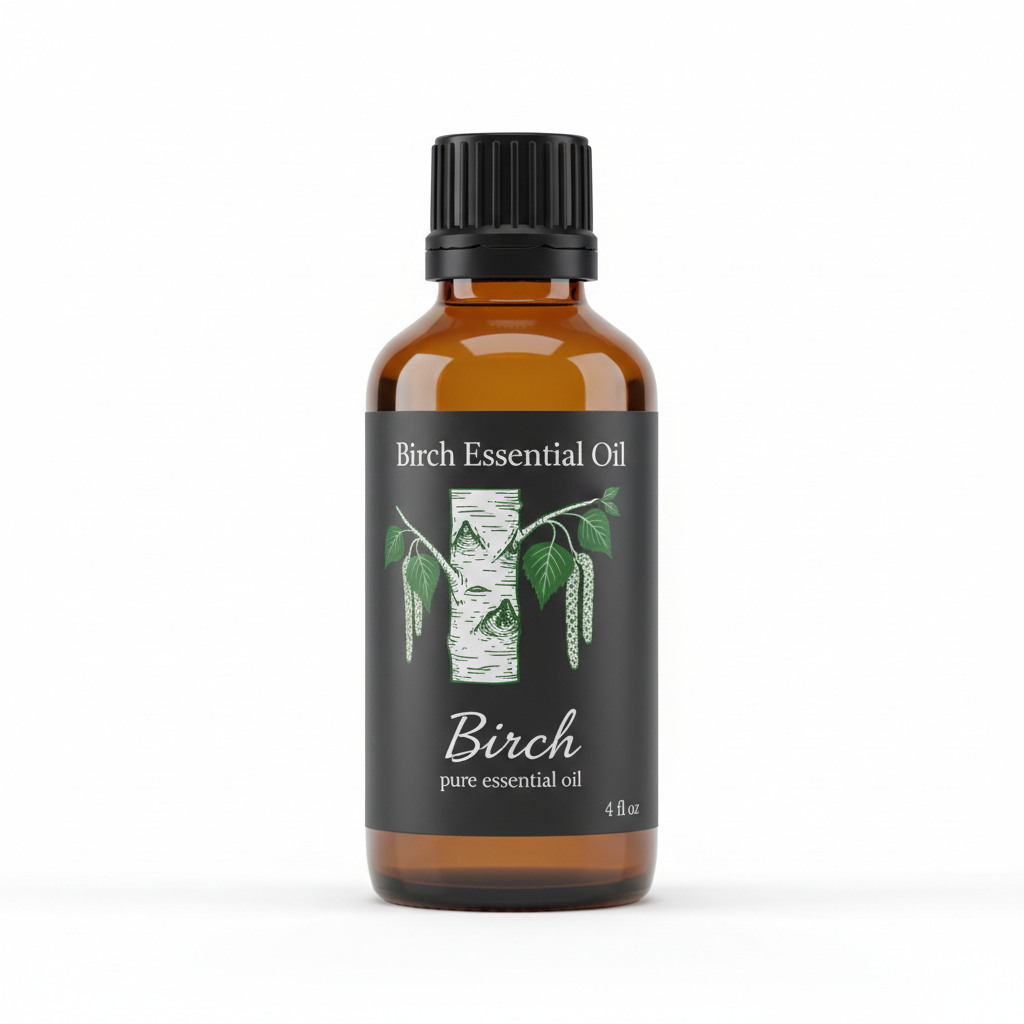
Birch Essential Oil
Birch Essential Oil from our own shop, in sizes from 1 oz to bulk.
From $17.99
Shop Now →Sources & Further Reading
- National Library of Medicine. PubChem, alpha-Pinene (CID 6654). pubchem.ncbi.nlm.nih.gov
- National Library of Medicine. PubChem, (+)-Limonene (CID 440917). pubchem.ncbi.nlm.nih.gov
- National Library of Medicine. PubChem, Menthol (CID 1254). pubchem.ncbi.nlm.nih.gov
- National Library of Medicine. PubChem, Methyl salicylate (CID 4133). pubchem.ncbi.nlm.nih.gov
- European Commission, 2023. Regulation (EU) 2023/1545, Annex III entry 324 (text mirror). lawplayer.com
- Tisserand Institute. Methyl Salicylate: Essential Oil Constituents in Food Part 5. tisserandinstitute.org