How Many Drops of Birch Oil to Diffuse in Your Room
Most diffuser guides count drops by the size of the water tank. For birch oil, that is the wrong yardstick. What matters is the size of the room, because everything the diffuser sends out ends up in the air you are breathing, and birch is a very small-dose oil.
Why the tank does not set the dose
Whether your diffuser holds 100 ml or 300 ml of water does not change how much oil reaches the room. More water just means a longer run. So a rule like "drops per 100 ml" tells you little, and a rule per room tells you more.
Birch oil is nearly all methyl salicylate, the wintergreen compound, and it is a loud one: ScenTree notes that a very low dilution is enough to detect its impact. We describe it as a dominant note, so even one drop is audible.
The arithmetic uses three things. A drop (taken as 0.05 ml, a rough convention) of the batch on our Certificate of Analysis weighs about 59 mg, since its relative density is 1.183. Methyl salicylate has a molecular weight of 152.15, so 1 ppm in air is about 6.2 mg per cubic metre. And NOAA's CAMEO Chemicals lists a US Department of Energy emergency-planning level (PAC-1) of 2.3 ppm, noting the vapor irritates the eyes and airways. PAC-1 is not a home exposure limit; we use it only as a ceiling to stay well under.
What a drop does to a room
This is the worst case, where every drop stays airborne and nothing leaves through a door or window. Real rooms leak, so real concentrations are lower, but the scaling is the point. Volumes assume an 8-foot ceiling.
| Room | Volume | 1 drop | 2 drops | 4 drops | 8 drops |
|---|---|---|---|---|---|
| 100 sq ft (small bedroom or office) | 22.7 m3 | 0.42 ppm | 0.84 ppm | 1.7 ppm | 3.4 ppm |
| 200 sq ft (bedroom or living room) | 45.3 m3 | 0.21 ppm | 0.42 ppm | 0.84 ppm | 1.7 ppm |
| 400 sq ft (open living area) | 90.6 m3 | 0.10 ppm | 0.21 ppm | 0.42 ppm | 0.84 ppm |
Look at the top right. Eight drops is an ordinary "strong" dose in many guides, and in a closed 100 square foot room it lands above that 2.3 ppm yardstick. The same drop count that is gentle in a living room is a very different thing in a shut office.
Our starting rule
We recommend keeping the worst-case figure at about 1 ppm or less and starting at half of that. In practice:
- Under 150 sq ft: start with 1 drop, and never go past 2.
- 150 to 300 sq ft: start with 2 drops, never more than 4.
- Over 300 sq ft and open plan: start with 3 or 4, never more than 8, and put the diffuser where air moves.
This is a conservative rule built from the numbers above, so treat it as a place to begin. Smell the room after ten minutes and stop if it is already pleasantly noticeable. Run one tank, then open a window. Methyl salicylate evaporates slowly for a fragrance material (a vapor pressure of 0.0975 mmHg at 20 C, according to PubChem), so the scent can linger on fabrics. Our post on taming birch in a blend shows how far a trace carries.
Who and where to skip
Tisserand Institute guidance advises against sweet birch for children of any age, during pregnancy, and with blood-thinning medication. We add aspirin or salicylate sensitivity. Applying that to a diffuser is a cautious reading, and it is the one we follow: no birch in a nursery, a child's room, or the room of anyone pregnant or on an anticoagulant. Parents and expectant mothers should check with a pediatrician, midwife or obstetrician. Our pregnancy and children post lays out the sources.
Pets deserve thought too. The Merck Veterinary Manual says active diffusers (ultrasonic and nebulizing) emit microdroplets of oil into the air while passive ones such as reed diffusers do not, and that wintergreen and birch oils can produce aspirin toxicosis. The ASPCA says a short diffuser run in a secured space the pet cannot enter is not likely to be an issue, and advises against diffusers around pets with breathing problems. With a cat, a bird or a pet with breathing trouble in the house, skip birch in a diffuser and ask your veterinarian. Our dog post goes into more detail.
Picking the machine
A reed set removes the droplet question altogether, and our reed diffuser post covers it. If you want an active diffuser, the ultrasonic versus nebulizing comparison is the place to start. A nebulizer puts out the most undiluted oil, so our reasoning is that it is the one to leave on the shelf for birch. Rinse the tank after each session and follow the maker's guidance on what oils the plastics allow. If you spill the oil, wipe it with a cloth, wash your hands with soap and water, and keep the cloth away from children and pets. The first-aid post covers swallowed oil and skin or eye contact.
It helps to keep a small note by the diffuser: the room, the number of drops and how it smelled after ten minutes. After a few sessions you will have a simple rule of your own that fits your room better than any table. If you are ever unsure, go lower. You can always add a drop later, but you cannot take one back out of the air.
For a gentler birch scent in a room you live in, a trace in a candle or a reed set is a good fit. The contact page is open for questions.
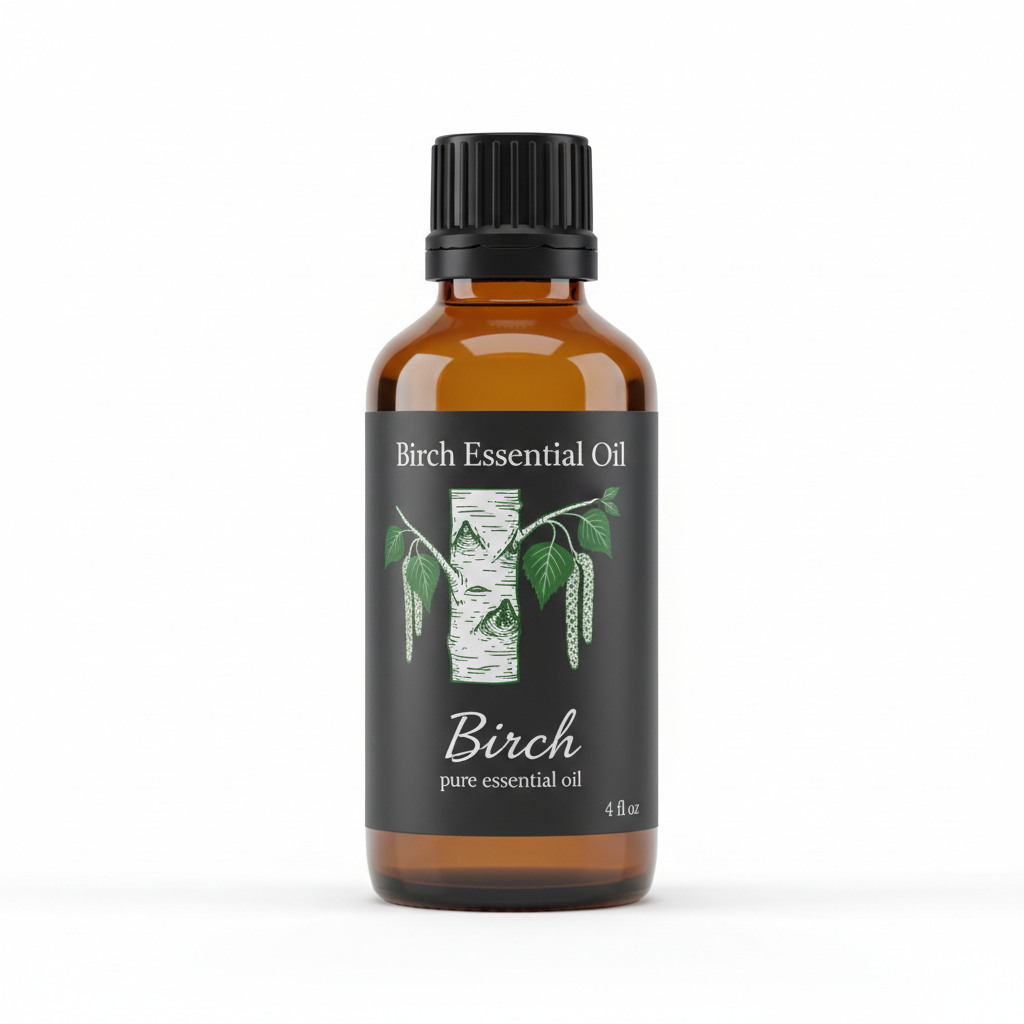
Birch Essential Oil
Birch Essential Oil from our own shop, in sizes from 1 oz to bulk.
From $17.99
Shop Now →Sources & Further Reading
- NOAA, CAMEO Chemicals: Methyl Salicylate (hazards, Protective Action Criteria). cameochemicals.noaa.gov/chemical/17825
- PubChem, Methyl Salicylate (CID 4133), vapor pressure. pubchem.ncbi.nlm.nih.gov/compound/4133
- ScenTree, Methyl salicylate. scentree.co/en/Methyl_salicylate.html
- Tisserand Institute, Methyl Salicylate (Essential Oil Constituents in Food, Part 5). tisserandinstitute.org
- Benson K and Brutlag A, March 2025. Toxicoses From Essential Oils in Animals, Merck Veterinary Manual. merckvetmanual.com
- ASPCA, 2022. The Essentials of Essential Oils Around Pets. aspca.org