How to Read a Birch Oil SDS: What Each Section Tells You
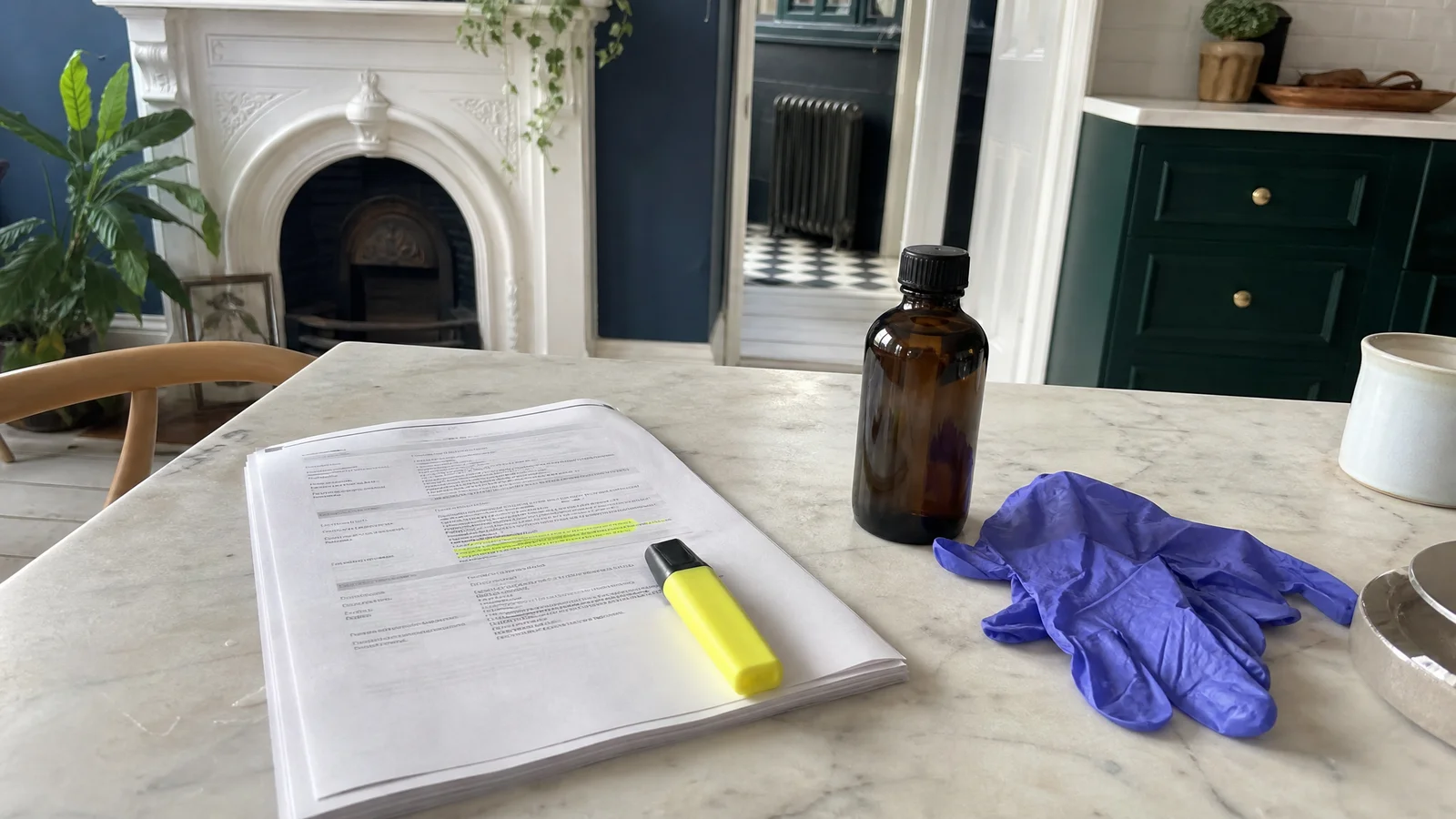
A safety data sheet looks like a wall of codes, but once you know where to look, it is a short story about one bottle: what is in it, what hazards the supplier assigns, and what to do if something goes wrong. Here is how to read one for a sweet birch oil, and the questions worth asking any supplier before you buy, us included.
Four checks before you read a hazard statement
- Supplier and product match. Section 1 should name the product and the supplier you are actually buying from. A sheet for "methyl salicylate" from a chemical distributor describes the chemical, not a distilled birch oil, even though the two are close cousins.
- Chemical or oil. Section 3 shows what the sheet really describes. Authentic sweet birch oil is 93 to 99.8 percent methyl salicylate with dozens of minor compounds, according to a 2022 study of 21 authentic samples. A sheet listing a single substance with one CAS number is describing the pure chemical.
- A date. Section 16 carries the date of preparation or last revision. An undated sheet cannot be compared with current classifications.
- Whose classification. Section 2 should say which system produced the hazard statements. That matters more than you might expect, as the next sections show.
Who an SDS is written for
The OSHA Hazard Communication standard is a workplace rule. It does not apply to a consumer product when it is covered by Consumer Product Safety Act or Federal Hazardous Substances Act labeling requirements. A retail bottle is labeled under the FHSA, which asks for a signal word (danger, warning or caution) and a statement such as "harmful or fatal if swallowed." The SDS is really for businesses that use the oil at work, such as a soap or candle studio with employees. If that is you, ask any supplier for one in writing before ordering.
The 16 sections at a glance
Every compliant sheet runs from section 1 to 16 in the same order. The ones that matter most for a methyl salicylate oil:
- Section 2, hazards: the signal word, pictograms and hazard statements. Compare these with the classifications below.
- Section 4, first aid: poison-center guidance for swallowed salicylates is not to induce vomiting, so a sheet that says otherwise deserves a second look.
- Section 7, storage: look for cool, dark and tightly closed, since PubChem lists methyl salicylate as sensitive to light and heat.
- Section 8, exposure limits: a blank here is not a statement that the vapor is harmless, so check where any stated number comes from.
- Section 9, physical properties: flash point, density and boiling point. More on this below.
- Section 10, reactivity: NOAA CAMEO lists oxidizers and strong bases as incompatible.
OSHA states it will not enforce sections 12 through 15, so treat those as supplier-supplied extras.
One chemical, four classifications
This is the part that surprises people. The public records for methyl salicylate do not agree with each other, as PubChem's aggregated data shows:
- EU classification (CLP): Warning, with H302 (harmful if swallowed), H317 (may cause an allergic skin reaction), H361d (suspected of damaging the unborn child) and H412 (harmful to aquatic life).
- ECHA company notifications for methyl salicylate: Warning, mostly H302.
- ECHA notifications for wintergreen oil: Warning, H302 and H319 (serious eye irritation).
- Japan's NITE-CMC: Danger, with H314 (severe skin burns and eye damage) and H318.
These describe the pure chemical or a wintergreen extract, not a sweet birch oil as such. A seller's sheet can cite any of them and still be internally consistent. The sensible response is to ask which source the sheet used, and to plan your handling around the strictest one. The H361d statement is the one that bears on pregnancy; our pregnancy and children post covers it.
Section 9 and the certificate of analysis
The Certificate of Analysis we publish for one batch lists a relative density of 1.183 at 20 C, a refractive index of 1.537, and an optically inactive oil. Those constants are consistent with a methyl salicylate oil: PubChem lists density of 1.176 to 1.185 and refractive index of 1.534 to 1.538 for the compound. They cannot, by themselves, tell natural from synthetic methyl salicylate, which are both optically inactive. Marker compounds found by GC-MS can, which is what the 2022 study used. Our lab report guide shows what each type of test adds.
Flash point is another number worth a look. PubChem lists 96 to 101 C closed cup for the pure chemical, so a sheet for a birch oil should sit close to that. If it gives something very different, ask which test produced it.
Questions to ask any seller
- Do you have an SDS for the product as sold, with a revision date and the supplier's name and contact details?
- Which classification system does Section 2 use?
- Does Section 3 describe the pure chemical or the named oil?
- What does the lot reference on the bottle tie to? Our bottles are dated with a still date, fill date and lot reference.
- Does the packaging meet the child-resistant rule for liquid preparations above 5% methyl salicylate by weight (16 CFR 1700.14)?
- Is there an IFRA certificate? IFRA's 51st Amendment has no standard for methyl salicylate, so any limit on such a certificate would be the supplier's own. Our post on selling soap goes further.
For anything beyond the Certificate of Analysis, please write to us through the contact page before ordering and we will tell you what we can provide. Our dilution chart is the place to start for handling, and the shop lists sizes from 1 oz to bulk.
Keep the sheet somewhere you will actually find it. A printed copy in the same folder as your batch notes, with the bottle's lot reference written at the top, saves a scramble later. When a new bottle arrives, glance at the revision date again, since sheets get updated and the one in the drawer may no longer be the current one.
An SDS is a record of what a supplier claims. Reading it alongside public sources, as above, turns it from a wall of codes into something useful. For workplace obligations, a safety consultant can confirm what applies to you.
Birch Essential Oil
Birch Essential Oil from our own shop, in sizes from 1 oz to bulk.
From $17.99
Shop Now →Sources & Further Reading
- Dosoky NS, Poudel A, Satyal P, 2022. Authentication and Market Survey of Sweet Birch (Betula lenta L.) Essential Oil. Plants 11(16):2132. pmc.ncbi.nlm.nih.gov/articles/PMC9412571
- OSHA, 29 CFR 1910.1200, Hazard Communication. law.cornell.edu/cfr/text/29/1910.1200
- CPSC, 16 CFR 1500.121, labeling of hazardous substances. law.cornell.edu/cfr/text/16/1500.121
- Poison Control, First aid for poisonings. poison.org/first-aid-for-poisonings
- PubChem, Methyl salicylate (CID 4133), including HSDB, ECHA and NITE-CMC data. pubchem.ncbi.nlm.nih.gov/compound/4133
- NOAA, CAMEO Chemicals: Methyl Salicylate. cameochemicals.noaa.gov/chemical/17825
- ScenTree, Methyl salicylate. scentree.co/en/Methyl_salicylate.html
- CPSC, 16 CFR 1700.14, substances requiring special packaging. law.cornell.edu/cfr/text/16/1700.14