10 Birch Oil Blending Mistakes and How to Fix Them
The most common birch blending mistake is also the simplest: using too much, then piling on other oils to cover it. Birch is nearly a single, very potent molecule, so its slip-ups come down to dose, timing and what is in the bottle. These ten are grouped by when they happen, each with an easy fix.
Before you mix
- Skipping the lot report. A 2022 study of 21 authentic sweet birch oils found methyl salicylate at 93.24% to 99.84%, and a synthetic marker only in commercial samples (Dosoky et al., 2022). Because the same molecule can be made synthetically, the nose cannot tell them apart. The Certificate of Analysis we publish for one batch lists density, refractive index and optical rotation. If you need the methyl salicylate figure or GC-MS for your lot, ask us in writing through the contact page before ordering, and ask any supplier the same.
- Mixing up the look-alikes. Wintergreen is also methyl salicylate-dominated, which is why Tisserand lists topical maximums of 2.4% for wintergreen and 2.5% for sweet birch (Tisserand Institute). Birch tar is a smoky, different material that we do not sell; our tar versus sweet birch post explains the split. A ratio written for one should not be borrowed for another.
- Counting drops. A milliliter of our certificate batch weighs about 1.18 g, and drop sizes vary. When the share you want is 1% or 2% of a few grams, one drop can be the whole margin. Weigh on a 0.001 g scale, or make a 1% stock in a carrier and weigh the stock.
While you mix
- Treating birch as a base note. ScenTree classes methyl salicylate as a heart material and says a very low dilution is enough to notice it (ScenTree). Staying power comes from a wood underneath, so give it one, as in the cedarwood comparison.
- Adding more oils to hide it. Volume will not mask a note that registers at parts per billion. Methyl salicylate's vapor pressure is 0.0343 mmHg at 25 C against 4.75 for alpha-pinene (PubChem), so faster partners leave first and birch is what remains. Trim the birch instead, using the steps in our dilution ladder.
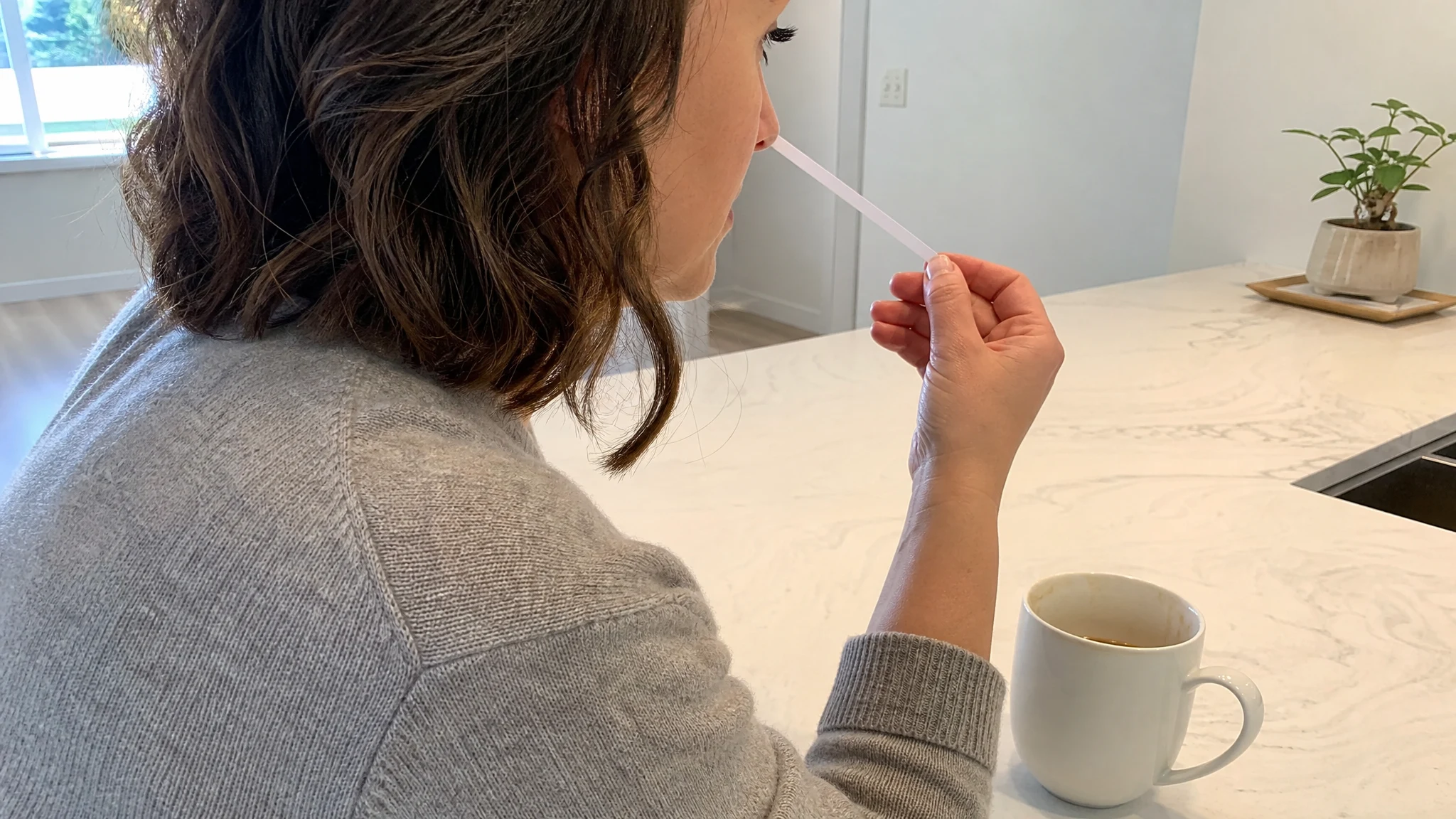
- Judging at ten seconds. Smell at the start, at twenty minutes and at two hours, with a breath of fresh air between sniffs. A blend that is lovely at ten seconds and wrong at two hours is not one you will enjoy.
- Adding vanilla without checking the form. Vanillin darkens in light and, per ScenTree, is unsuitable for candle bases (ScenTree, Vanillin). Our vanilla and birch post shows what to look for.
After you mix
- Using the skin range as a product limit. We recommend 0.5% to 2% in a carrier with a patch test for general skin use. EU Regulation 2023/1545 caps methyl salicylate at 0.06% of most leave-on and rinse-off products and 0.6% of hydroalcoholic fragrances (text of the regulation). For anything you sell, follow the lower figure. The dilution chart has the math.
- Heating it in a food pot. Warmth raises the vapor pressure of everything in the pot, and a kitchen pot is a place where food, children and pets are all close by. We would keep birch out of simmer pots; the simmer pot post explains.
- Forgetting who shares the room. Tisserand advises avoiding sweet birch in children of any age, in pregnancy and with blood thinners such as aspirin or warfarin. If any of that describes your household, check with a pharmacist or physician first, and see our aspirin and blood thinner post. Pets are a question for a veterinarian.
A habit that prevents most of them
Keep a small notebook next to the scale. Write the date, what went in, in grams, and one sentence about how it smelled at the start and an hour later. It sounds fussy, but it turns every mistake into a lesson, and it means that when a blend finally comes out right, you can make it again. Label every jar, too. Two clear liquids in two identical bottles are how recipes get lost.
Be kind to yourself about the first few tries. Birch is a loud oil, and nearly everyone overdoes it once. The mistake that teaches you the most is usually the one that smelled wonderful for ten seconds and wrong an hour later, so keep that jar on the shelf for a few days and smell it again as a reminder of what too much looks like.
If a blend is already too birchy
Do not pour more of one oil into the same bottle. Weigh what you have and work backward. Say a 10 g blend holds 0.5 g of birch, which is 5%. To bring it down to 2%, the total must be 25 g, so you add 15 g of a birch-free base made in the same proportions as the rest of the blend. Adding a single oil changes the character as well as the dose. If a trial is too faint at 1%, doubling to 2% and smelling again is a safer move than jumping further.
One more check for anything touching skin: work out birch as a share of the finished product, not of the blend. A 5% fragrance load with birch at 2% of the blend is 0.1% birch in the product, above the 0.06% EU leave-on cap. Cutting to 1.2% of the blend gets under it, or you can move the project into a candle or room spray.
Every item here comes back to three questions: how much, for how long, and who is in the room. Answer them in grams, minutes and names and the aroma choices are the fun part.
Birch Essential Oil
Birch Essential Oil from our own shop, in sizes from 1 oz to bulk.
From $17.99
Shop Now →Sources & Further Reading
- Dosoky NS, Poudel A, Satyal P, 2022. Plants 11(16):2132. pmc.ncbi.nlm.nih.gov
- Tisserand Institute, Methyl Salicylate (Part 5). tisserandinstitute.org
- ScenTree, Methyl salicylate. scentree.co
- ScenTree, Vanillin. scentree.co
- PubChem, Methyl salicylate (CID 4133). pubchem.ncbi.nlm.nih.gov
- Regulation (EU) 2023/1545, Annex III entry 324. lawplayer.com