What Does Birch Oil Smell Like? Wintergreen and Woods
The first sniff of sweet birch oil surprises people. It is not "woodsy" the way cedar is. It is sweet and cool, with wintergreen candy up front and something warm and barky behind it. We describe it as winter woods and old-fashioned root beer at once, and a single drop will announce itself across a room.
Where the candy comes from
That signature comes from methyl salicylate, which makes up 93% to 99.8% of sweet birch oil in a study of authentic samples (Dosoky, Poudel and Satyal, 2022). The food-additive committee JECFA gives its smell as a "characteristic wintergreen odour" (collected in PubChem). Our chemistry article goes deeper into why one molecule can carry a whole oil.
Reading the scent in layers
Give yourself a minute and you will notice the smell is not one flat thing. First comes the sweet, cool wintergreen snap, the part that tells you what it is. A little later the sweetness rounds out and you can pick up something softer and woodier underneath, the barky warmth that keeps it from smelling like mint candy alone. Over the next hour it settles into a quieter sweet-woods note that hangs around long after the first rush has gone.
The same molecule, two moods
Here is the interesting part. Perfumers use methyl salicylate at very low levels to build tuberose and orange blossom accords and to add a sunny, slightly fruity lift (ScenTree). Turn the dose up and the same molecule reads as pure wintergreen candy. So birch is a chameleon: a whisper adds warmth and sparkle, a spoonful takes over the whole room.
That is why we describe it as a dominant note, and why a trace is enough to flavor a whole blend. It lingers after citrus and mint have faded, which makes it a heart note in most descriptions, and it is easy to overshoot. Our dilution ladder for a dominant note shows how little it takes.
How to meet it properly
Skip the deep breath at the bottle neck. A gentler way to get to know it:
- Hold the capped bottle at arm's length, open it and wave the air toward you once.
- For a closer look, put a drop on a paper blotter and smell it at intervals: the first impression, the one after ten minutes and the dry-down after an hour.
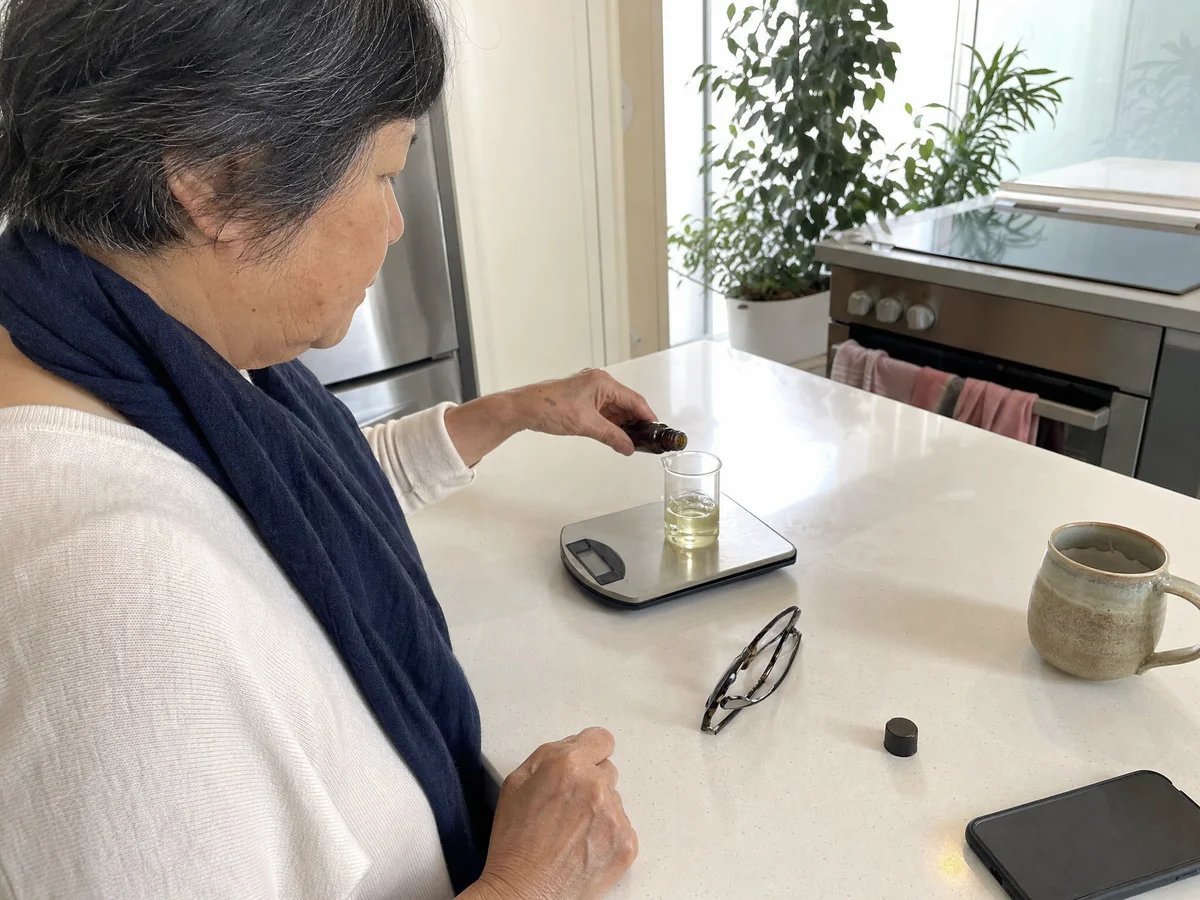
- To judge it in a blend, make a smelling stock. Two drops (about 0.1 ml, or roughly 0.12 g at our batch density of 1.183) in 10 ml of a carrier from your pantry or craft shop makes a stock of about 1%. That is for blotters, not skin.
Drop counts are a rough convention of about 20 drops per ml, and drop size varies, so treat the numbers as a guide. Keep every bottle and vial capped and out of reach of children and pets. For anything that touches skin, we recommend 0.5% to 2% in a carrier with a patch test, and many crafters keep birch to candles and room scenting alone; the dilution chart has the arithmetic.
Keep a smelling notebook
If you enjoy this sort of thing, jot down a word or two each time: candy, cool, cedar-ish, sweet bark. Your words will be different from ours, and that is the point. After a few sessions you will have your own vocabulary for the scent, which makes it much easier to decide what to pair it with.
Names people reach for
Hand a blotter to a few friends and don't be surprised if the answers scatter: root beer, a candy cane, an old-fashioned mint tin, a cabin in winter. They are all describing the same cool, sweet snap, and every one of them is a useful clue about where the scent will feel at home.
What your nose cannot tell you
Smell is a pleasure, not an authenticator. Wintergreen oil measured 99.47% to 100% methyl salicylate in the same study, against 93.24% to 99.84% for sweet birch, and the compounds that separate real birch from commercial look-alikes are present in traces far below what a nose can pick out. So if someone says they can smell the difference, treat it as a belief. If authenticity matters for your project, ask us in writing for the lot report through the contact page, and see our wintergreen myths article.

Where the scent belongs
Candy-cool woods suit cabin candles, woodsy room sprays and winter-woods diffusing. Fir, cedarwood, vanilla, pine, spruce and sandalwood are natural partners; our blending guide covers them, and the root beer story explains why the scent feels so nostalgic. Compared with eucalyptus, which is sharper and more herbal, birch is sweeter and rounder; our side-by-side sets them next to each other. It is not a quiet background scent, because even a trace announces itself.
A good rule when you are starting out is to treat the scent as an accent, like a pinch of salt. It brightens what is around it, and a pinch is plenty. Add a little, step away, and come back with a fresh nose before you decide you want more.
Birch Essential Oil
Birch Essential Oil from our own shop, in sizes from 1 oz to bulk.
From $17.99
Shop Now →